
More than $197 million has already traded on the 2026 midterms across Kalshi and Polymarket, and Kalshi says total election volume this cycle has passed everything traded in 2024. A lot of that money is coming from people who have never placed an order on an exchange.
If you’ve bet sports, you already understand most of this. The vocabulary is different and the math is better, though not as much better as the pitch usually suggests. Here it is worked through on a live market, including the part where the advantage is smaller than you think.
What you’re buying
A contract on a political outcome pays $1 if the thing happens and $0 if it doesn’t. You buy it somewhere between one cent and ninety-nine cents, and the price is the probability.
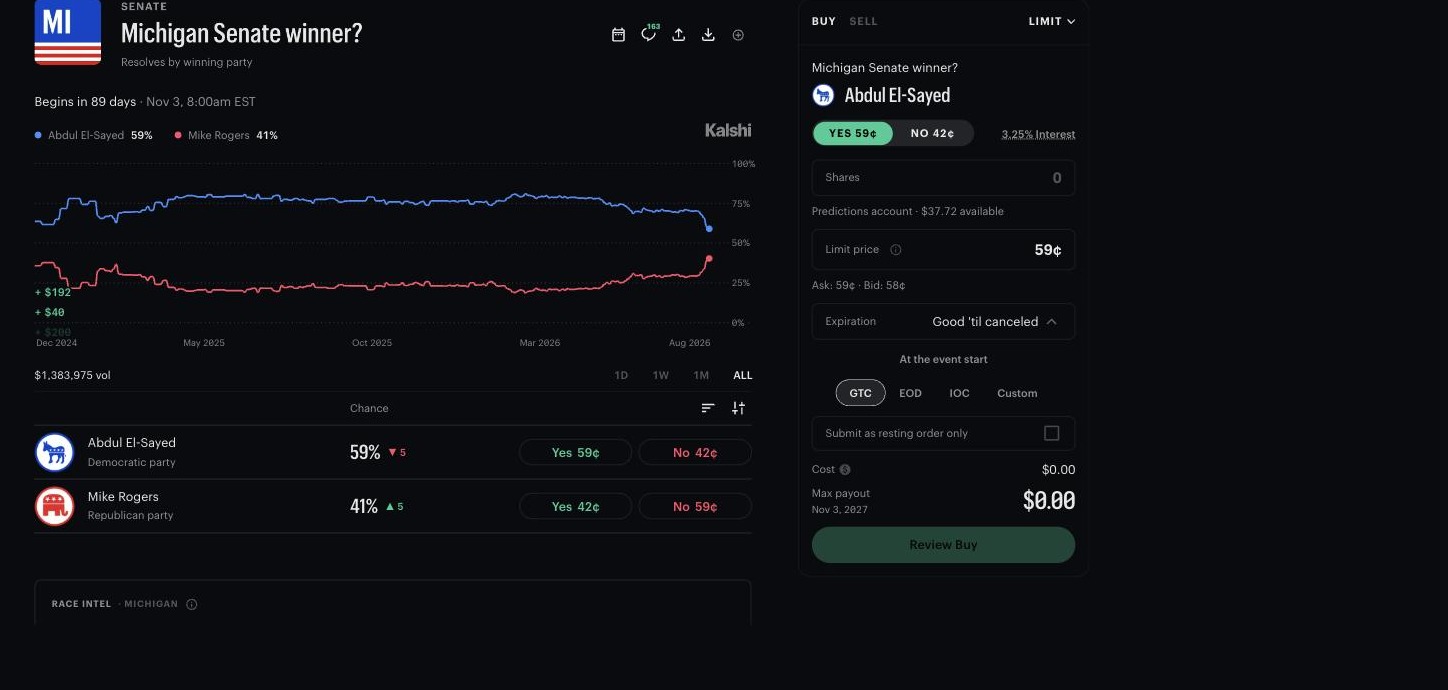
Kalshi, Michigan Senate winner, August 5, 2026. El-Sayed 59 cents, Rogers 41 cents, $1,383,975 traded.
Abdul El-Sayed trades at 59 cents. Buy one for 59 cents and if he wins in November you collect a dollar, so you make 41 cents on 59 at risk. If Mike Rogers wins, your 59 cents turns into nothing.
59 cents is also 59%, which is euivalent to -144. Divide the price by one minus the price, multiply by a hundred, add a minus sign to anything above 50 cents (or just use our odds converter calculator). Rogers at 41 cents is +144. Use that page if these odds feel a bit foreign compared to how you're traditionally familiar with valuing bets.
What it actually costs
The spread. El-Sayed Yes is 59 cents, El-Sayed No is 42. They add to 101, and that extra cent is the market’s built-in cost. Buy both sides for 101 and you’re guaranteed to lose a dollar, so the round trip holds about 1%.
The fee. Kalshi charges takers 7% times the price times one minus the price. A bit confusing but it's for a reason. On 100 contracts at 59 cents that’s 0.07 x 0.59 x 0.41 x 100, or $1.69 on $59 at risk. Call it 2.9%. This method ensures that the long shots and heavy favorites that would otherwise not be traded as much if they had the same fees as more even markets.
The ask. The book is 58 bid, 59 ask. Cross it and you’ve paid a penny you didn’t have to, which is another 1.7%.
Add it up. Take the ask on that Michigan trade and you’re in for roughly 4.6% all-in. A standard -110 both ways at a sportsbook holds about 4.5%.
Why the confusing fees
Near a coin flip, taking the ask on a prediction market costs about what a sportsbook costs. The pitch that these venues are four times cheaper is true of the spread on its own and stops being true the second you add fees and impatience. The larger opportunity here is in two areas:
1) Rest your orders. Sit on the bid instead of hitting the ask and you skip the penny and pay a lower fee tier. This is what you may familiar with as being a maker (vs taker).
2) Trade away from 50/50. The fee formula peaks at a coin flip and shrinks toward the edges. At 90 cents it’s $0.63 on $90, about 0.7%. Sportsbooks charge you the most exactly where these markets charge you the least, which is why heavy favorites, longshots and season-long futures are where the difference stops being academic.
There are also things a sportsbook does better. No promos or boosts here. Thinner market selection on a random Tuesday. Nobody hands you a risk-free bet to sign up. When possible, use both but know how to optimize them both.
Where each type of trader should start
Coming from sports betting. Go straight to futures. That’s where the pricing gap is widest and where you already know the cashout math is against you. If you’ve ever watched a book offer you 55% of what your ticket was worth, you know the problem this solves. This article by Justin Herzig is a great start: Why I’m Forever Done with Futures Bets on Sportsbooks.
Coming from investing. Start with the shutdown and Fed markets rather than races. The resolution language is cleaner and the catalysts sit on a published calendar.
New to both. Pick one race you can explain in a sentence and watch it for two weeks before funding anything. The price history will teach you more than any guide will.
Which venue you can use
Kalshi is a CFTC-regulated exchange. Open an account, fund it in dollars, trade: join now to cash in on their best sign-up offer.
Polymarket is two things under one name. The global platform at polymarket.com settles in USDC and has been geo-blocked to US traffic since a 2022 CFTC settlement. Polymarket US runs on QCX, the CFTC-registered exchange Polymarket bought in 2025, and that’s the one open to Americans. Use our exclusive partnership with Polymarket to get their best sign-up offer for new customers.
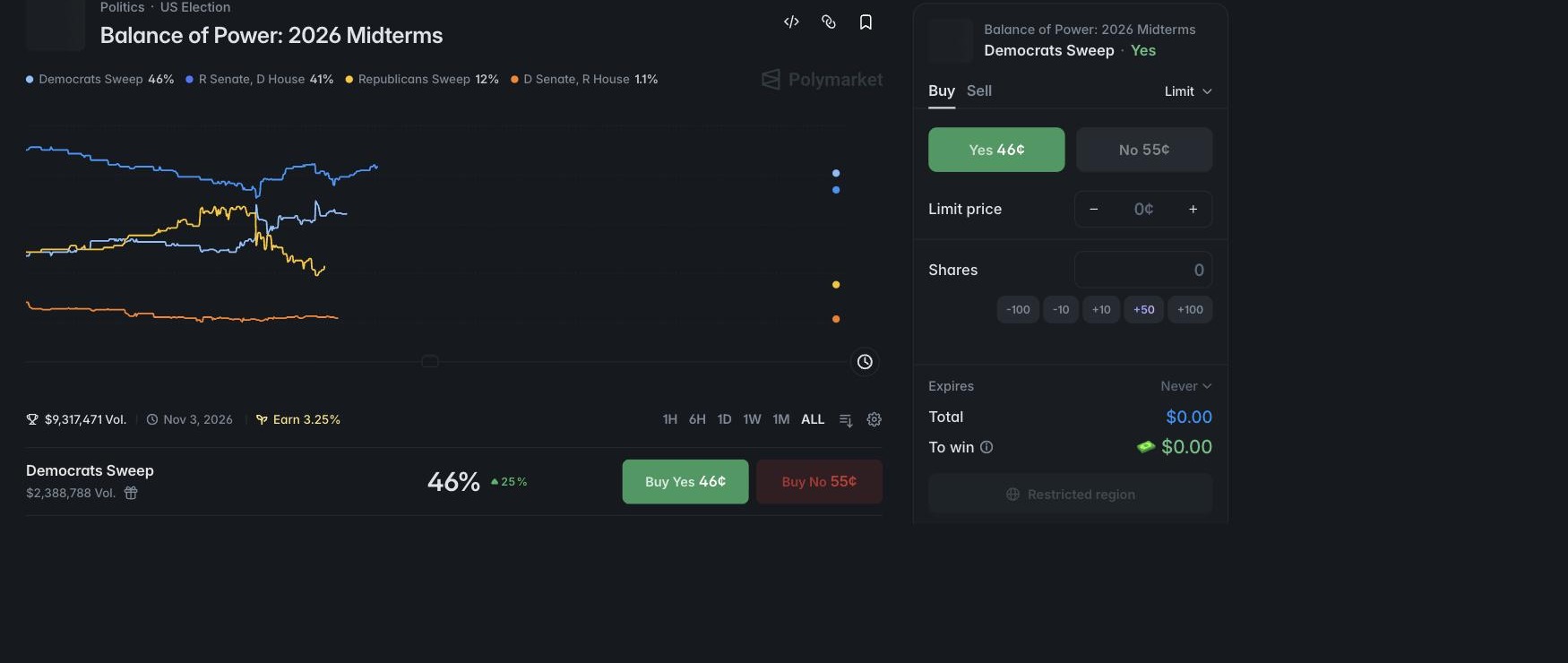
Polymarket, Balance of Power 2026 Midterms, August 5, 2026. $9,317,471 traded across four mutually exclusive outcomes.
Two things that trip up new traders
Liquidity. A quoted price tells you where one contract trades, not where a thousand do. Michigan has done about $1.38 million. A governor race nobody is watching may have traded four figures since it listed, and a few hundred dollars will move that book against you before you finish filling. Check liquidity before you decide a price is wrong.
Exiting. You can sell any time before resolution. If El-Sayed climbs to 72 after a good September, take the 13 cents instead of carrying the risk another three months. If it drifts to 40, close for a 19 cent loss instead of risking the whole 59. You’re selling into a real orderbook rather than a cash-out number somebody invented to discourage you, which is the single biggest mental shift coming from a sportsbook.
What moves the price
Most lists of catalysts skip the part that matters, which is the size of the move.
Primary results. Big and scheduled. El-Sayed picked up five points the day he won Michigan and Rogers dropped five, and the move landed after the call rather than ahead of it.
Court rulings on maps and ballot access. The largest single-day moves and the hardest to position for, because the timing isn’t on a calendar.
Candidate withdrawal. Instant reprice, and sometimes the contract voids. Read the rules before you assume you get made whole.
The generic congressional ballot. Small on any one race, enormous on combined outcomes, for the correlation reason above.
Polling averages. A cent or two over a week. A single poll moves almost nothing, because the trend is already in the price.
How I use it
I’m not opening a political market to find a trade the way I’d open a projection sheet. It’s closer to how I check projections before I build a DFS lineup. The number tells me where the consensus already is, and my job starts at the gap between that and what I think.
Fund small and sit on it a week. Cash on Kalshi earned 3.25% as of today, so it isn’t idle, and the week stops you trading the first headline you see. Pick one thing you already know. Rest your orders and decide your number before you look at the ask.
The open question, and the one we spend most of our time on, is which of these signals is actually predictive and which is noise dressed up as a price. Where does the market lag? Which races are thin enough that the number means nothing? That’s the work, and if you want to argue about it, we’ll be in the PredictQ Discord.
You can get started by trading on Kalshi here and Polymarket here.