
More than $20 trillion was indexed or benchmarked to the S&P 500 by the end of 2024. That's the number Kalshi led with this morning, and it tells you exactly how big they want this to get.
S&P Dow Jones Indices and Kalshi announced their collaboration on Oct. 26. Kalshi followed with a detailed update on Oct. 27. Kalshi's update framed it with a history lesson. The Dow launched in 1896, the S&P 500 in 1957, and both took a pile of individual stocks and turned them into one number people could follow. Now they want to do the same thing with event contracts.
Here's what was announced, how an event index works with the math on the page, who should care, and the parts nobody has answered yet.
What did Kalshi and S&P actually announce?
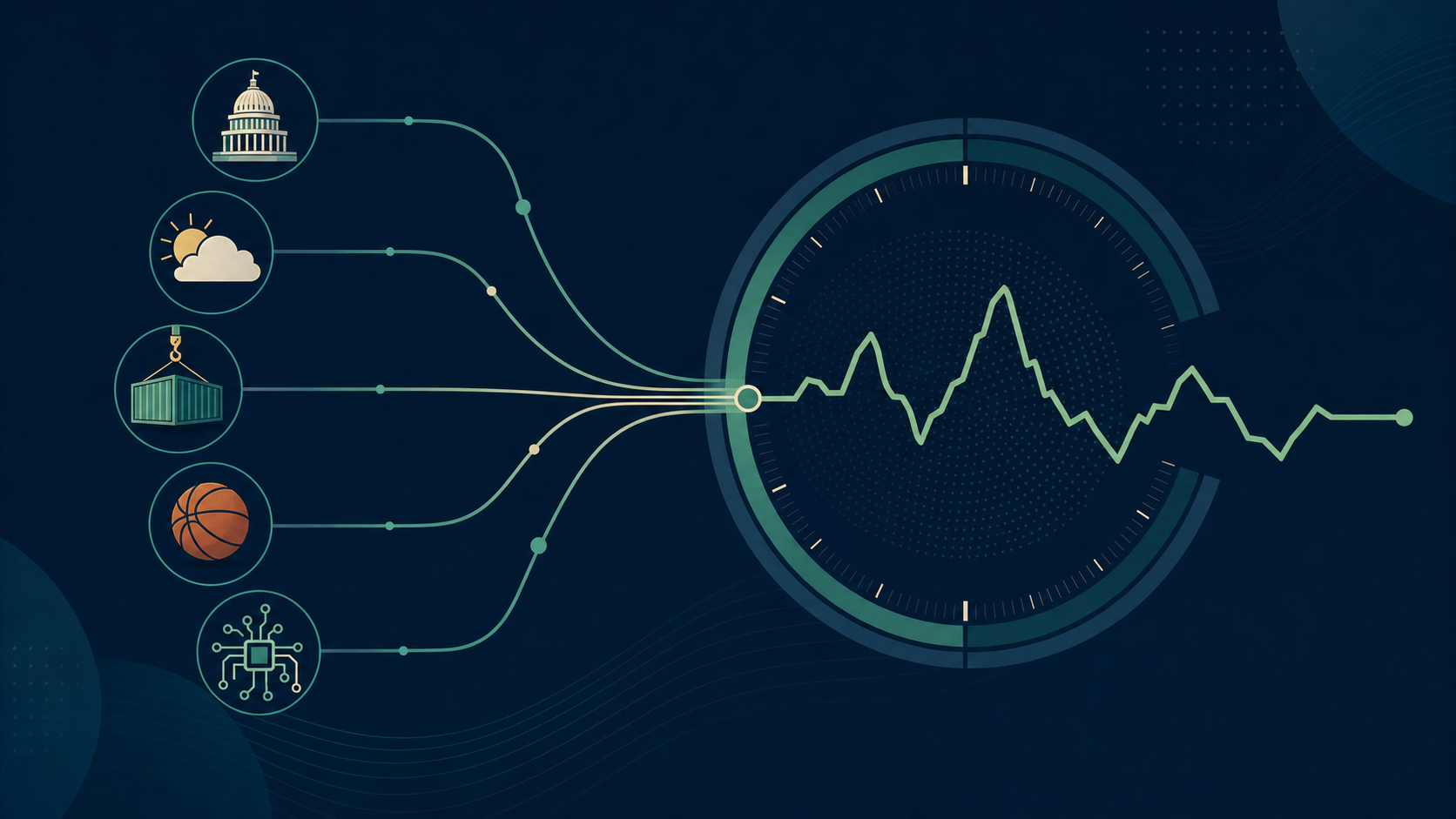
#1 Indices built from Kalshi markets. S&P DJI will take prices from Kalshi event contracts and turn them into indices, applying the same rule-setting it uses for its stock benchmarks: what goes in, how the pieces are weighted, and how the index changes as markets open and settle. Kalshi floated five examples: political power, supply chain risk, AI's impact on employment, sports outcomes with real economic stakes, and weather risk to harvests and energy demand.
#2 Kalshi contracts that settle to official S&P data. The agreement enables Kalshi to list contracts on the S&P 500, the Dow Jones Industrial Average and other S&P DJI indices, settling directly to the official values S&P DJI publishes.
That second piece is a bigger change than it sounds. Kalshi has listed S&P 500 contracts for years, but its own CFTC filings carried a disclaimer that it wasn't affiliated with S&P, and an early version settled to the index price as reported by Quandl Data, a third-party feed. As recently as August, Kalshi filed a perpetual future tracking the MerQube US Large Cap Index, an S&P look-alike, which Finance Magnates reported was a way around S&P's licensing. Now the source of truth is the source itself.
S&P DJI CEO Cathy Clay said the firm wants to be the index provider of choice as prediction markets mature. The two companies called each other "preferred" providers. Not exclusive.
And if the index idea sounds familiar, it should. Kalshi already runs KPOW, its American Power Index, which blends current House, Senate and White House control with market odds on future elections and a shutdown penalty. Kalshi's own page says KPOW aims to be the S&P 500 for politics. Now it's partnered with the actual S&P.
Why offer an index of event contracts?
Think of the value of the aggregate. One contract tracks one outcome. An index can bring several outcomes into one number. If you've built fantasy sports lineups, you know how much one player's injury can matter. A broader basket can spread that single-component exposure, though shared risks can still move the whole basket.
Here's a made-up five-race Senate basket, equally weighted, to show the mechanics. The races trade at 60, 55, 50, 45 and 40 cents. Average them and the index sits at 50: (60 + 55 + 50 + 45 + 40) / 5 = 50.
Now a scandal hits the first race and it drops from 60 cents to 10. That's a 50-point collapse if you held that one contract. The index? It goes from 50 to 40. (10 + 55 + 50 + 45 + 40) / 5 = 40. Same news, one fifth of the point move, because the other four races didn't move. That's the assumption doing the work here. If several races move together, the basket can fall further.
Now the cost side. For this example, assume Kalshi's standard taker-fee formula applies to all five races. The fee is 0.07 × number of contracts × price × (1 − price), with price in dollars and the order fee rounded up to the next cent. Some markets have different fees. Building that basket yourself at 100 contracts per race gives the following costs.
60¢ | $60 | $1.68 |
55¢ | $55 | $1.74 |
50¢ | $50 | $1.75 |
45¢ | $45 | $1.74 |
40¢ | $40 | $1.68 |
Total | $250 | $8.59 |
That's about 3.4% just to get in: $8.59 / $250 × 100 = 3.436%. Five separate orders. Additional fees can apply if you trade out or rebalance; that's different from holding a contract to settlement. A single product that tracked the whole basket could, in theory, do that in one trade. Kalshi says products built on these indices could come over time. No tradable event-index basket has been announced through this partnership, so any fee savings are still hypothetical. Fees can change; check the current schedule.
Fee example checked Oct. 27, 2026 against Kalshi's fee schedule. This is a hypothetical basket, not a confirmed S&P DJI methodology or a live product.
Who is this for?
Stock market people who've never opened Kalshi. If you already follow the S&P 500, the announced contracts would settle to the exact number S&P publishes. The official settlement source is the familiar part, though launch dates and contract terms still matter. For a lot of people, that's a familiar starting point for understanding what a Kalshi contract measures.
Prediction market traders. The index layer is a new way to read the board. A category index could show a shift before you've checked every market inside it. I'm not going to trade off an index number alone, but I'll use it the way I check Vegas odds before locking a DFS lineup: a fast read on where the whole slate is leaning, then I go find the mispriced piece.
Journalists and people who follow the odds without trading. "The political power index moved 4 points this week" is a sentence a reporter can use. Fifteen separate race prices isn't. A clean, rules-based number is what turns market odds into something people cite.
Businesses with real-world risk. A farm co-op watching drought, a retailer watching tariffs, a stadium town watching a playoff run. Kalshi's pitch is that a weather or supply chain index lets them follow the risks across every region they operate in at once, and eventually hedge them. That's the furthest-out use case, and it's the one that depends most on products that don't exist yet.
Where do things stand now?
This is currently a foundational framework. As Finance Magnates pointed out, neither company has named the first index, the first contract, a methodology or a launch date. Until those show up, the Senate basket above is a thought experiment.
The bigger question is what goes into the index. I trade Kalshi markets in part because a lot of them are thin, and thin markets misprice. That's an opportunity for a trader. It's a problem for a benchmark. An index is only as honest as its least liquid component, so the rules on what qualifies (minimum volume, how wide a spread is too wide, how a market gets dropped) matter more here than they do for the S&P 500, where every component is a deeply traded listed stock. KPOW today is re-weighted weekly on a proprietary formula, with methodology available on request. S&P's whole value is published, rules-based construction. I'd expect the S&P-branded versions to show their work, and that's the thing I'll be reading first.
Kalshi also isn't alone on either half of this deal. Cboe launched yes-or-no contracts on its Mini-S&P 500 Index in June, live on Interactive Brokers and rolling out to Schwab, cleared through the OCC under SEC oversight. On the data side, ICE already packages Polymarket odds into a signals feed for professional investors. Kalshi's proposal spans politics, weather, sports and economics. The open question is how those markets become consistent, useful benchmarks.
And the regulatory backdrop is still loud. CME is suing the CFTC over Kalshi's bitcoin perpetual, and several states are still fighting Kalshi in court. An S&P partnership doesn't settle any of that. It does bring an established benchmark provider into a commercial relationship with Kalshi. That isn't an endorsement of the contracts. S&P DJI explicitly says it doesn't sponsor, sell or endorse them.
What we're watching next
We don't have a verdict on this one yet. Here's what we're tracking.
Which index ships first. Politics has a head start with KPOW. Weather and sports would tell us S&P is serious about going beyond the obvious.
The inclusion rules. Liquidity floors and rebalancing rules will decide whether these indices are signal or noise.
Whether the index leads or lags. Does a category index move before the individual markets inside it, or just summarize them after the fact? That's the difference between a tool and a chart.
Who trades the S&P-settled contracts. If stock traders show up, Kalshi's financials category gets a whole new crowd.
What would you want indexed first? Come make your case in the PredictQ Discord.
This article includes a link to PredictQ partner Kalshi and discusses Polymarket, another PredictQ partner. We may earn a commission if you use our partner links. It doesn't cost you anything extra, and it helps keep the lights on here. Nothing in this piece is investment advice. Prices, odds and entry counts can change, and trading involves risk.