
The election may end Tuesday night, but the trading doesn't.
For months, prediction-market traders have been buying and selling contracts on everything from control of Congress to individual Senate races. As those markets settle, capital tied to election outcomes will be freed up.
Some traders will withdraw their profits. Others will look for their next opportunity. Once the midterms are behind us, attention may shift toward the 2028 presidential election.
But something else happens on election night. Candidates previously unknown to much of the country suddenly find themselves in the national spotlight. Victory speeches get replayed on television, interviews circulate on social media, and compelling moments reach millions who may never have heard of those politicians.
For political junkies, these may be familiar faces. For millions of casual observers, they're brand-new names.
Could that sudden recognition translate into increased demand for their prediction-market contracts?
Trading the Attention, Not the Outcome
The idea isn't necessarily to identify the next president. It's to identify politicians who might experience a surge in attention following Tuesday's election.
That opens the possibility of attention-driven price movements. Increased recognition and trading interest could push a contract's price higher, even without a corresponding change in the candidate's underlying chances of winning.
The strategy would be to purchase a contract before that attention arrives, then sell into the increased demand rather than holding it until the 2028 election. If the excitement fades and prices retreat, the trader would ideally have already exited.
Why This Might Not Work
There's no guarantee attention translates into higher prices, or that sufficient liquidity will exist to sell at the desired price. The trade requires anticipating how other traders might react, not correctly predicting the eventual winner.
A compelling speech and an executable exit are two different things.
A Familiar Face to Some, a New Name to Others
Consider Georgia Senator Jon Ossoff.
For those who follow politics closely, Ossoff is hardly a newcomer. But political enthusiasts sometimes fall victim to the curse of knowledge. We assume other people know what we know.
Ossoff has drawn comparisons to Barack Obama for his measured speaking style and delivery. His campaign has also demonstrated an understanding of social media, turning speeches and congressional hearings into widely circulated clips. An August remark about Trump aide Natalie Harp went viral, generating national attention.
Now imagine someone scrolling through Instagram or TikTok next Wednesday. They come across a clip of Ossoff delivering a victory speech, assuming he wins reelection Tuesday. They like what they hear, watch another clip, and suddenly a politician they barely knew yesterday is on their radar.
A few days later, that same person opens Kalshi's 2028 presidential election market. Alongside familiar names like Gavin Newsom and Alexandria Ocasio-Cortez, they recognize another name: Jon Ossoff.
Could that newfound familiarity translate into increased demand for his contract?
As of November 2, Ossoff's contract to win the 2028 presidential election was available to purchase for approximately 12¢ on Kalshi.
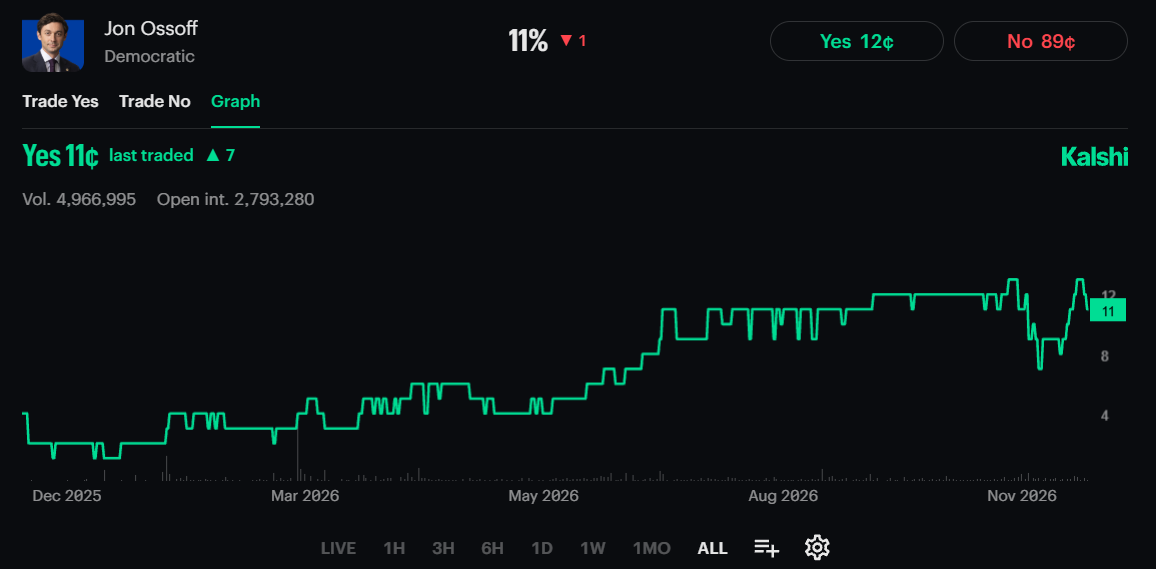
There's an important caveat. Ossoff has repeatedly stated that he has no interest in running for president in 2028, even pledging to serve his full Senate term if reelected. While political history offers examples of candidates changing their minds, there's no guarantee Ossoff will.
That's why the distinction between a short-term price move and the eventual election outcome matters here. Consider a hypothetical purchase at 12¢ followed by a sale at 16¢ after a burst of post-election attention. That seemingly modest four-cent increase would represent a 33.3% gross return, before fees and spreads.
Of course, the opposite could happen. The attention might already be reflected in the price, or traders could react differently than expected.
What Past Attention Spikes Can Tell Us
Have we seen similar short-term price movements surrounding major political moments before?
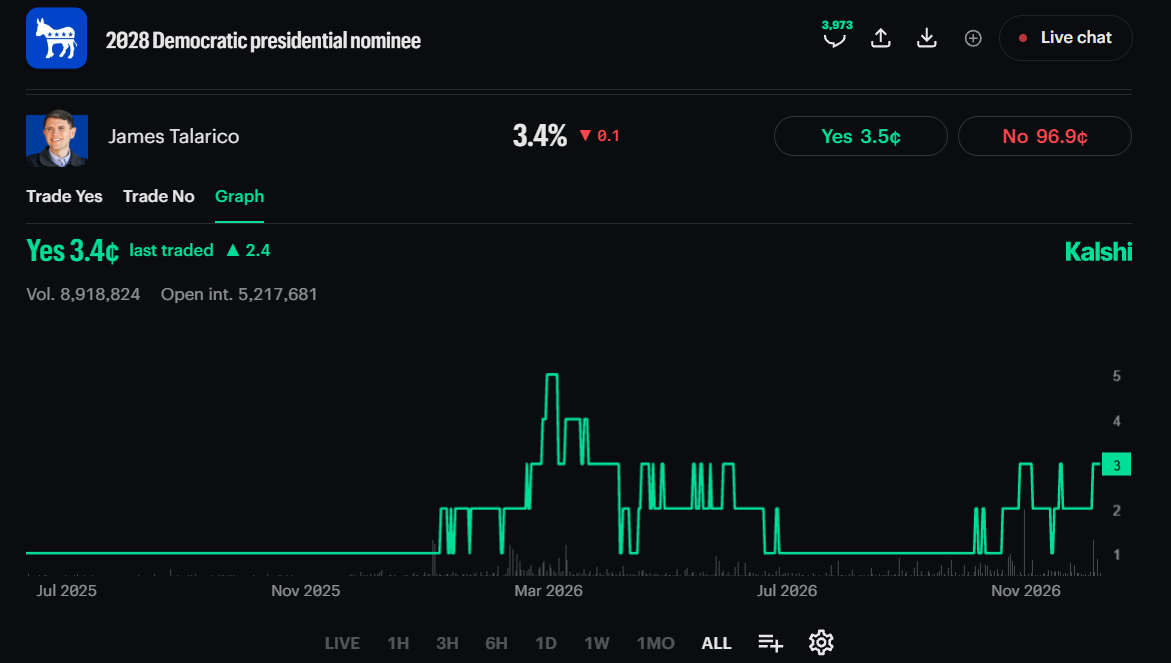
Consider James Talarico. On February 24, just over a week before his Texas Senate primary victory, his 2028 Democratic presidential nomination contract traded around 2¢ on Kalshi. By primary day, March 3, it had doubled to 4¢. Three days later, it reached 5¢, representing a 150% increase in less than two weeks.
But the excitement didn't last. By summer, his contract had retreated to around 1¢, below where it traded before the primary.
Or take Abdul El-Sayed. After a town-hall exchange went viral in mid-October, attracting millions of views, his 2028 Democratic vice-presidential nomination contract briefly climbed from approximately 1¢ to 4¢ around October 22–24, before returning to 1¢ within days.
Neither example proves that media attention caused the price movements, and thinly traded contracts can exaggerate these swings. But the timing is intriguing, particularly with El-Sayed's viral moment.
With both candidates appearing on Tuesday's ballot, their 2028 nomination contracts offer additional markets to monitor. As of November 2, Talarico's Democratic presidential nomination contract was trading around 3.5¢, while El-Sayed's Democratic vice-presidential nomination contract was priced around 1¢. Both could experience attention-driven price movements following Election Day, although neither an increase nor a profitable exit is guaranteed.
Prices quoted here are attributed to Kalshi as of the dates stated and can change.
The lesson? Identifying a potential price spike is only half the equation. Knowing when to exit may be just as important.
In poker, inexperienced players often focus entirely on the strength of their own hand. Experienced players think about something else. What might their opponents be holding, and how will they react?
Prediction markets aren't so different. Sometimes the opportunity isn't about correctly assessing a candidate's chances of winning. It's about anticipating how other traders will respond when that candidate suddenly enters the spotlight.
You don't need to predict the next president. You need to anticipate who everyone will be talking about next week.
This article includes a link to PredictQ partner Kalshi. We may earn a commission if you use it. It doesn't cost you anything extra, and it helps keep the lights on here. Nothing in this piece is investment advice, and prices, odds, and entry counts can change.