
In sports betting, not all markets are created equal.
The Super Bowl or Monday Night Football attracts enormous attention, with sophisticated models and millions of dollars influencing the lines. Finding an edge can be difficult. But what about an Ivy League basketball game on a Tuesday night? With fewer eyes on the action, there's a greater chance something gets overlooked.
Prediction markets may offer a similar dynamic.
Consider the U.S. Senate race in Texas, where Democrat James Talarico and Republican Ken Paxton have attracted national attention. But Texas voters aren't just choosing a senator this November. They're also electing an attorney general, comptroller, agriculture commissioner, and several other statewide officials.
And that's where things get interesting.
Could Talarico's campaign translate into stronger performances for lesser-known Democrats further down the ballot? Could increased turnout, voter enthusiasm, or dissatisfaction with Paxton influence races that receive far less attention?
In politics, this phenomenon is known as the coattail effect. For prediction-market traders, it raises another question: Are the markets accounting for these relationships, or could there be value hiding beyond the top of the ticket?
Why Texas?
The cost of living remains a major concern for Americans, gas prices have risen, and trust in Washington is low.
But economic concerns are only part of the picture. President Trump remains a polarizing figure, while Republican Senate candidate Ken Paxton has faced years of controversy and negative headlines.
Which brings us back to James Talarico.
Recent polling has shown a competitive Senate race against Paxton. Yet on October 28, Talarico's Kalshi contract was priced at 67 cents, reflecting considerably more confidence than the narrow polling margins might initially suggest.
But perhaps the most interesting number isn't his overall polling or his prediction-market price.
It's his support among independents.
A University of Texas/Texas Politics Project survey, fielded September 25 through October 5, 2026, found Talarico leading Paxton 69% to 11% among independents who don't lean toward either party. That's a remarkable margin, but there's an important caveat: these voters made up only about 5% of the likely-voter sample, meaning we're working with a relatively small subgroup.
Could Talarico's appeal among independents extend beyond the Senate race, benefiting lesser-known Democrats whose campaigns receive far less attention?
We don't know. Supporting Talarico doesn't automatically mean supporting every Democrat running for statewide office. Some voters will split their tickets, while others may simply skip races involving candidates they know little about.
But that uncertainty is precisely what makes the question worth exploring.
And it brings us to two lesser-known Texas Democrats whose prediction-market prices offer an interesting way to examine the theory: Nathan Johnson and Sarah Eckhardt.
Nathan Johnson: A Different Story in the Polls?
Texas Attorney General Ken Paxton is leaving the office he's held for more than a decade to pursue a U.S. Senate seat. His departure creates an open contest between Republican state senator Mayes Middleton and Democratic state senator Nathan Johnson.
But Paxton's influence doesn't necessarily end with his departure. Middleton has positioned himself as a continuation of Paxton's conservative approach, while Johnson has campaigned on restoring public trust in the office.
And there's another possibility beyond independent voters switching sides: What if some Republican voters are dissatisfied with Paxton's tenure as attorney general but aren't willing to vote for a Democrat?
They might simply skip the attorney general race altogether. That could change the outcome without requiring those voters to switch parties.
Now consider the polling.
The University of Texas/Texas Politics Project survey showed Johnson narrowly ahead, 48% to 47%. More recently, an October 21–26 survey from 254 Labs/YouGov Blue found Johnson leading 47% to 45%.
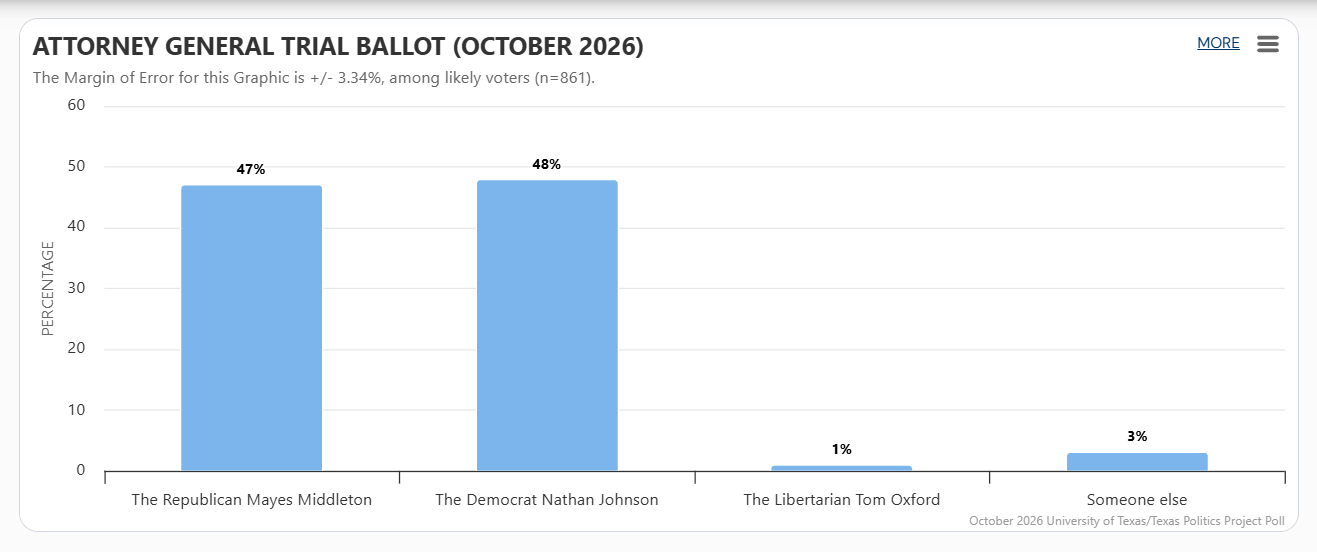
Those are narrow margins, and other surveys have shown Middleton ahead. But they illustrate why the race deserves closer examination: recent polling has produced a much more competitive picture than Johnson's prediction-market price might initially suggest.
On October 27, Johnson's Kalshi contract was quoted around 27 cents.
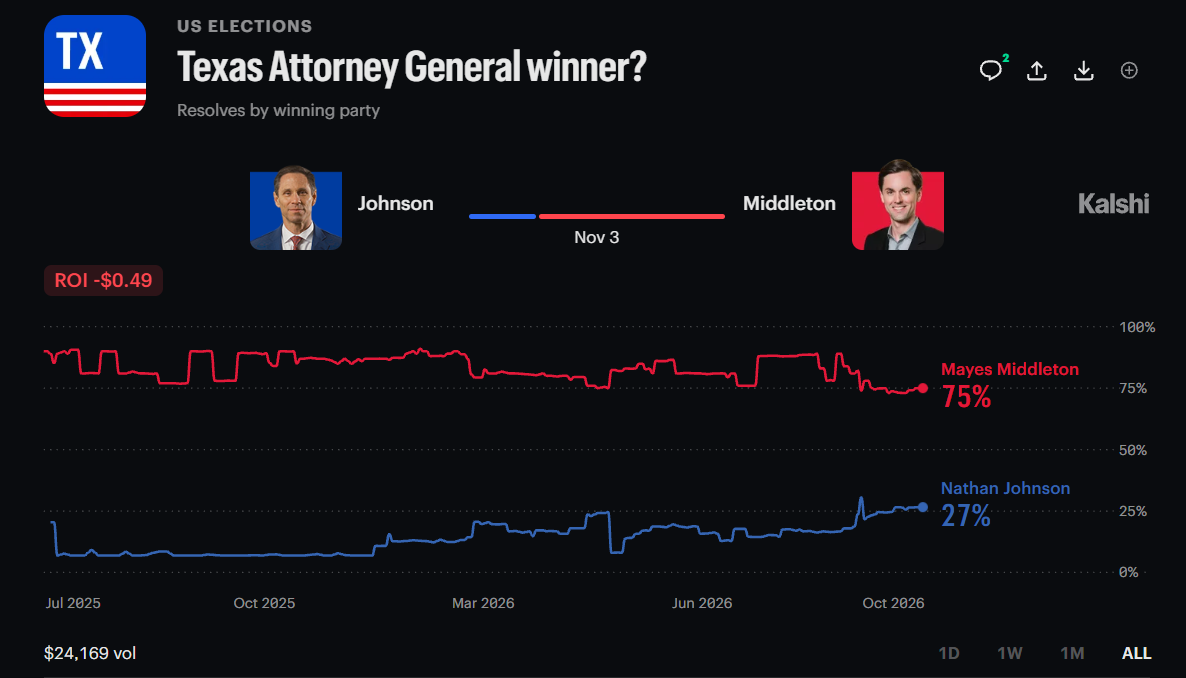
None of these scenarios is guaranteed, and Johnson remains an underdog for a reason. But at a price of roughly 27 cents, the question isn't whether he's likely to win. It's whether his chances are better than the market suggests.
Another Race Worth Watching
The attorney general contest isn't the only down-ballot race worth examining. In the race for Texas comptroller, Democrat Sarah Eckhardt has also shown signs of competitiveness against Republican Don Huffines.
The University of Texas/Texas Politics Project survey had Huffines leading just 47% to 46%, while a more recent Slingshot Strategies poll showed a 47%–44% margin, although other polling has shown a wider Republican lead.
Yet as of October 28, Eckhardt's Kalshi contract was priced at just 16 cents.
Like Johnson, Eckhardt remains an underdog. But could independent voters and broader statewide turnout dynamics give her a better chance than that price suggests?
Looking Beyond the Top of the Ticket
None of this means Johnson or Eckhardt will win. Texas has a long history of voting Republican in statewide elections, and a competitive poll doesn't automatically translate into a competitive election.
But that's not really the point.
The coattail effect doesn't require every voter to change their mind. Sometimes, a shift in turnout, a handful of independent voters, or even dissatisfied voters choosing to stay home or skip a particular race can make a meaningful difference.
And when those possibilities intersect with contracts priced at 27 cents or 16 cents, they're worth investigating.
Just like that Tuesday night Ivy League basketball game, the most interesting opportunities might not be where everyone is looking.
Sometimes, they're a little farther down the ballot.
This article includes a link to PredictQ partner Kalshi. We may earn a commission if you use it. That doesn't cost you anything extra, and it helps keep the lights on here. Nothing in this piece is investment advice, and prices, odds, and entry counts can change.