
Six days. Last week Georgia changed favorites. This week Nevada ran away. Aaron Ford's governor contract closed at 58 cents on Kalshi a week ago Tuesday and is 77 this morning, a 19-cent move, the biggest on our board since the series started. Keisha Lance Bottoms added 11 cents in Georgia to reach 62. Kalshi's Senate control contract slipped a cent to 64, and the House contract is still at 91. Underneath the quiet headline numbers, the Democratic House, Republican Senate combination gained four cents, and Troy Jackson gave back three in Maine, the race Decision Desk HQ now rates the closest Senate contest in the country.
This is part four of five, and it's the one we promised for the week before Election Day. Every contract on the board turns into a dollar or nothing at some point after Nov. 3, and the two biggest venues get there by different rules. Some of those contracts will pay within hours of the first network calls. Others can't, by their own terms, settle until weeks or months later, and a couple of the states on our board have counting rules that make a Tuesday-night answer unlikely no matter how lopsided the result. Below is how each contract type settles on Kalshi and Polymarket, where the calendar can slow things down, and then the board and the movers as usual.
The election-morning edition runs Nov. 3 and the Scoreboard a week after that. Every market here is live on PredictQ.
Every price is Kalshi's price Wednesday morning, with each contract's Oct. 20 daily close for the week's change. A few of those closes differ by a cent from the prices we published last week. Prices may change.
The Big Board
Democrats are 64 cents to win the Senate and 91 cents to win the House. Polymarket has the two questions at 66.5 and 91.5.
Senate control, Democrats | 64¢ | 65¢ | -1 |
House control, Democrats | 91¢ | 91¢ | 0 |
Democrats sweep both chambers | 62¢ | 64¢ | -2 |
Democratic House, Republican Senate | 29¢ | 25¢ | +4 |
Republicans sweep both chambers | 9¢ | 9¢ | 0 |
Republican House, Democratic Senate | 0.8¢ | 0.6¢ | 0 |
Forbes's daily poll tracker, updated Tuesday morning, has the Silver Bulletin generic ballot average at Democrats 50.6% to Republicans 41.7%. Reuters/Ipsos, fielded Oct. 22 to 26, has the national ballot at 47-36, or 50-41 once leaners are included, per Al Jazeera.
How the contracts settle
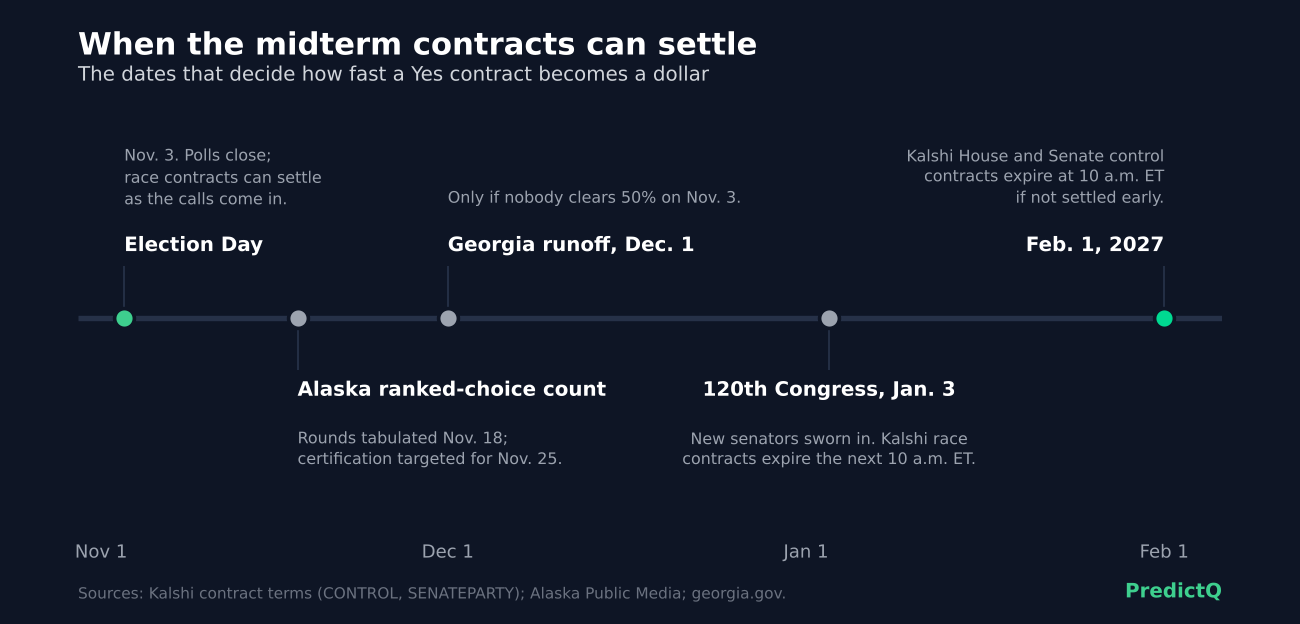
The House and Senate control contracts on Kalshi. The question Kalshi's contract answers is who leads the chamber on Feb. 1, 2027. The contract terms define the payout by the party of the Speaker of the House and the President pro tempore of the Senate on that date, as documented on congress.gov, with the expiration time set at 10 a.m. ET. On its own, that rule would leave the biggest markets of the cycle open for nearly three months after the vote. The terms also allow an accelerated settlement. If at least four of eight designated media sources declare a winner, and none of the eight has issued a contradictory call, Kalshi may settle early. The eight are The New York Times, the Associated Press, Decision Desk HQ, CNN, Fox News, NBC News, CBS News and ABC News. A local affiliate's call can stand in for its parent network, the national desk's call supersedes the affiliate's, and a network and all of its affiliates count as one source. Settlement is due no later than the day after expiration unless Kalshi opens what its rulebook calls the Market Outcome Review Process, which the contract terms let it start at its own discretion before settling.
Two smaller details from the same documents. The control contracts tick in tenths of a cent, which is why you see prints like 91.1 on the House market. And the rules let Kalshi designate a new source agency if something undermines the reliability of the one it has, a clause that exists for every contract and that we mention only because it's in the terms.
Kalshi's race contracts. The Texas Senate market on our board pays on the party of the first candidate who presents a certificate of election to the Senate and is sworn in for the term beginning in 2027. The governor contracts work the same way, keyed to the person sworn in as governor, with the state as the source agency. Both contract types carry the same four-of-eight media clause as the control markets. Two edge cases are written in. If the winner announces a party switch between Election Day and the swearing-in, the contract resolves on the party they belonged to on Election Day. If a senator-elect or governor-elect never takes the seat, the party of whoever is first sworn in as the replacement, temporary or permanent, is what counts. Each race contract expires at the first 10 a.m. ET after the swearing-in, or a year after the vote, whichever comes first, and the market page says it closes early once the swearing-in happens.
The combination and seat-count markets. The Democratic sweep contract and its three siblings are combination markets. Each component resolves under the CONTROL rules above, including the accelerated clause, and the terms say that if any single component resolves No or becomes impossible, the whole contract resolves No right away. The House seat-count brackets resolve on how many seats Democrats hold on Feb. 1, 2027, with members who caucus with the Democrats included.
Polymarket's control markets. Polymarket's Senate control market resolves on the party that wins a majority of voting seats. If neither party has a majority, the chamber goes to the party that holds half the seats plus the vice presidency, and if that's still ambiguous, to the party of the first President pro tempore the new Congress selects. The House version substitutes the first Speaker elected. Independents count toward whichever party they caucus with, and if an independent's caucus decision isn't known on Election Day the market can stay open until the earlier of an announcement or 11:59 p.m. ET on Jan. 4. Runoffs count toward the seat they decide even if they fall after November. The listed resolution sources are official information from state election authorities, the United States Congress, and a consensus of credible reporting. There's no numbered media-call trigger in the control rules.
Polymarket's race markets. Each Senate and governor market on our board names the Associated Press, Fox News and NBC as its resolution source and resolves once all three have called the race for the same candidate. If the three never line up, it resolves on the official certification. The Senate markets say the result is inclusive of any runoffs; the governor markets we checked don't mention runoffs at all. A candidate who runs as an independent never counts under the Democrat or Republican options, and if a named nominee is replaced before Election Day the market resolves on the replacement.
What happens after the calls on Polymarket. The calls are the trigger, not the payout. Polymarket's markets resolve through UMA's optimistic oracle. Someone proposes the outcome with a bond, the proposal sits in a two-hour challenge period, and if nobody disputes it, the market resolves and winning shares redeem for a dollar. A dispute sends the question to a vote of UMA stakers, who commit secret votes over a 24-hour window and reveal them over the next 24 hours, with a dispute needing to be at least four hours old to enter a voting round. That's how the presidential market worked two years ago. Fox called the race for Trump a little after 1:45 a.m. ET on Nov. 6, 2024, the AP and NBC followed a few hours later, and CoinDesk reported the market resolved just before 11 a.m. ET that morning, with the oracle's challenge window accounting for the gap. Kalshi's presidential contract that cycle was written to settle on Inauguration Day, according to Axios. This cycle's Kalshi terms carry the four-of-eight clause instead.
Where the calendar gets in the way
Three states on our board have counting rules that can push a result past Election Night even in a race that isn't close.
Alaska. Alaska Public Media's guide to the general election says that in any race where no candidate clears 50%, the ranked-choice tabulation happens on Nov. 18, with certification targeted for Nov. 25. Networks can and do project races before a tabulation, so a Peltola or Sullivan call could still come early. On Polymarket, note that the Alaska market is structured as candidate markets rather than party markets, so the contract you're trading is "Peltola wins" rather than "Democrats win."
Maine. Maine uses ranked-choice voting for its Senate race, and the Bangor Daily News reported Monday that only first-choice votes get counted on Election Night. If nobody has a majority, the Secretary of State's office collects ballot data from every town and runs the count centrally in Augusta, a process that in past years has finished the week after the election. Secretary of State Shenna Bellows told the paper she wants voters prepared for results the week following the election. The BDN also noted that in the 2024 2nd District race, the paper and Decision Desk HQ called the result the day after Election Day without waiting for the tabulation.
Georgia. Georgia requires a majority to win a general election outright. The state's election page lists Dec. 1, 2026 as the general election runoff date. A runoff is possible in either the Senate race or the governor race, and the two venues treat it slightly differently on paper. Polymarket's Senate market says it resolves inclusive of runoffs, while its governor market doesn't mention them; Kalshi's contracts key off who's sworn in, so a runoff just delays the answer.
None of this changes what a contract is worth if the race itself isn't in doubt, only when the dollar arrives, and a contract that's going to pay in December is still a contract that's going to pay.
The movers, and what was happening around them
For each move of three cents or more, here's what the polls, the money and the campaigns were doing in the same seven days. Where we can't tie a move to anything, we say so.
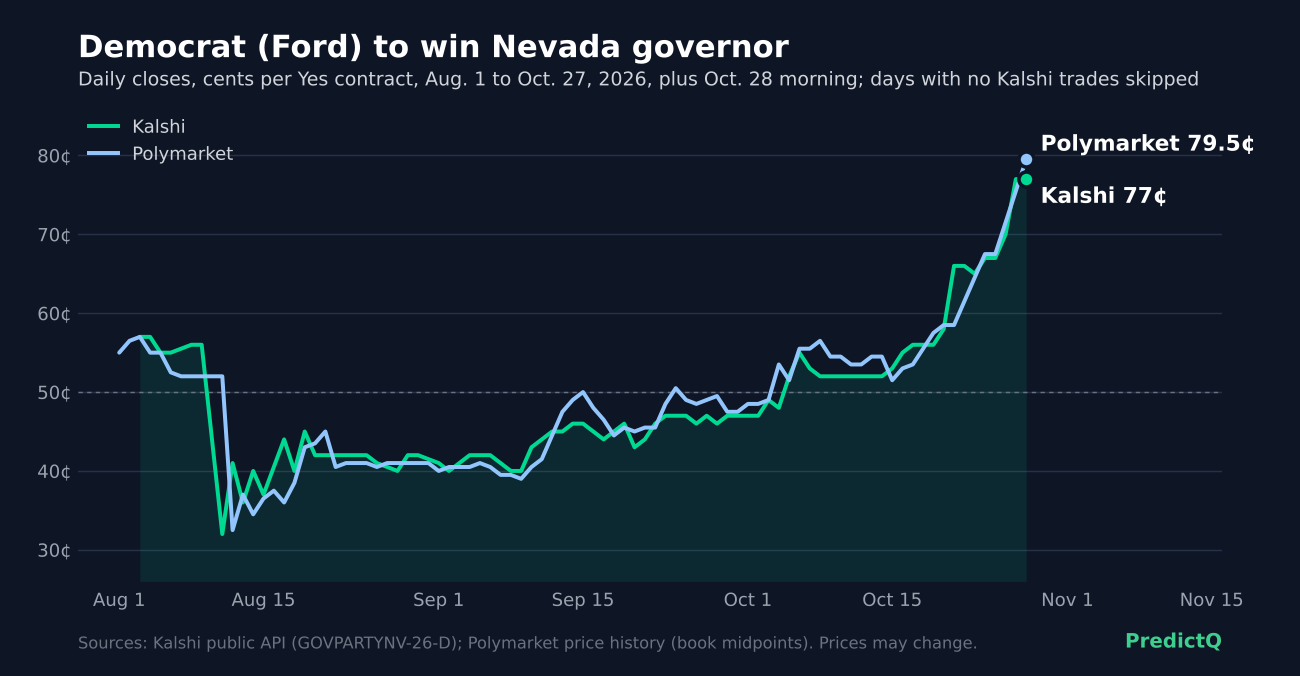
Nevada governor, Ford 58 to 77 (+19). Aaron Ford, Nevada's attorney general since 2019, is challenging Gov. Joe Lombardo. The contract jumped from 58 to 66 on Wednesday, Oct. 21, drifted to 67 by the weekend, closed at 70 on Monday and ran to 77 on Tuesday, with Tuesday's volume the heaviest of the week. The clearest thing in the window is the early vote. The Nevada Independent's early-voting blog had Democrats ahead by nearly 30,000 ballots statewide as of Wednesday morning, just under six points, after a 5,300-ballot Tuesday. A week ago Monday the lead was 24,395 ballots, against a 3.1-point Democratic lead at a similar point in 2022, and the blog had the Clark County lead at 12.4 points against 7.9 in 2022. The blog's author wrote that Lombardo would probably lose if the election were held today, that he can't lose Clark by double digits and win, and on Wednesday that Lombardo still has two win scenarios out of 15. On the polling side, a RedBox Research poll of 1,407 likely voters released Oct. 22 had Ford up 46-43, per PoliAgg's tracker, which lists no sponsor for it and whose average has the two within a point of each other. Polymarket's Ford contract is at 79.5 this morning.
Georgia governor, Bottoms 51 to 62 (+11). Bottoms, Atlanta's mayor from 2018 to 2022, faces Rick Jackson for the open seat. The contract went from 51 to 57 on Oct. 21 and to 60 on Oct. 22, then held around 60 before closing at 62 on Monday and Tuesday. The Atlanta Journal-Constitution's early-vote analysis, published Oct. 20, had turnout slightly ahead of 2022. Black voters were about 35% of the early electorate and women outnumbered men by about ten points. In areas Harris won in 2024, 21% of voters had already voted, against 16% in areas Trump won. A follow-up AJC analysis found early turnout flat in the 132 counties Trump carried in 2024 and up 9% in the 27 Harris counties. Jackson told a Calhoun crowd on Oct. 20 that he was concerned rural Georgia still thinks the state is red and that Republicans have to overperform there to win. His campaign first said he'd skip Trump's Saturday rally in Perry to campaign with Gov. Brian Kemp, then said Friday he'd do both. The only new public poll in the window was the AJC survey we covered last week, with Jackson up 46-45. Barack Obama rallies in Atlanta with Bottoms and Jon Ossoff on Wednesday, Kamala Harris starts a three-day Georgia visit the same day, and early in-person voting ends Friday, per Al Jazeera. Polymarket has Bottoms at 62.5.
Texas governor, Hinojosa 29 to 34 (+5). Gina Hinojosa's contract added five more cents after last week's nine. The Fox News Texas poll, fielded Oct. 15 to 19, had Gov. Greg Abbott up 52-47, unchanged from September, with the Senate race tied 49-49 among likely voters. Trump was in Texas on Tuesday, at the Port of Corpus Christi and then Lubbock, campaigning for Ken Paxton, while James Talarico held his own rally in Lubbock. We found nothing specific to the governor race behind the move. Polymarket has Hinojosa at 34.5.
Democratic House, Republican Senate, 25 to 29 (+4). The sweep contract slipped two cents to 62 and Senate control lost one, so this one picked up its four cents from the gap between the two. We don't have an event to pin it to.
Ohio Senate, Brown 65 to 68 (+3). Sherrod Brown's contract went from 65 to 69 on Oct. 21 and 70 on Oct. 22, then settled back to 68. The Fox News Ohio poll in Forbes's roundup, updated Oct. 22, has him up 52-47 over Jon Husted. Trump holds his third Ohio rally of the month in Chillicothe on Wednesday. Polymarket has Brown at 69.
Maine Senate, Jackson 64 to 61 (-3). Troy Jackson's contract closed at 60 on Monday and 61 on Tuesday. The Fox News poll fielded Oct. 16 to 20 had the race tied 49-49 among likely voters, with Jackson up 50-48 among registered voters, according to Newsweek. The Portland Press Herald reported Tuesday on a Marist poll with Jackson at 49% and Susan Collins at 47%, inside its margin. Decision Desk HQ's forecast gives Jackson a 54% chance and calls it the closest Senate race in the country. And then there's the ranked-choice count above. Polymarket has Jackson at 62.5.
Vance, 2028 Republican nominee, 42 to 39 (-3). Off the midterm board but on ours since part one. We didn't chase a cause.
Kalshi and Polymarket
Last week the two venues were within a cent and a half on every Senate race, with Kalshi the higher of the two in four states. This morning Polymarket is above Kalshi on nine of the ten Senate races and on every governor race, mostly by half a cent to a cent and a half. The widest gaps are the two governor races that moved most: Nevada, where Polymarket has Ford at 79.5 to Kalshi's 77, and Ohio, where it has Acton at 79.5 to 77. Texas (67.5 to 66) and Maine (62.5 to 61) are a cent and a half apart. Iowa is the one Senate race where Kalshi is higher, 45 to 43.5.
The rest of the board
Texas | James Talarico (D) vs. Ken Paxton (R) | 66¢ | 64¢ | +2 |
Maine | Troy Jackson (D) vs. Susan Collins (R) | 61¢ | 64¢ | -3 |
Ohio, special | Sherrod Brown (D) vs. Jon Husted (R) | 68¢ | 65¢ | +3 |
Michigan | Abdul El-Sayed (D) vs. Mike Rogers (R) | 69¢ | 69¢ | 0 |
Iowa | Josh Turek (D) vs. Ashley Hinson (R) | 45¢ | 44¢ | +1 |
Alaska | Mary Peltola (D) vs. Dan Sullivan (R) | 74¢ | 75¢ | -1 |
Kansas | Adam Hamilton (D) vs. Roger Marshall (R) | 40¢ | 40¢ | 0 |
New Hampshire | Chris Pappas (D) vs. John E. Sununu (R) | 89¢ | 90¢ | -1 |
North Carolina | Roy Cooper (D) vs. Michael Whatley (R) | 96.3¢ | 96.1¢ | 0 |
Georgia | Jon Ossoff (D) vs. Mike Collins (R) | 95.2¢ | 95.3¢ | 0 |
Texas added two cents in a week that had the Fox News poll tied and Univision/YouGov at 50-45 for Talarico, per Forbes. Kansas is unchanged at 40, with Marshall at 61. Iowa is up a cent to 45.
Governors: Nevada's Ford 77 (+19), Georgia's Bottoms 62 (+11), Texas's Hinojosa 34 (+5), Florida's David Jolly 24 (+2), Ohio's Acton 77 (0), Pennsylvania's Josh Shapiro 97 (0).
House seat brackets, Below 210 through Above 249: 3.7, 3.4, 3.2, 3.1, 4.9, 7.0, 9.5, 15, 14, 13, 8.8, 19. The Above 249 bracket is now the most expensive at 19 cents, up from 14 a day ago, and the 230-233 bracket that led last week has fallen from 16 to 9.5.
What to watch on Election Night
The first four calls. For the control contracts on Kalshi, count designated sources, not networks you happen to have on. Four of the eight, with no dissent, is the trigger.
AP, Fox and NBC on the state races. Polymarket's race markets need all three. One or two won't do it.
Nevada. The biggest mover on the board going into the final week, with Kalshi at 77 and Polymarket at 79.5.
Maine and Alaska. Two of our ten Senate races might not have a first-choice majority on Election Night. Watch whether the networks call them anyway.
Georgia. If either statewide race finishes under 50%, the next date on the calendar is Dec. 1.
This article includes links to PredictQ partners Kalshi and Polymarket. We may earn a commission if you use our partner links. It doesn't cost you anything extra, and it helps keep the lights on here. Nothing in this piece is investment advice or a trade recommendation. Prices, odds, and entry counts can change. Availability depends on the platform, product, and your location; check each platform's age and eligibility requirements before trading.