
Say you’re planning an outdoor event. A rain market for the nearest airport might tell you whether it’ll rain somewhere nearby that day. It won’t tell you whether your venue will get rain during the four hours people are actually there.
That’s the gap Kalshi’s on-request weather markets are designed to fill. As of November 2026, the live API supports contracts that count rainy hours at eligible locations in the contiguous U.S. API users can request a contract for a specific place and time, then ask market makers for a price.
How the New Rain Markets Work
The request starts with latitude and longitude. It also specifies a future date, a window of whole hours and a threshold for how many of those hours count as rainy. Kalshi creates the eligible market and returns a ticker. If the same market already exists, the API returns its ticker instead.
An hour counts as rainy if the settlement data show at least 0.01 inch of precipitation for that hour.
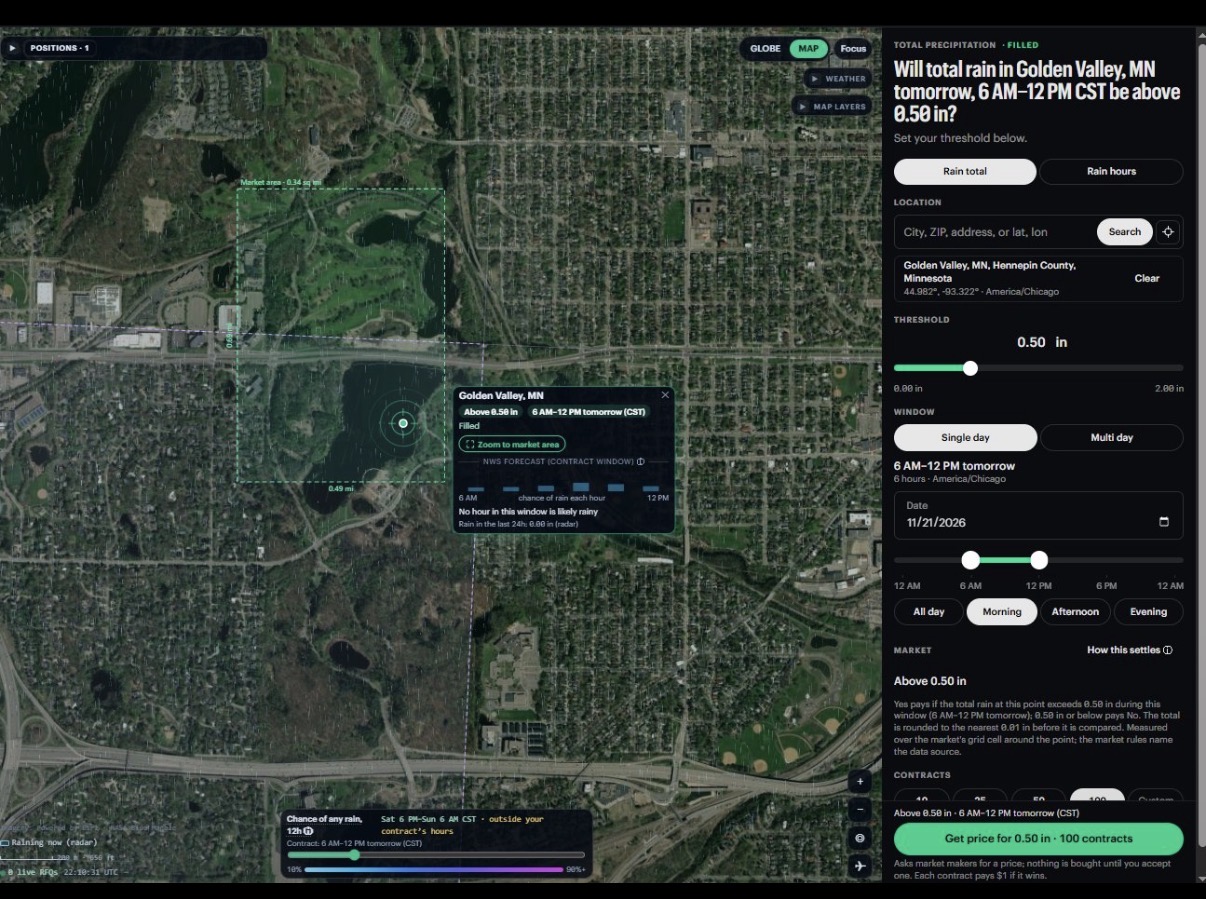
Say the contract asks whether there’ll be more than one rainy hour between 1 p.m. and 5 p.m. It settles YES if at least two of those four hours each meet the threshold. A single hour with 0.02 inches wouldn’t do it.
In production, a new market’s window has to start at least six hours in the future. Kalshi sets the geographic and timing limits, and the contract uses the exchange’s settlement rules.
Creating a Market Is Not the Same as Buying a Contract
Once the market has a ticker, an API user can specify a position size and send a request for quote, or RFQ. Market makers can respond with prices. If a requester accepts a quote, the maker still has to confirm it before the orders go in. Even then, a fill isn’t guaranteed.
Standard weather markets often already have bids, asks and a trade history. A new rain market might have none of those. Someone still has to price the other side.
Market Example: Protecting an Outdoor Event
Imagine a restaurant hosting an outdoor event from 1 p.m. to 5 p.m. on a Saturday. Sales tend to drop sharply when rain lasts for two hours or more, but a passing shower rarely changes attendance.
A daily rain market is a poor fit. Rain at 7 a.m. could settle a daily YES contract even if customers arrive to clear skies. A contract tied to the restaurant’s location, the event’s four-hour window and at least two qualifying rainy hours could line up more closely with the risk the restaurant cares about.
Suppose a market maker quotes YES at 35¢ and the restaurant buys 1,000 contracts. The upfront cost would be $350 before fees.
If the contract settles YES, a $1,000 payout leaves a $650 trading profit before fees. If it settles NO, the restaurant loses its $350 upfront cost, plus any fees.
Whether that hedge makes sense depends on how closely the settlement condition tracks the restaurant’s lost profit. The probability of rain is only part of the picture.
Why the Data Source Matters
These contracts don’t settle on a nearby airport’s daily rain report. Kalshi uses NOAA’s Multi-Radar/Multi-Sensor (MRMS) radar-and-gauge analysis, which estimates precipitation on a grid of roughly one kilometer. Settlement is normally expected about two hours after the window ends. If an hourly reading is still missing after 24 hours, the rules call for NOAA’s High-Resolution Rapid Refresh (HRRR) analysis as a fallback for that hour.
That makes forecast models, radar observations and the timing and coverage of showers relevant to the analysis. It also introduces basis risk: disruptive rain can hit the venue even if the settlement grid cell doesn’t clear the threshold. The reverse can happen, too.
A New Opportunity for Weather Traders and Businesses
For systematic traders, custom locations and hourly windows open up more events to model. An API-based strategy could compare point-specific forecast probabilities with RFQ prices and assess whether the gap is large enough to cover fees and forecast uncertainty.
For businesses, the bigger question may be what happens to revenue. Outdoor concerts, farmers markets, restaurants, sporting events and construction projects can see very different financial outcomes from one rainy hour versus several. A contract tied to the venue and schedule may be a closer hedge than a daily city market.
Still, thin liquidity and wide quotes can make a hedge expensive or hard to put on. And even a well-matched forecast doesn’t guarantee the payout will track the actual loss.
Conclusion
On-request rain markets give API users more control over what a weather contract measures. They can specify where and when rain matters, set the number of qualifying hours and ask market makers for a price.
As the system develops, the most valuable question for both traders and businesses may become: not simply whether it will rain, but whether the exact hours and location that matter to them will experience enough rain to affect the outcome.
PredictQ is a marketing partner of Kalshi. We may earn a commission if you use our referral link. That doesn’t cost you anything extra, and it helps keep the lights on here. You must be 18 or older to open an individual Kalshi account. Nothing here is investment or business advice. Availability, contract rules, fees and quotes can change, and trades may not fill.