
Seven days left, and I’m up $14.16. I haven’t closed a single day at a new high since Halloween. Spooky.
After about two weeks treading water at around +$1,500, the account gave back $1,709 in four days. Saturday night was rock bottom: the account closed under $50,000 for the first time since Day 1.
Since my hot start (my equity peaked at $52,037 on Halloween), I’ve gone an abysmal 20-23. Here’s the full damage report: the scoreboard, the four-day free fall, the college problem, and why a free extension is the most important button on my screen.
A quick note on the numbers: every price and P&L below comes straight from my Funding Predicts trade log. Prices are Polymarket prices, since that's the book the challenge mirrors. Pass rates come from my own simulation of the challenge rules, not from Funding Predicts or PredictQ.
New Here? The Challenge in 60 Seconds
A prop firm (short for proprietary trading firm) lends you capital to trade with once you prove you won't light it on fire. Funding Predicts is the first one built around Polymarket. PredictQ paid for their $50K evaluation (a practice account that trades live Polymarket prices). Pass the test and I get a funded account with real payouts. Break one rule and the account is cooked.
The test in one breath: make $3,000 in 30 days without breaking a rule.
The rules that matter this week:
$2,000 max drawdown, trailing. The floor sits $2,000 below my best end-of-day balance and only moves up. Touch it and it's over. (I call it the lava floor.)
$1,000 daily loss limit. Open positions count, not just closed ones.
35% consistency. No single day can be more than 35% of total profit. At a $3,000 pass, that's $1,050.
One free 15-day extension. It unlocks with 7 days left, but only if the account is at or above the $50,000 starting balance. Remember this one. It's about to matter a lot.
The Scoreboard: Up $14.16, $227 of Room
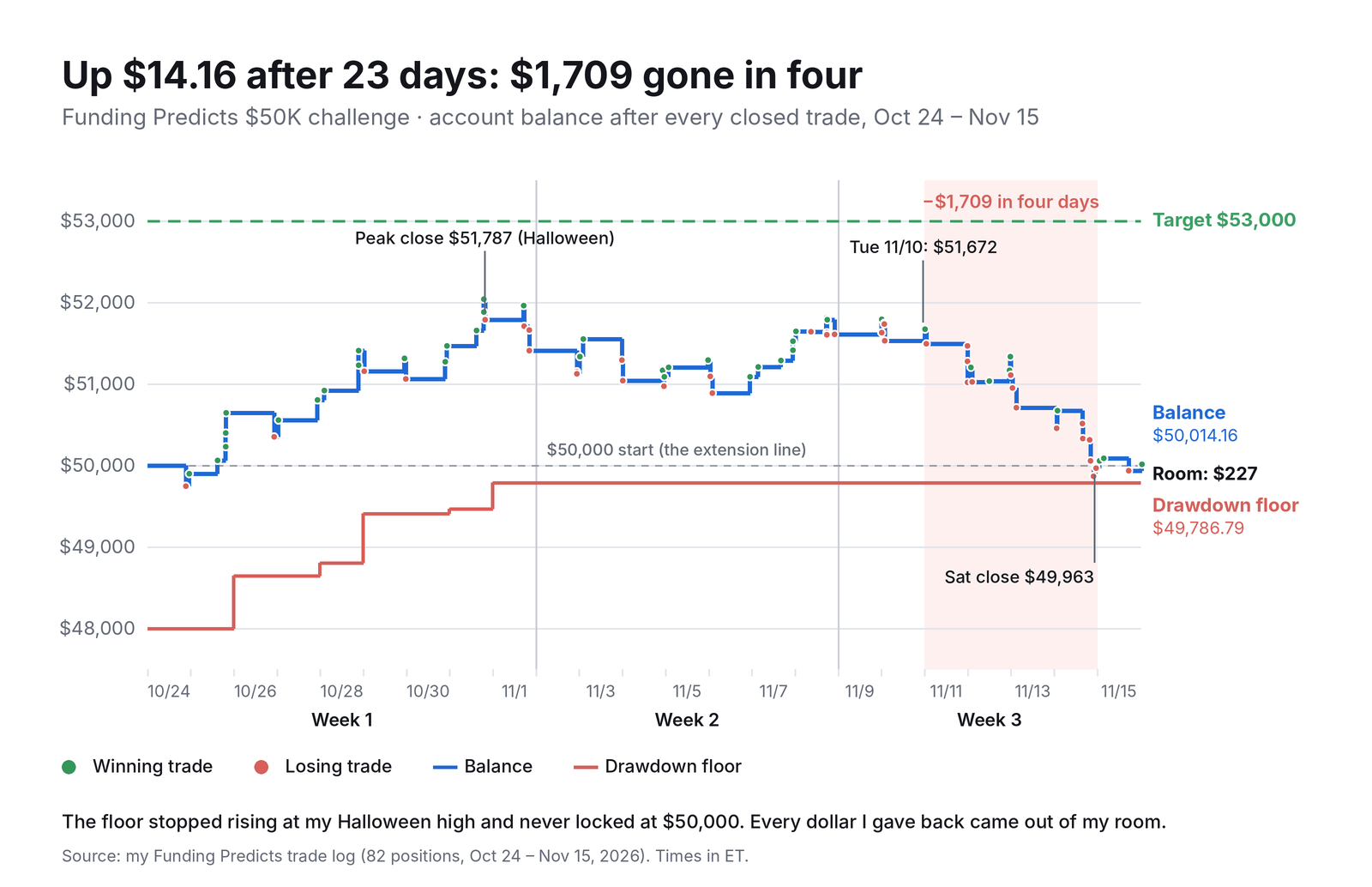
Twenty-three trading days (Sat Oct 24 – Sun Nov 15), 82 positions, and a balance line that climbed, flatlined, then fell off a cliff.
Balance: 50,014.16(+14.16)
Record: 37-30 (44-38, or 54%, counting every ticket)
Best day: +$746.57 (Sun 10/25)
Worst day: −$745.28 (Sat 11/14)
Drawdown floor: $49,786.79, which leaves $227.37 of room
Left to target: $2,985.84
Days left: 7, plus the free extension (15 days)
Week 1 (Oct 24 – Nov 1) | 17-7 | +$1,405 |
Week 2 (Nov 2 – Nov 8) | 12-8 | +$202 |
Week 3 (Nov 9 – Nov 15) | 8-15 | −$1,593 |
Yes, my best day and my worst are $1.29 apart. Three weeks of work and the scoreboard has turned into a mirror.
The stat that stings. I've paid $239.89 in fees. My profit is $14.16. The fee line has out-earned me about 17 to 1.
My hourly rate. If this were a 40-hour-a-week job, Oct 24 through Nov 15 is about 131 hours on the clock. For $14.16. That's 11 cents an hour, or $224 a year. The first federal minimum wage, back in 1938, was 25 cents an hour. I’m making less than half of a Great Depression paycheck.
Meanwhile the fee line clocked in at $1.83 an hour. Somebody here is getting paid, and it isn't me.
Why the bleed? My average entry since Week 1 is about 55¢. At that price I need to win roughly 55% just to tread water. Since Week 1 I've only won 46%.
Two Weeks of Treading Water, Four Days of Free Fall
Week 2 was a holding pattern. I went 12-8, made $202, and actually followed my sizing rule. When my room dipped to about $1,250, my unit dropped to $200 and I sized down. Boring. Fine. By Tuesday 11/10 I'd climbed back to $51,672.37, with more than $1,800 of room.
Then Wednesday happened. And Thursday. And Friday. And Saturday.
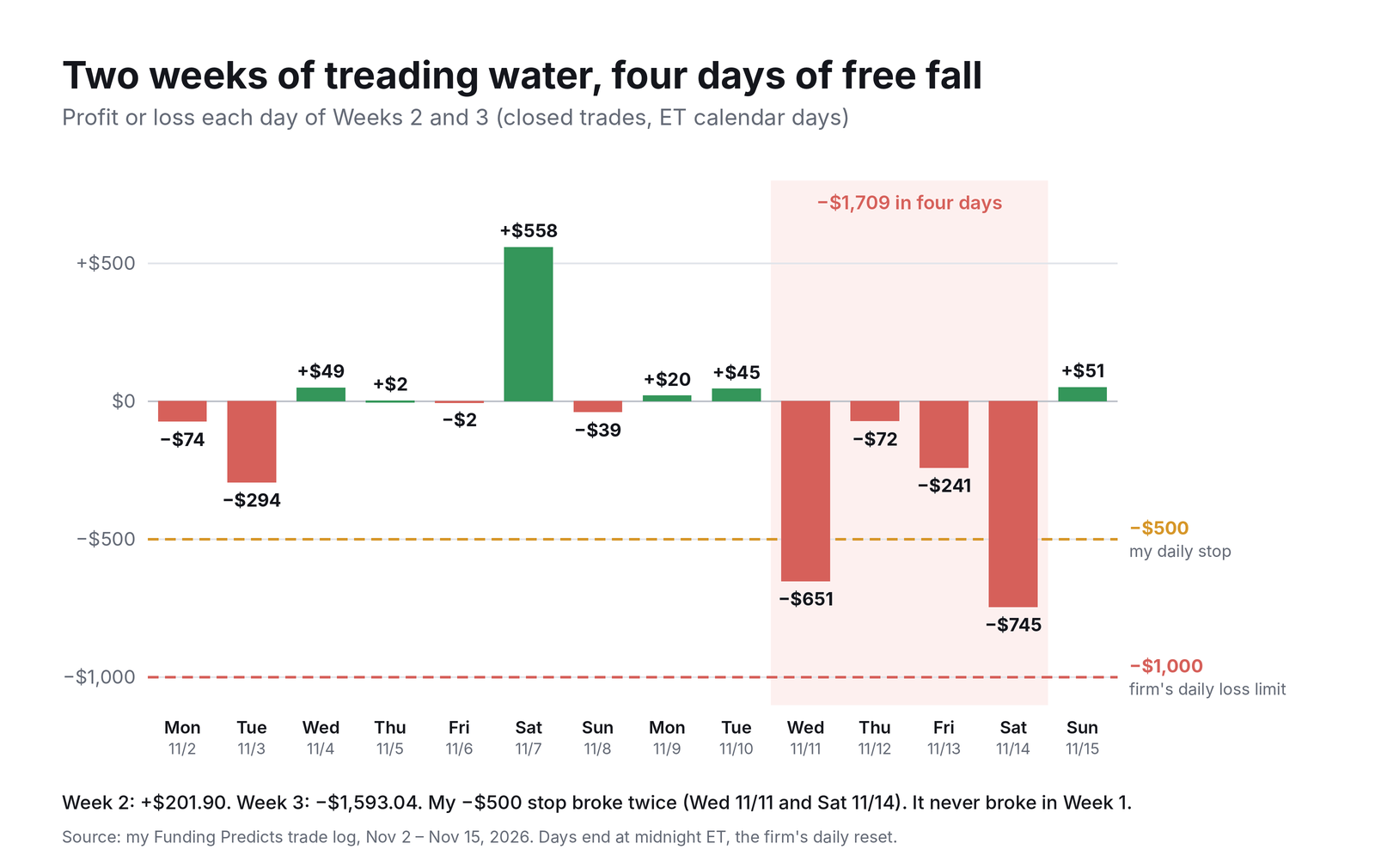
Four days, 5-12, -$1,709. Just typing that out makes me want to listen to Alice in Chains in a dark room and think about every mistake I've ever made.
Wednesday: one game, three bad tickets. Nets vs. Pelicans. I had Pelicans −2.5 at 54¢ (-$255.75) and Derik Queen over 5.5 rebounds at 60¢ (-$187.90). When it got ugly, I chased the Pels ML at 13¢ (-$26.09). Just absolutely horrendous reads here. I still can’t imagine losing by 30 at home to the Nets, but that’s something Zion and I need to take up with God and move on.. In Week 1 I literally wrote that two tickets on one team is one bet wearing two jerseys. On Wednesday I wore three, and paid for every one.
Saturday: nine tickets. My max is four. The daytime card was college (more on that below). The night card had its own lowlight, a Mavericks + Nuggets combo at 66¢ that I sold at 15¢ (-$192.37). Another bad read. Mavs buyers got great CLV that day when the Cavs rested their entire starting five (Mitchell, Harden, Mobley, Merrill and Allen all sat). I missed the move, paid the expensive ML price, and still got beat by the Cavs’ B-team.
Sunday: $148.18 from the end. For the first time since I started the challenge, Saturday closed below its starting point. $49,963.37. Just $176.58 above the lava floor. My UFC and late college tickets cashed overnight, then the Texans + Jaguars combo lost $150 (trading against the Deshaun revenge was silly, I suppose). That’s a $150 ticket with $148.18 of room. If the Bengals lose, so do I. They won, so I live to fight at least one more day.
Bad swings happen. My lack of discipline made this one a lot worse than it had to be.
My Weak Spot: College Sports
Here's the number that explains the slide: between college basketball and college football, I'm 3-9 for −$1,318.77.
My whole account is up $14.16. Take college out and I'm up $1,332.93.
I laid out the plan for Day 0. My rules covered sizing, price zones, a daily stop and a trade cap. Nowhere did I say college was a strength, because it isn't. College snuck in through the side door. I was lured in by the delicious aroma of Saturday football.
Some receipts and a winning trade I turned into a loss:
Illinois State +15.5 vs. Purdue at 53¢: −$215.59. (−$204.71 on the spread, −$10.88 on an 8¢ moneyline sprinkle).
Saturday's daytime card (11/14): three $250 tickets, −$593.41.
Ohio State -13.5 vs Northwestern. Sold at 23¢ (−$153.37). Up 8 late in the third, Ohio State got a stop and was set up for good field position, until the Northwestern punter accidentally drilled an Ohio State blocker in the back for a muffed punt. Watching this one live felt like the punter kicked me directly in the face. Tough loss, but selling early saved me about $100. Final: Ohio State 28-19
Wake Forest vs SMU Under 61.5. Wake was up 40-0 at the half, and after one more score in the third, I panic-sold at 16¢ (−$184.79). Let it ride and it’s a dub. Final: Wake Forest 49-7
Liberty −20.5 vs. Middle Tennessee (−$255.25). Never close. MTSU came to play, and I rode it all the way to zero because I didn’t like the price to sell. Any price would’ve beaten zero. Final: Liberty 28-23.
As much as I’d love to blame a bunch of 20-year-olds for losing me fake money in a simulated challenge, I can’t. The 20-year-olds didn’t break my rules on which markets I trade. I did.
Is college a weak spot, or just a spot I had no business being in?
What Still Worked (and the Leak I Didn't See Coming)
Not everything broke. Here's every market type since Week 1, best to worst:
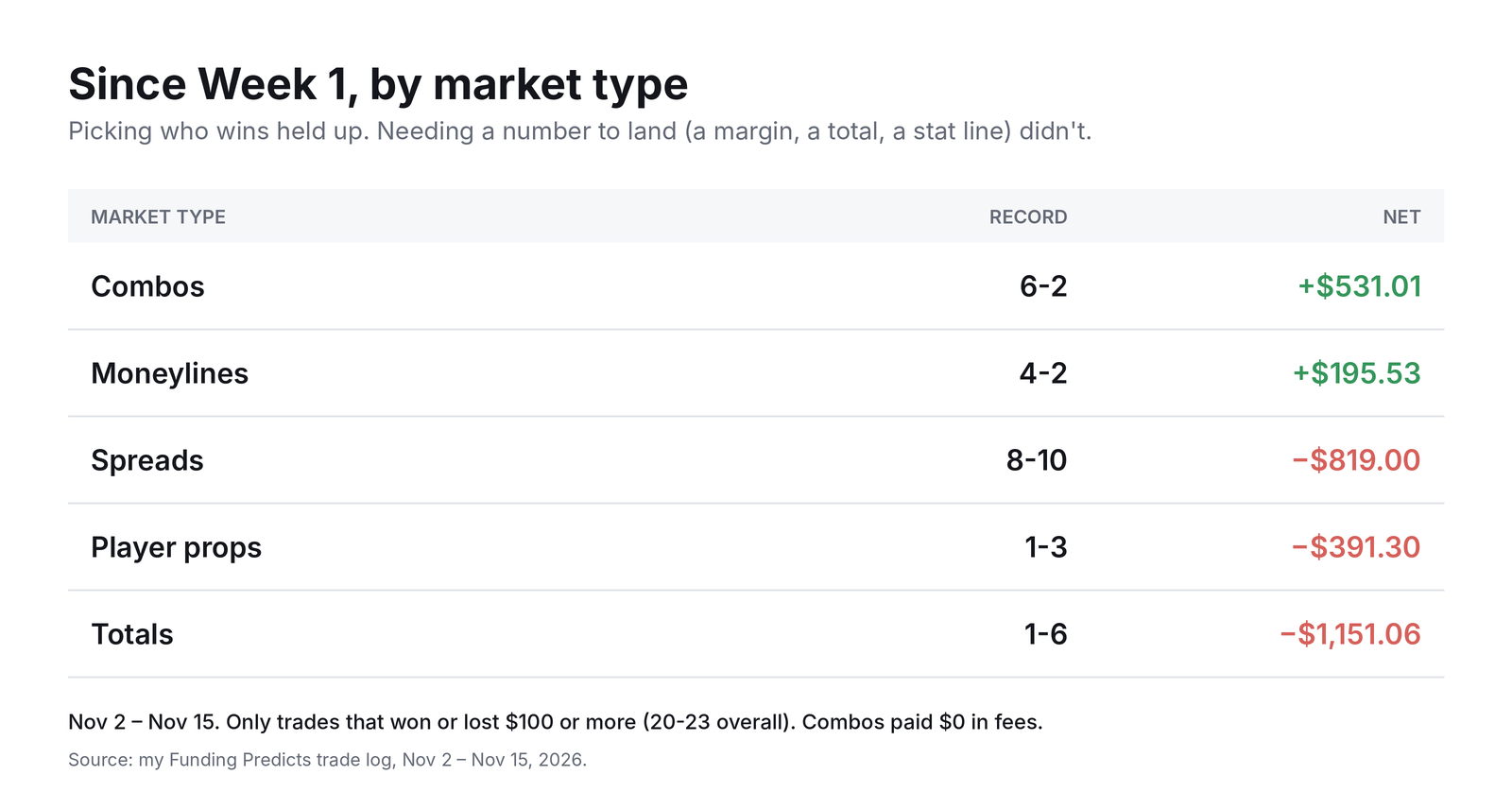
What worked. Combos went 6-2 for +$531.01, and every one of them cost me $0 in fees. Moneylines went 4-2. When I just picked who wins, I was fine. When I needed a number to land (a margin, a total, a stat line), I bled.
I’m not giving up on spreads, though. 8-10 isn’t a terrible record in the middle of a downswing, and a lot of that −$819 came from college. What stands out is that my winners aren’t paying enough: my average spread winner made $165.75, and my average loser cost $214.50. Two games under .500 shouldn’t cost $819 on $250 units. At those numbers, it does.
The leak I didn't see coming. Totals. In Week 1 my overs and unders went 2-0. Since then, I’m 1-6 for −$1,151.06. Player props weren't much better at 1-3.
One more thing that held: Week 2 sizing. When my room dropped under $1,500, I cut to $200 like I said I would. I could follow the rules when the account was green. Are totals a real leak, or just a 54¢ coin I kept flipping?
Rule Check: The Report Card I Didn't Want to Write
Same deal as Week 1: my rules are in writing, so here's the report card, straight from the trade log.
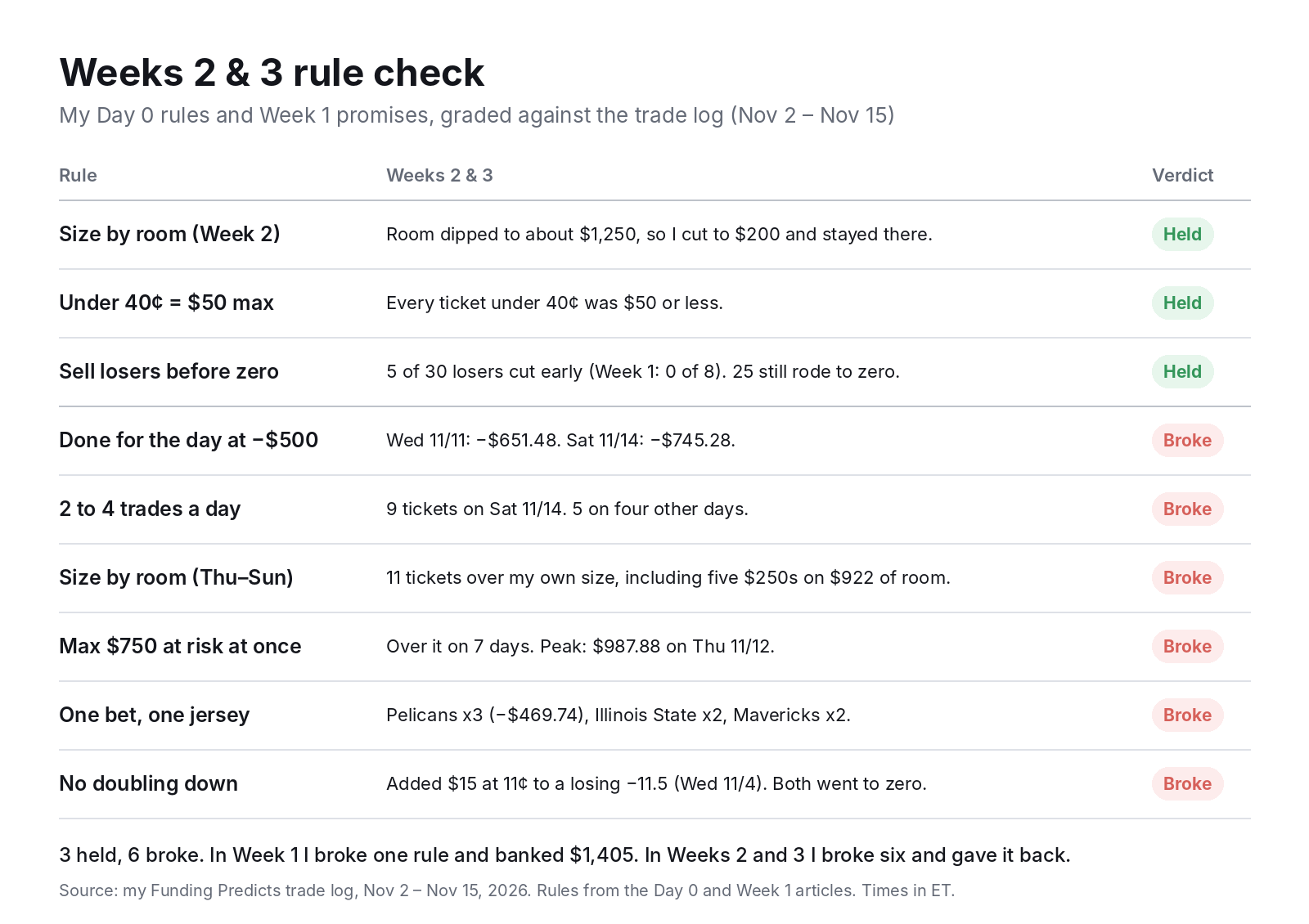
3 held, 6 broke. In Week 1 I broke one.
What held.
Fliers stayed fliers. Every ticket under 40¢ was $50 or less.
I sold losers before zero. Five of my 30 losers since Week 1 got cut early. In Week 1 it was zero of eight. (Still, 25 of 30 rode to zero. Progress, not a fix.)
Week 2 sizing. Room under $1,500, unit down to $200. Done.
What broke.
The −$500 daily stop. Twice: Wed 11/11 (-$651.48) and Sat 11/14 (-$745.28) In Week 1 it never triggered.
The four-trade cap. Nine tickets on Saturday. Five on four other days.
Size by room. Saturday I had $921.86 of room, so my own rule said $150 a ticket. I bet $250, five times. Thursday and Friday it said $200; four tickets went over. Sunday it said $100; I bet $150 twice, including the Bengals ticket.
The $750 open-risk cap. Went over it on seven days since Week 1. Peak: $987.88 on Thu 11/12, about $12 under the firm's $1,000 daily loss limit.
One bet, one jersey. Pelicans (three tickets), Illinois State (two), Mavericks (two).
No doubling down. On Wed 11/4 I added $15 at 11¢ to a −11.5 that was already losing. Both went to zero. Same habit as Week 1, same result.
Week 1, I broke one rule and banked $1,405. Weeks 2 and 3, I broke six and gave it all back. The account followed the rule count, not the record.
The Sim, Rerun: Why One Button Matters Most
On Nov 9, at $51,608, my sim gave me a 62% shot with a 2¢ edge. I reran the same 20,000 simulations from today: $50,014.16, $227.37 of room, 7 days left, and sizing by my own room rule, which now says $100 a ticket.
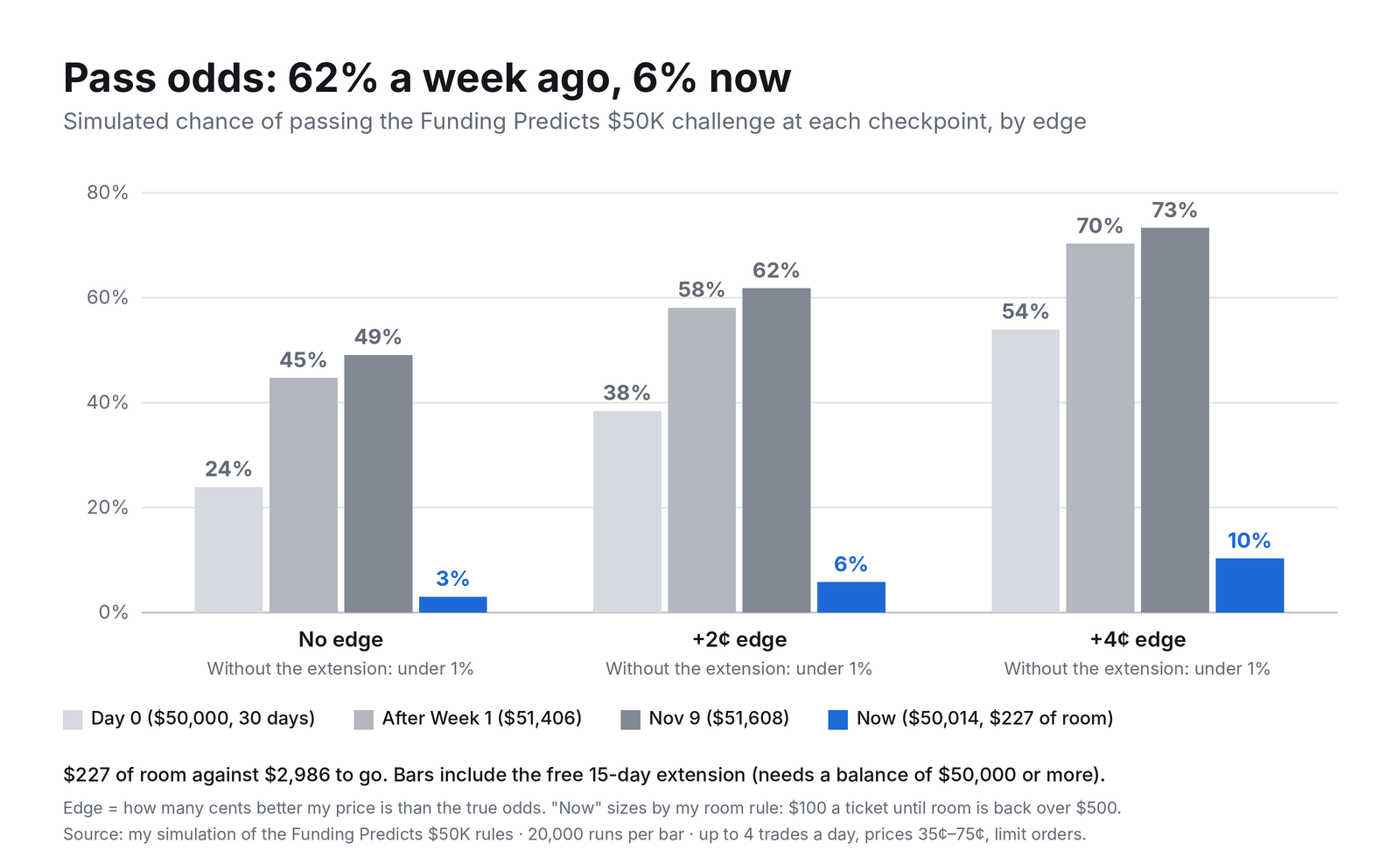
No edge | 3% | Under 1% |
+2¢ | 6% | Under 1% |
+4¢ | 10% | Under 1% |
From 62% to 6% in one week. Real men cry, right?
The math is brutal. $227 of room against $2,986 to go. At $100 a ticket, seven days isn't enough time to get there. With the extension, it's 22 days. That doesn't make me a favorite. It makes me possible.
And no, sizing back up doesn't save me. At a flat $250, the sim only gets to 4%–11%, and the account dies faster. One full-size loss from here and I'm through the floor.
The extension unlocks with 7 days left, but only at or above $50,000. I'm at $50,014.16. That's $14.16 between me and losing it. I'm claiming it before I place another trade.
The Final Stretch: The Swing Factors
The extension button. $14.16 above the line. Claim first, trade second.
The $100 unit. My room rule says $100 a ticket until I'm back over $500 of room, which means a balance of $50,286.79. One full-size loss ends this, so the rule isn't a suggestion anymore.
College: zero. Not smaller. Zero. If it isn't in my Day 0 plan, it isn't on my card.
One game, one ticket. Three tickets on the Pelicans cost me $469.74. One ticket per game, no exceptions, no late fliers on the same team.
$2,985.84 to go. With the extension, that's about $136 a day for 22 days. No hero bets. There's no room for them anyway.
Let us know in the Discord: do I claw back to $53K, or does the lava floor get me first?
Funding Predicts evaluation and funded accounts are simulated and priced from public Polymarket data. This series documents my own paid challenge and is not an endorsement of Funding Predicts. Pass rates mentioned above come from my own simulation of the challenge rules, not from Funding Predicts or PredictQ. My sizing, my math, what I'm hunting and my overall plan may not be profitable and are not meant to be a strategy guide for others. The purpose of this series is to document my own experience and journey with the challenge.
This article includes a link to PredictQ partner Polymarket. We may earn a commission if you use it. It doesn't cost you anything extra, and it helps keep the lights on here. Nothing in this piece is investment advice, and prices, odds, and entry counts can change.