
I’ve been spending every week in the Culture Radar and Market Movers tracking the boards and reporting changes in the markets. Let's call a spade a spade here though: I’ve been hiding in the shadows and stalking small movements like I’m Gollum from Lord of the Rings. “My precious”… I’d seethe when yet another Rookie of the Year favorite slides 10% after a bad game.
This is the week I stop watching and start playing for funding. Funding Predicts is the first prop firm built around Polymarket and I will be undertaking their $50k evaluation challenge. The deal is simple: if I hit $3,000 in profit within 30 days without breaking their risk rules, I get a funded account. I break one rule, the account (and by extension, myself) is cooked. No appeals, no do-overs, just a receipt and a “GG”.
This series will be the whole run documented. Day 0, what you’re reading now, is the gameplan. I will go over the rules, what traders who actually win on Polymarket do, the math, how I’ll be sizing, what I’m hunting and how I could blow this.
Going forward, I will recap the scoreboard every week: the dubs, the ugly prints and both green and red weeks.
The Challenge: $3K to Make, $2K to Lose, and a 35% Leash
Here's the $50K Standard account, straight from the Funding Predicts FAQ:
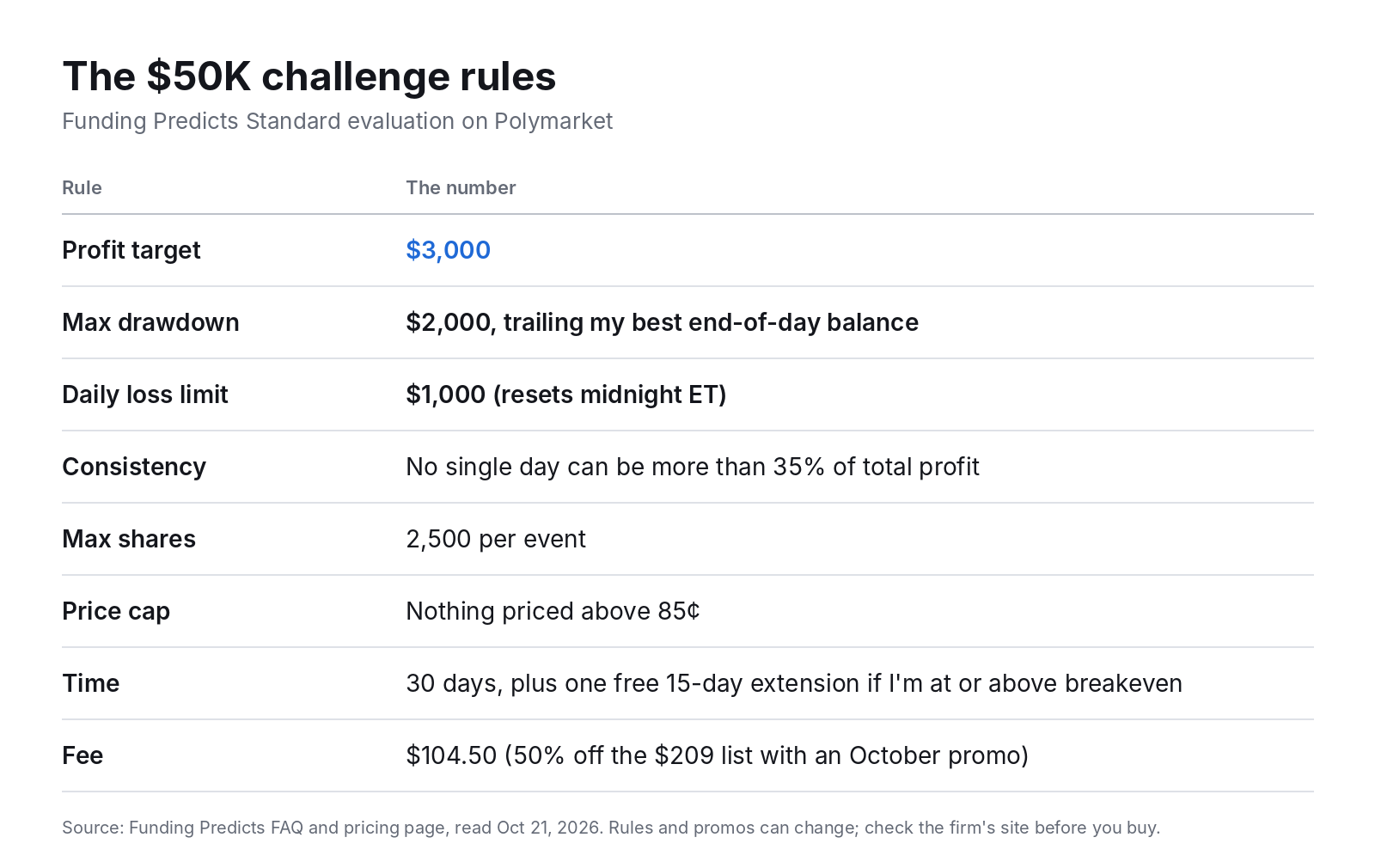
So, a $50K account where I can only lose $2K. The 50 burger is more of a nothing burger in this sense, as my real bankroll is the drawdown of $2,000. And because the drawdown trails, every green EOD close raises the lava floor under me until I close a day at $52k. Which means I could still blow up the account with a breakeven balance of $50k. Basically, this is not going to be easy.
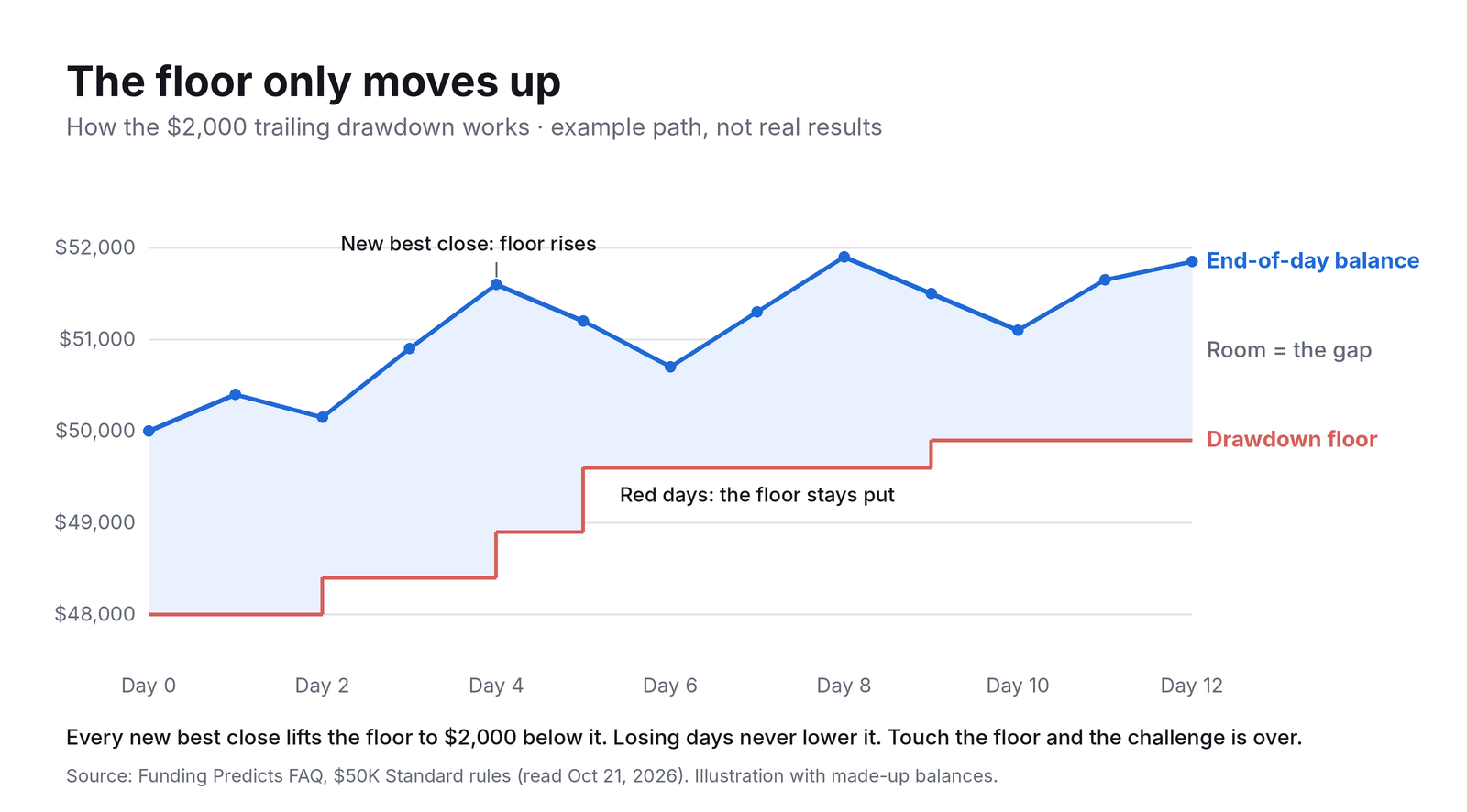
Two rules jump out to me immediately: The 35% consistency rule means I can't (unfortunately) ride one heater into the sunset. A $1,500 Sunday forces me to clear $4,286 instead of $3,000 before the account passes and I have no plans on making this more difficult than it has to be. The other one is the 85¢ price cap. No clipping pennies and buying the huge favorites, that door is shut.
So the real question isn’t whether I can turn a $3,000 profit, it’s whether I can do so in the allotted timeframe with the given rules. Let’s develop a plan.
What the Profitable Traders Do
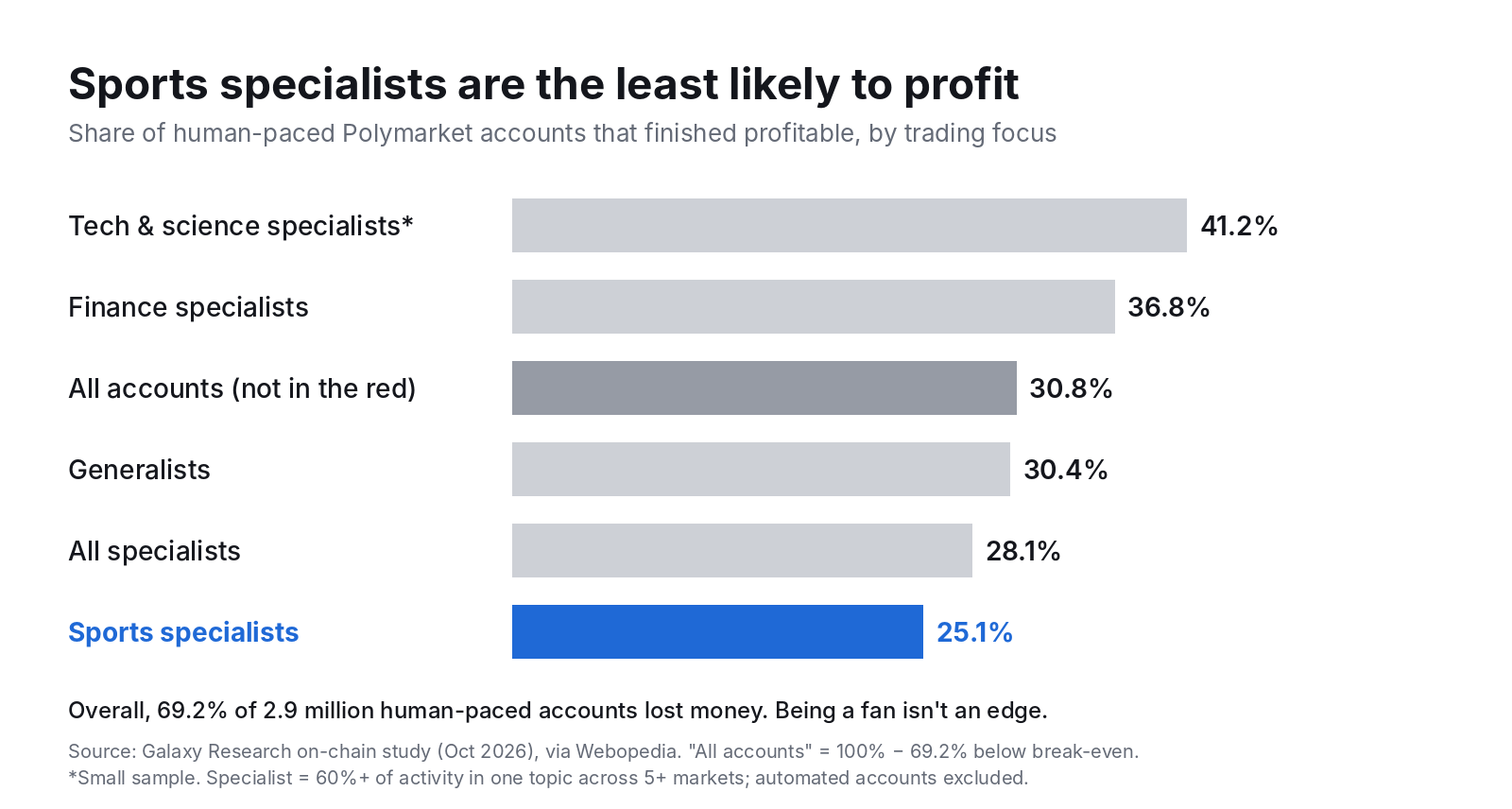
Let’s start with the ugly. Galaxy Research looked at about 2.9 million human-paced Polymarket accounts and found a depressing 69% that finished in the red. The line that stung though was the sports specialists. They were the least profitable group, with only 1 in 4 in the green. Yikes. Simply being a fan is not an edge.
So what do the few winners have in common? From my standpoint, one of three things:
Their own information. Théo, the 2024 election whale, reportedly paid for his own “neighbor” polls before making a fortune on the results. His edge was simply data that nobody else had. I am hoping my version of this will be my trackers and the tools and sharp minds we have here at PredictQ.
Trading the swings, not just the result. Domer, one of the top Polymarket traders by volume and a former poker pro, described playing the 2023 Speaker chaos on Manifold by backing the backup candidates: names that could be bought around 20% and sold near 50%. He didn't need to be right necessarily, just early. He identified names that could gain some steam and sold high on movement. I will be looking at a similar strategy with NFL award markets.
Being the maker. In a study of 300,000+ Kalshi contracts, traders who took posted prices lost around 32% on average, versus about 10% for the traders who posted them. Limit orders aren't a nice-to-have, they are a must have if I am looking to beat this challenge.
The Math: There Are No Hero Bets in This Plan
Before I risked a single cent of the firm’s fake money, I ran the challenge 20,000 times per scenario through a simulation of the same rules: the trailing drawdown, the daily limit, the 35% consistency rule, the 30 days, etc.
“Edge” here is how much better my price is than the true chance of the event actually happening. Buying at 50¢ something that truly wins 52% of the time is a +2¢ edge.
I used $900 as the example size for the “hero bet” since the 35% consistency rule means no single day can be more than $1,050 for a $3,000 pass. I wanted to see if speedrunning the challenge with one big bet a day was a viable strategy.
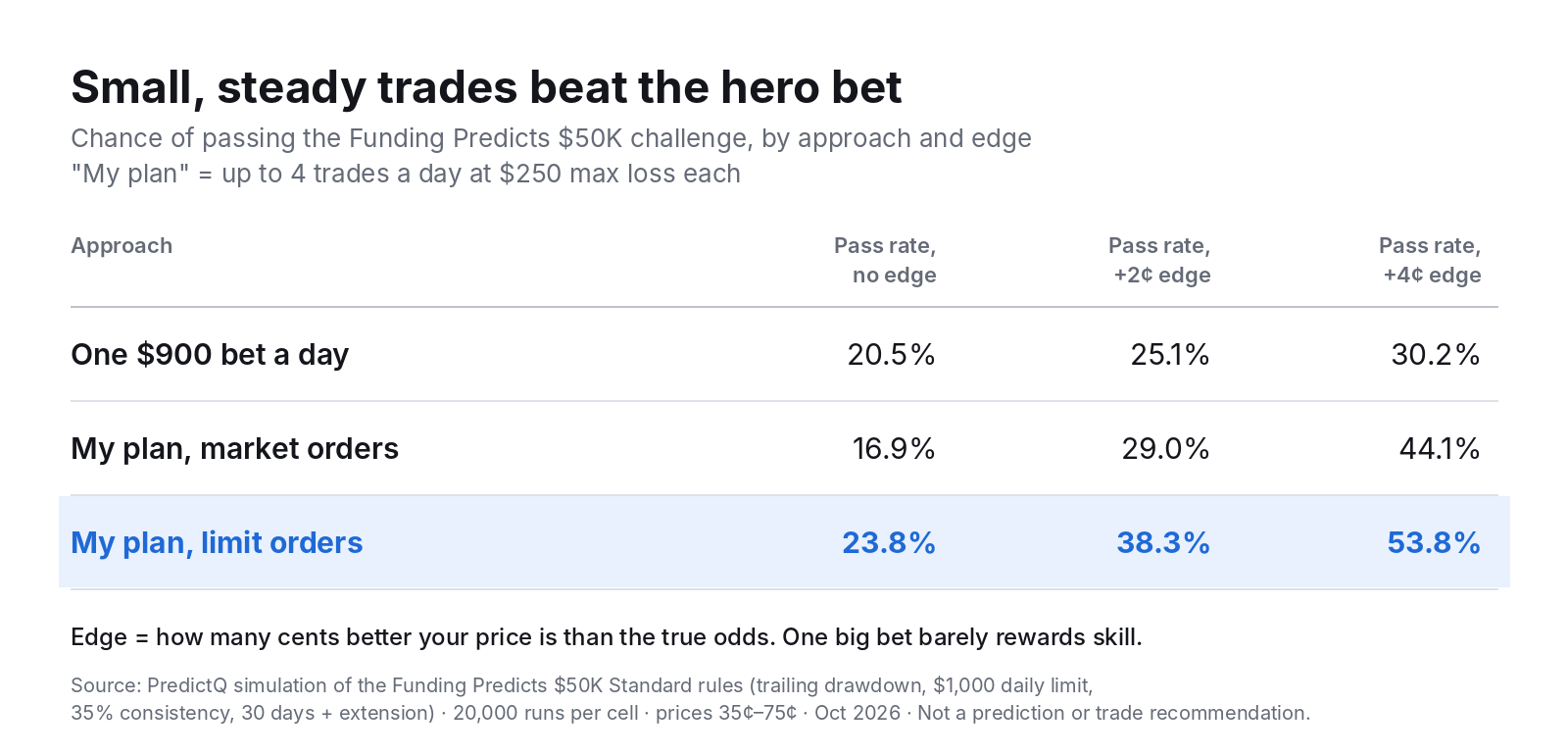
Three things jump off that table.
Hero betting isn’t worth it. The swings are just too violent. Two losses in a row and I am staring at the floor. Even if I get blessed enough to find a repeatable +4¢ edge my pass rate only moves from about 20% to 30%.
Edge is the whole game. Every extra cent of edge adds roughly 6 to 8 points to the pass rate on my plan. Sizing doesn't create an edge; it just stops me from wasting any I find.
Market orders are a tax I can't afford. Same plan, same picks, and paying the taker fee costs about 9 points of pass rate at a 2¢ edge. On a 50¢ contract, the fee plus crossing the spread can eat the whole edge. So no market orders. I will post the price I want to enter at and let the market come to me. An order not filled is not a loss, if the price runs away from me that just means I skipped out on a trade that I no longer had an edge in.
And yes, even the best line on that table fails more often than it passes at +2¢. That's the honest number, we’ll see if I can chase it.
My Plan: Unit Sizing
I will be using units of $250 of max loss per trade. It’s 1/8th of the drawdown and a quarter of the daily limit, so it takes eight straight losers (or four in one day) to kill the account.
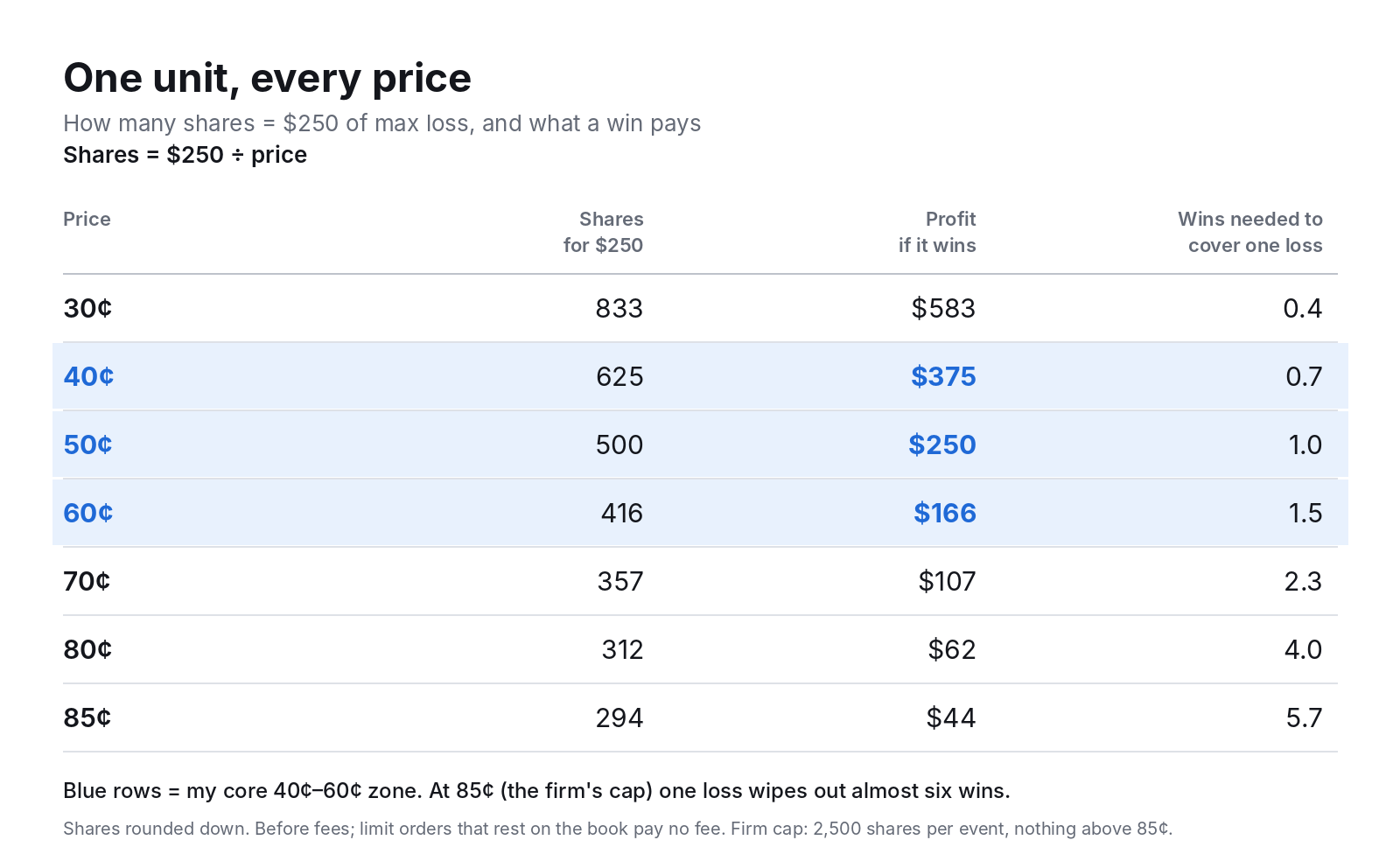
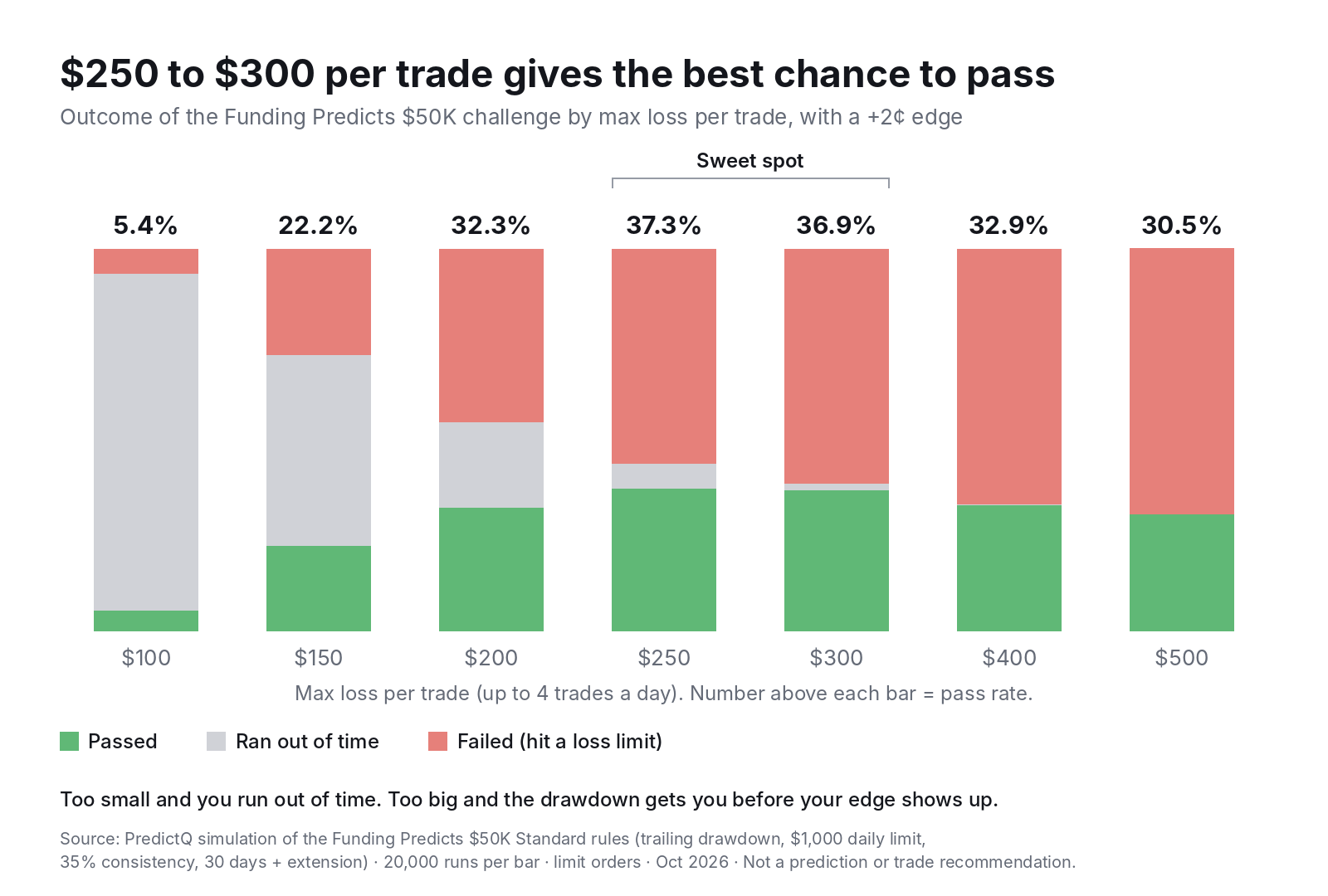
The sim showed that $250-300 a trade was the sweet spot, I originally considered $100 units but that would leave me at risk of timing out on the 30-day limit.
My daily rules on top of the sizing:
2 to 4 trades a day, max. That’s a ceiling, not a quota. If I do not like the board, or don’t believe I have an edge, the day will be skipped.
Never more than $750 at risk at once. I will not fail this challenge due to hitting the daily loss limit of $1k. Any and all open positions count toward the daily limit, I’m not going to fall victim to four 1pm kickoffs going sideways all together.
My personal floor is -$500. Two full losers and I log off for the day. Catch me on the couch watching Dexter.
No new trades after +$900. That will keep any big days under the 35% consistency line, maintaining my profit goal.
Size by room, not the account. If I start slow or drift to the floor, my unit sizing will shrink. No doubling down to get it all back.
Ironically I think the hardest rule for me to follow will be the profit cap. Am I going to be able to walk away if I go on a heater on a Sunday afternoon?
My Plan: No Favorite Farming
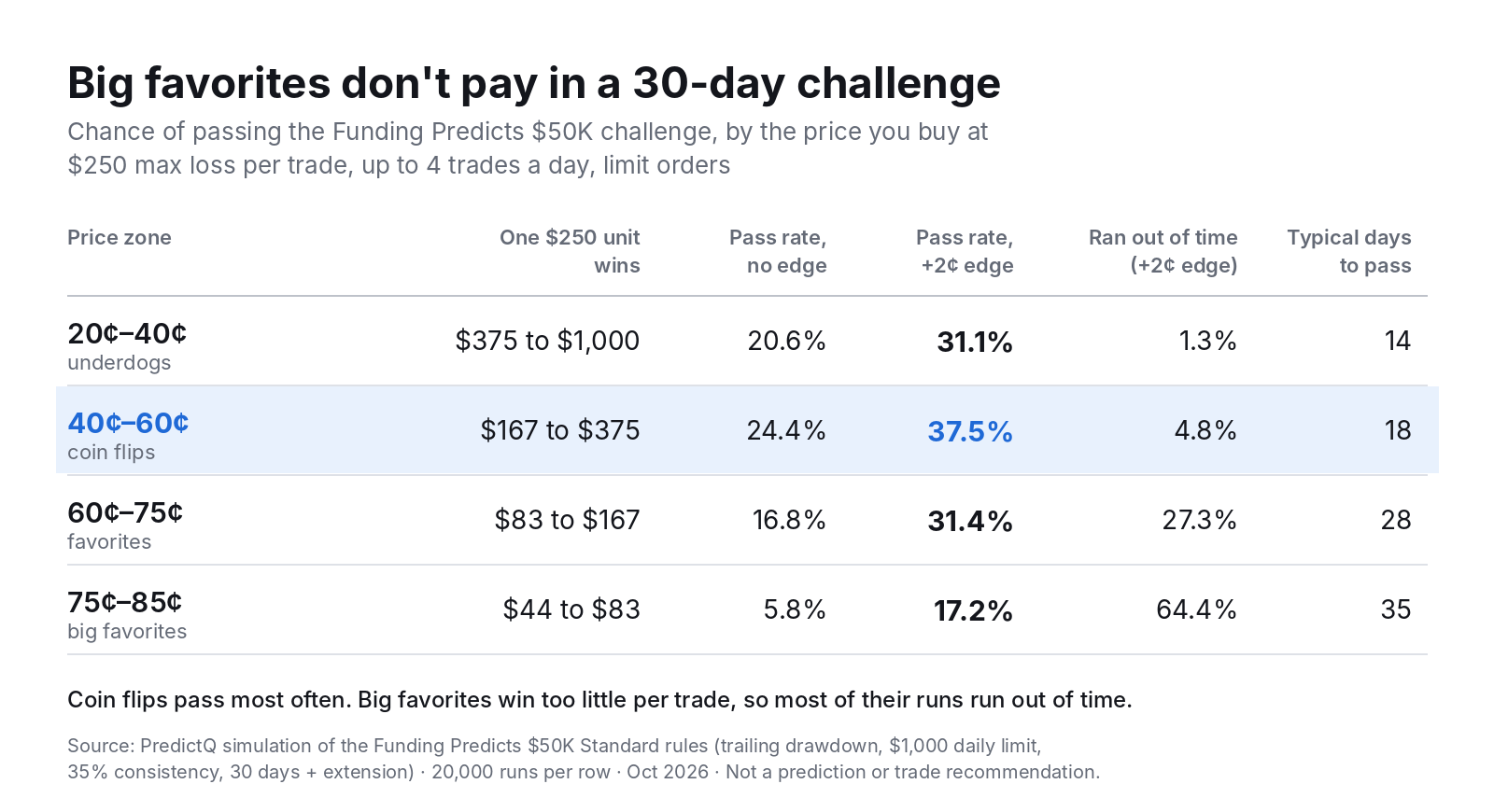
My home base will be in the 40¢ to 60¢ range. Yup, coin flips. I know it sounds scary but to stay within the challenge rules (85¢ cap and 30-day time limit), it’s what the sims are showing as most profitable.
The big-favorite strategy may look and feel safe on paper, but I think it might be a trap here. Even if I stay inside the 85¢ cap, a 75¢–85¢ favorite only pays $44 to $83 on a $250 unit. I would need 40+ winners to hit the $3k, and in the sim, 64% are running out of time before they get there.
A study of 300,000+ Kalshi contracts found that cheap contracts win far less often than their price implies, while pricey ones win slightly more and earn small, positive returns. So why not load up on favorites? Two reasons, mainly. The clearest example the authors give of that favorite edge is a 95¢ contract, and Funding Predicts won't let me buy anything above 85¢. And a small edge on a small payout is slow money in a challenge with a 30-day clock. One exception here is, if I believe I have a genuine edge in a 65-75¢ contract, I can take it but will likely size up to $500 on those trades. And since my personal daily stop is -$500, I will have to only be in one position at a time, if that exception arises.
Where the research and my plan for the challenge agree is on the other end of the board: longshots are tough to catch. I will mostly avoid anything under 40¢, if I happen to find a spot that I feel comfortable entering, it will be sized down in that range.
My Plan: The Markets I’m Hunting
I am going to stay in the realms I know, use data that I trust, and not force anything on days I don’t find an edge. Apologies in advance to MACtion, but I will not be trading Bowling Green vs Kent State on a random Tuesday night. It’s just not my lane, no matter how much I wish it was.
NFL is my home field. I track the award markets every week, getting familiar with how these boards move is becoming second nature to me. Of course, none of these will resolve within the 30-day window but I can trade them as swings: buy before the move I expect and sell when it does. I will naturally trade the games themselves too, but I will likely only be getting into a position early in the week to chase some solid closing line value.
NBA will be my mid-week filler. I want to wait until we get at least a week worth of data on the new season before diving in, but the scuba gear is ready.
Midterms (Nov 3) and other political markets get half size, max. The attention is massive, but the books aren't. One watchdog analysis found the top 1% of Polymarket wallets drive about two-thirds of the volume on congressional markets. With PredictQ’s latest addition of Grayson Nichols, who just wrote a great article on the Iowa Senate race, I will likely utilize his expertise on any political trades.
Macro data is more mid-week filler. The Fed decision (Oct 28), the October jobs report (Nov 6) and CPI (Nov 10) all land inside my window. My day-trading background helps here, but the expected Fed outcome will likely sit above the 85¢ cap, so only the other buckets are even eligible.
What I'm skipping: 5- and 15-minute crypto markets (bot territory, highest fee rate) and sports I don't follow closely. The World Series (Oct 23–31) is liquid, but liquid isn't the same as edge.
How I Could Blow This
Every trader has leaks. Here are mine, in writing, so you can hold me to them.
No stop-loss on a binary. In stocks, I can cut a loser in seconds. A contract I hold to the result has no stop: a 60¢ position can go to near zero on one play. So before every entry I write down what kind of trade this is: a hold to the final whistle, or a sell at a specific number.
Sunday tilt. Lose the 1 PM window, and the 4:25 games start looking like a way to get it back. That's exactly what the −$500 daily stop is for. Two losers and the laptop closes (hopefully still in one piece).
Fan brain. Galaxy's numbers say sports specialists are the least profitable group on the platform. If I can't explain my edge without the words "I just think," then it's not an edge.
Forcing the calendar. I don’t want the 30-day clock on my mind and I don’t want to feel like I have to force a midweek trade to turn profit.
The Scoreboard
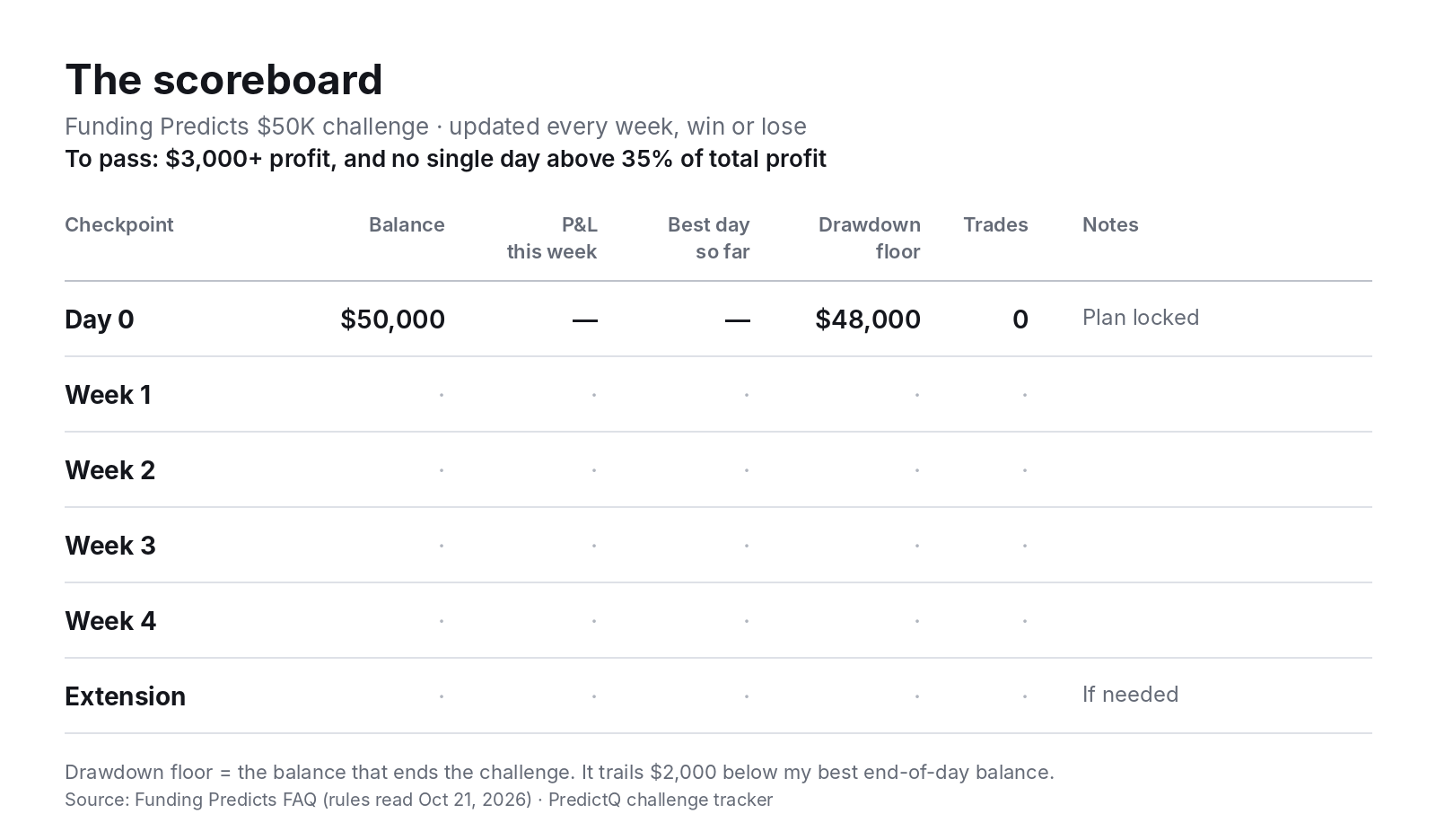
Every week I'll update this, win or lose.
Week 1: The Swing Factors
World Series Games. The most liquid (and fun) sports market of the week, and unfortunately not my lane. The first test of this challenge might be staying out of it.
The Sunday slate (Oct 25). First real stress test of the $750 open-risk cap. If three of my positions kick off at 1 PM, the daily limit sees them as one bet.
Fed day (Wed, Oct 28, 2 PM ET). Which outcomes are even under the 85¢ cap? If the answer is "only the longshots," I pass and go back to football.
The first green day over $900. The plan says stop. My gut will say keep pressing. We'll see who wins.
Let us know in the Discord whether you think I pass, and which rule you think gets me first!
Funding Predicts evaluation and funded accounts are simulated and priced from public Polymarket data. This series documents my own paid challenge and is not an endorsement of Funding Predicts. Pass rates mentioned above come from my own simulation of the challenge rules, not from Funding Predicts or PredictQ. My sizing, my math, what I’m hunting and my overall plan may not be profitable and is not meant to be a strategy guide for others. The purpose of this series is meant to document my own experience and journey with the challenge.