
CNN's headline two weeks ago called this "the first prediction-market election," and the volume keeps piling up. Kalshi's House control market shows $87.5 million traded and its Senate control market $52.1 million as of Oct. 7. A Rotowire piece on Oct. 6, citing Aldrin Research, counted $1.31 billion in election-based trades on Kalshi since the start of the year across 1,322 markets.
This is part one of a five-part series. Each edition tracks the same board of markets and explains what moved since the last one. We'll add or drop a market or two as the trading warrants, and if there's a race you want on the board, tell us at @PredictQmkt. The edition before election day will be a settlement guide, since these contracts resolve on different rules and on different dates, and there is an election-morning edition on Nov. 3. The series will close with the Scoreboard a week after election day, grading the board against the results. Between editions, every market on the board is live on PredictQ, so you can watch the moves before we write them up.
Every price here is Kalshi's price at 9:30 a.m. ET on Oct. 8, with the Oct. 1 close alongside for the week's change. Prices may change.
The Big Board
Control of Congress is the most heavily traded question on the board. The majority in each chamber decides which bills get a floor vote and who runs the committees, and the Senate majority decides whether the president's judges and cabinet picks get confirmed. Republicans hold both chambers today, so what the markets are pricing is a change of control.
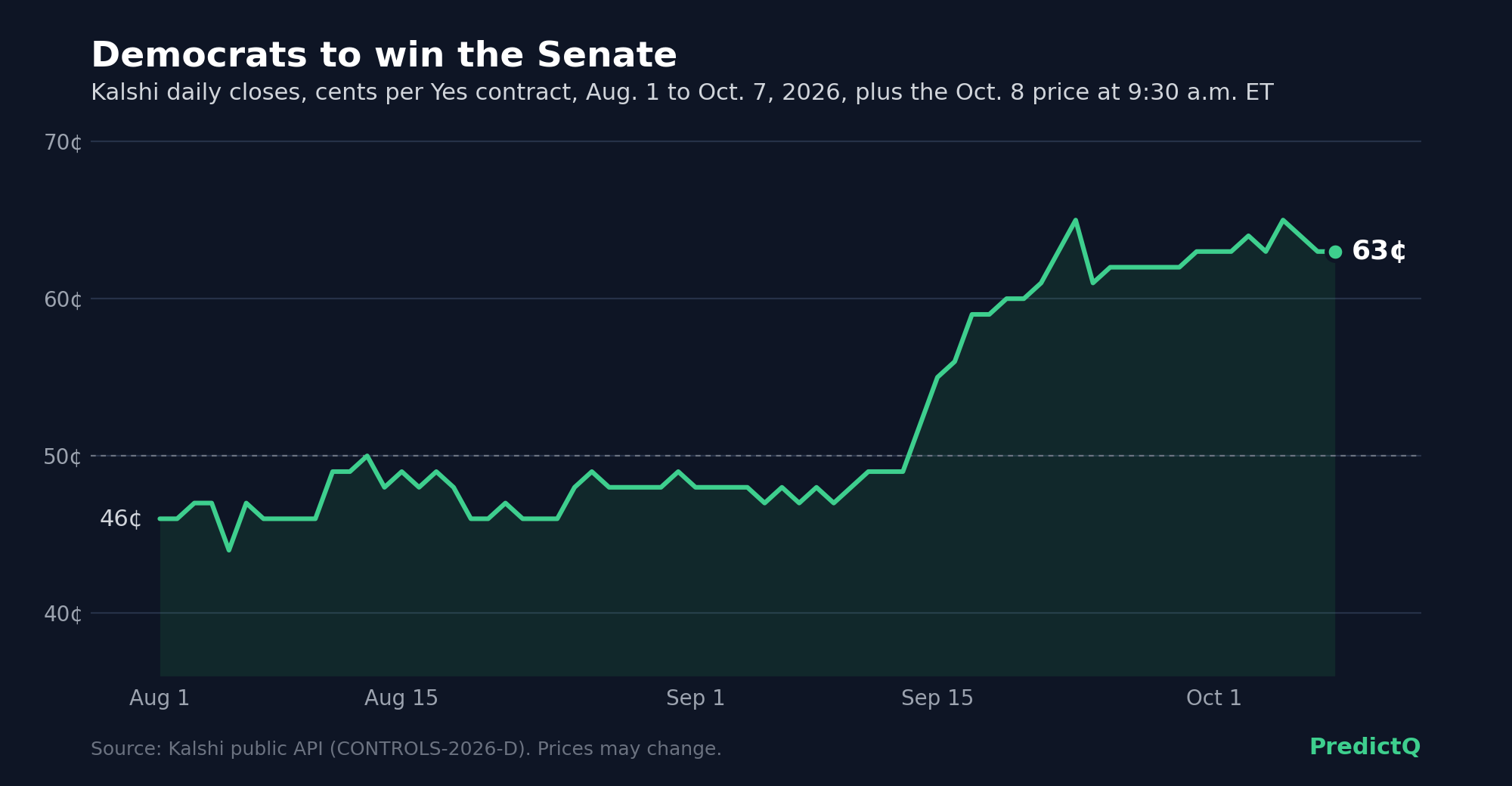
Democrats are 63 cents to win the Senate and 90 cents to win the House. The balance-of-power market prices each House and Senate combination as its own contract.
Senate control, Democrats | 63¢ | 63¢ | 0 |
House control, Democrats | 90¢ | 92¢ | -2 |
Democrats sweep both chambers | 62¢ | 62¢ | 0 |
Democratic House, Republican Senate | 28¢ | 29¢ | -1 |
Republicans sweep both chambers | 10¢ | 8¢ | +2 |
Republican House, Democratic Senate | 1¢ | 1¢ | 0 |
The Senate price is flat on the week at 63 after closing as high as 65 on Oct. 5. The House price gave back two cents on the week, to 90, and the Republican sweep picked up two. The difference in settlement rules could come into play in a close count. Kalshi's control contracts can be settled early on a consensus of media calls projecting control; otherwise the Senate contract settles on the party of the President pro tempore on Feb. 1, 2027, and the House contract on the party of the Speaker that day.
How many seats is a 90-cent House worth
With House control at 90, the House question with room left in it is the size of the majority. Kalshi's Democratic seat-count market prices brackets of four seats and settles on the chamber's composition on Feb. 1, 2027.
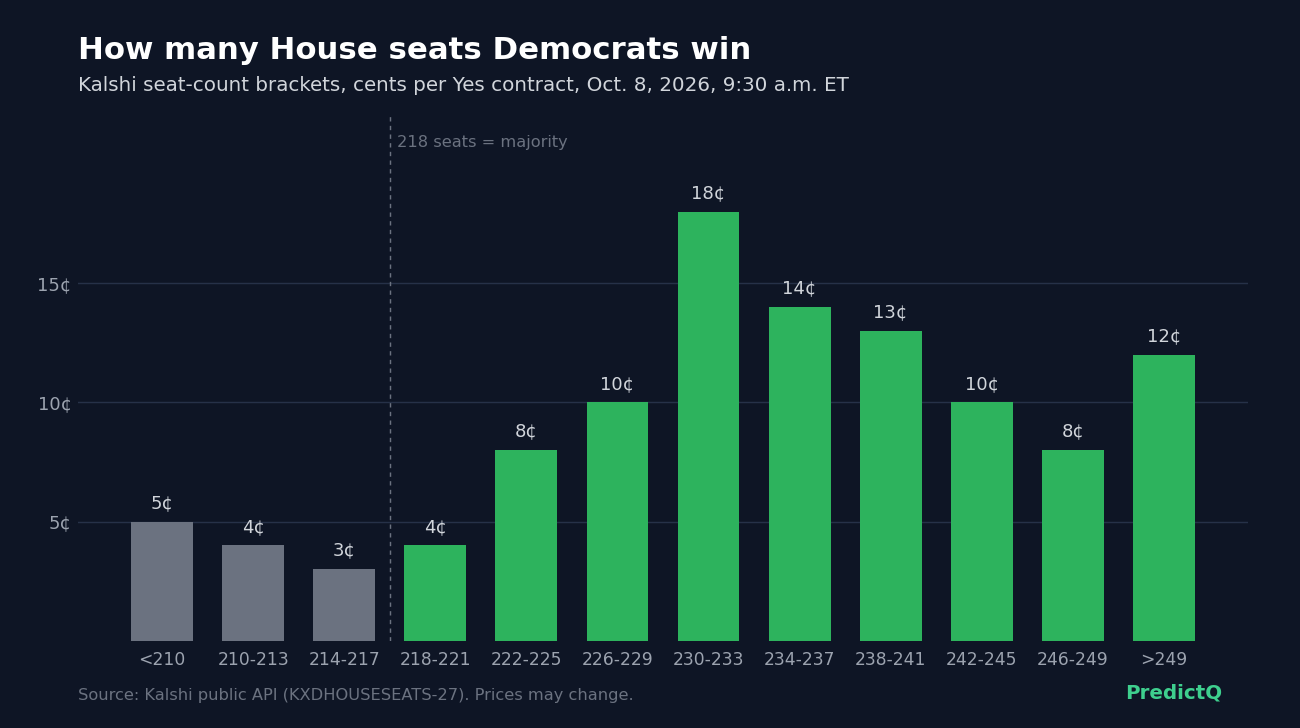
The 230-233 bracket is the most expensive at 18 cents. The three brackets under 218, where Democrats would fall short of a majority, add up to about 12 cents. The full set of brackets costs about 109 cents, so those three are roughly 11 percent of the total, in line with the 10-cent Republican side of the control market. That's a sum of prices, not a measured probability, and the brackets don't have to add to a dollar.
Everything is bigger in Texas, including the Senate market
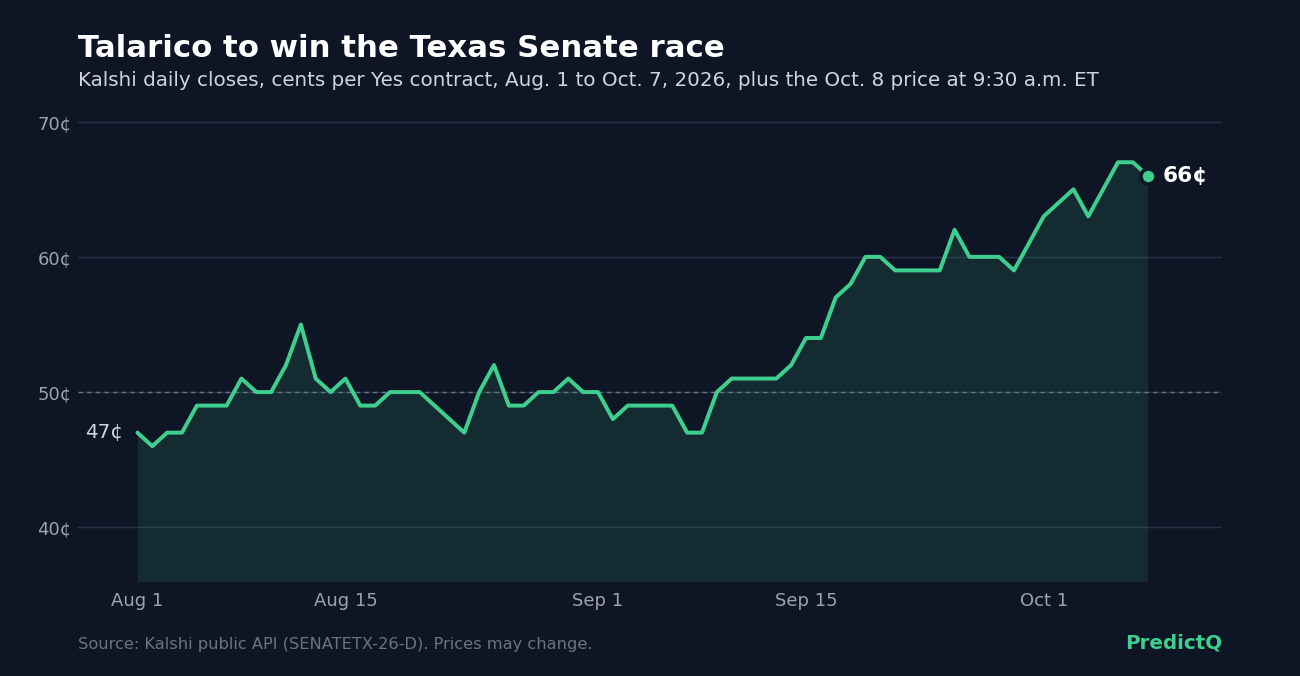
The name to know on this board is James Talarico, the Texas Democrat who is 66 cents to beat Ken Paxton, up three cents on the week, in a market with $20.3 million traded, more than Maine and Ohio combined. Democrats need a net gain of four seats for a majority, since the vice president breaks ties for Republicans, and Texas is one of the seats that gets them there. Cook Political Report rates Texas, Maine, Ohio, Iowa, Alaska, Michigan and Kansas as toss-ups. Kalshi favors the Democrat in eight of the ten races below, and four of those eight, Maine, Ohio, Alaska and Texas, are seats Republicans hold today.
Texas | James Talarico (D) vs. Ken Paxton (R) | 66¢ | 63¢ | +3 | $20.3M |
Maine | Troy Jackson (D) vs. Susan Collins (R) | 57¢ | 58¢ | -1 | $11.6M |
Ohio, special | Sherrod Brown (D) vs. Jon Husted (R) | 64¢ | 61¢ | +3 | $6.1M |
Michigan | Abdul El-Sayed (D) vs. Mike Rogers (R) | 70¢ | 72¢ | -2 | $7.9M |
Iowa | Josh Turek (D) vs. Ashley Hinson (R) | 45¢ | 42¢ | +3 | $4.7M |
Alaska | Mary Peltola (D) vs. Dan Sullivan (R) | 75¢ | 68¢ | +7 | $2.6M |
Kansas | Adam Hamilton (D) vs. Roger Marshall (R) | 37¢ | 30¢ | +7 | $3.0M |
New Hampshire | Chris Pappas (D) vs. John E. Sununu (R) | 90¢ | 87¢ | +3 | $1.9M |
North Carolina | Roy Cooper (D) vs. Michael Whatley (R) | 97¢ | 94¢ | +3 | $2.8M |
Georgia | Jon Ossoff (D) vs. Mike Collins (R) | 96¢ | 95¢ | +1 | $1.7M |
Talarico is 66 cents after the market sat at 50-50 on Sept. 5 and 60 on Sept. 28, by Kalshi's own posts, closed Oct. 1 at 63 and closed at 67 on both Oct. 6 and Oct. 7. Two polls released in the past week have him ahead, NYT/Siena by 51-45 and Fox News by 51-49.
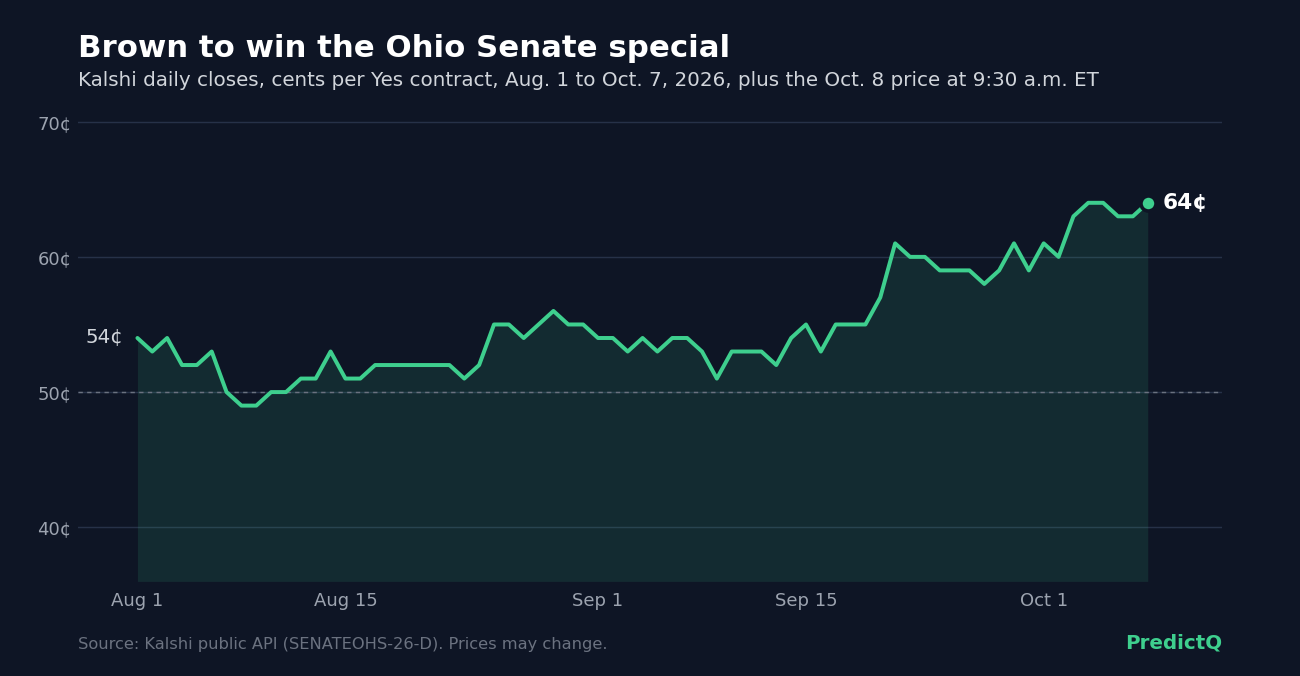
Ohio has moved the most over the past month. Kalshi noted on Sept. 30 that Brown had climbed nearly ten points since Sept. 9, to 61. He's 64 now. Maine is the closest race at 57, and the polls don't agree with each other. Marist has Jackson up 51-47, CBS/YouGov and Trafalgar have it tied, and co/efficient has Collins ahead 48-46. Iowa and Kansas are the two toss-ups where the Republican is favored. Turek is 45 in Iowa, and the past week's polls split on the leader.
Alaska and Kansas each moved seven cents on the week toward the Democrat, the biggest Senate moves on the board. Kansas gets a deeper look next week. Cook moved it to Toss Up on Oct. 6, NYT/Siena has it 45-45, and the Senate Leadership Fund committed $14 million there this week. Marshall is 63.
Thirty-six governors, four worth watching
Thirty-six states elect a governor this year, and Kalshi prices them by party. We're tracking the ones with a live question or a 2028 angle. Texas and Florida sit in the 70s for the Republican.
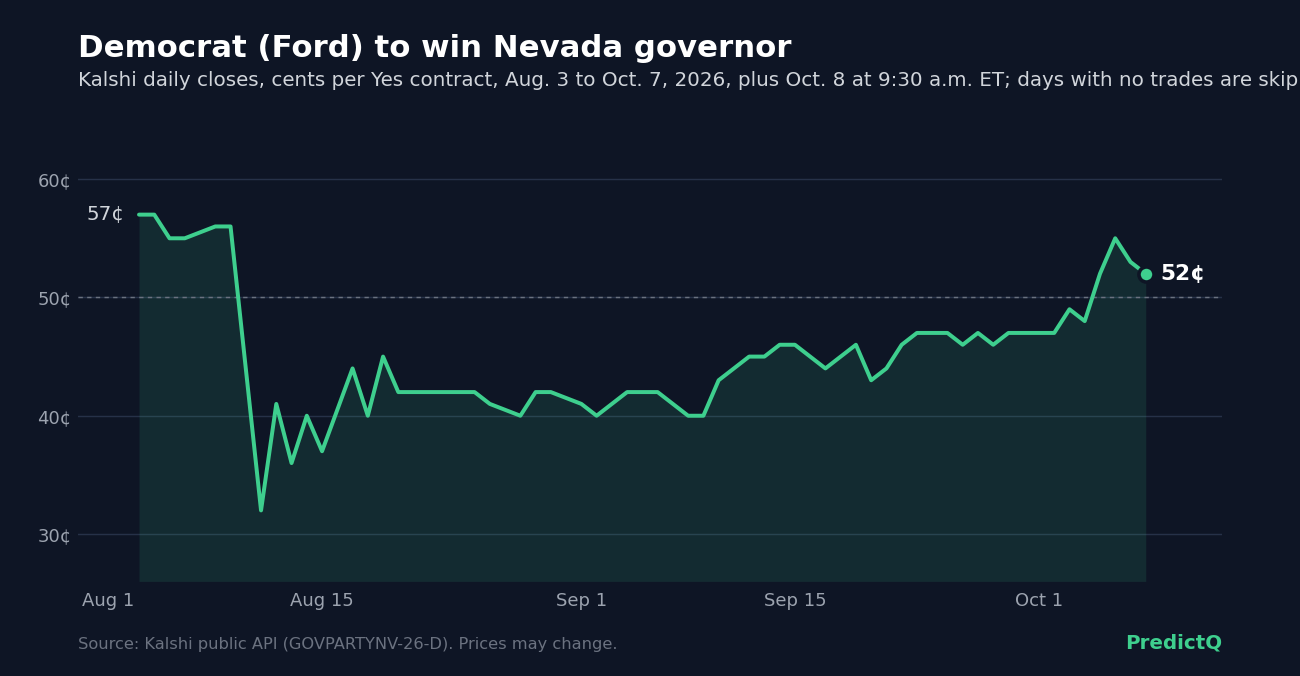
Nevada has Ford at 52, up five cents on the week from 47, after closing at 55 on Oct. 6. Georgia leans Republican, with Bottoms at 46 after a two-cent slip. Ohio has Acton at 70 against Ramaswamy, up eight cents on the week, the biggest move of any governor's race on the board. Pennsylvania is here for a different reason. Shapiro is 97 cents to win and 4.7 cents in the 2028 Democratic nominee market, so we'll watch his margin with that second market in mind.
Four weeks to the Senate, two years to the White House
Kalshi's 2028 Democratic nominee market has $233 million in volume, more than its House and Senate control markets combined. Ossoff leads at 17 cents, Ocasio-Cortez and Newsom are 13, Harris is 8.
Democratic nominee | Jon Ossoff | 17¢ |
Democratic nominee | Alexandria Ocasio-Cortez | 13¢ |
Democratic nominee | Gavin Newsom | 13¢ |
Democratic nominee | James Talarico | 2.5¢ |
Republican nominee | JD Vance | 44¢ |
Republican nominee | Marco Rubio | 17¢ |
Two names on this board are on a Senate ballot in four weeks. Ossoff leads the Democratic nominee market and is 96 cents to hold his Georgia seat. Talarico is 2.5 cents for the nomination while sitting at 66 to win Texas. The first week of data cuts against the idea that one pulls the other: his Senate price rose three cents, and his nominee price slipped from 3.9 to 2.5.
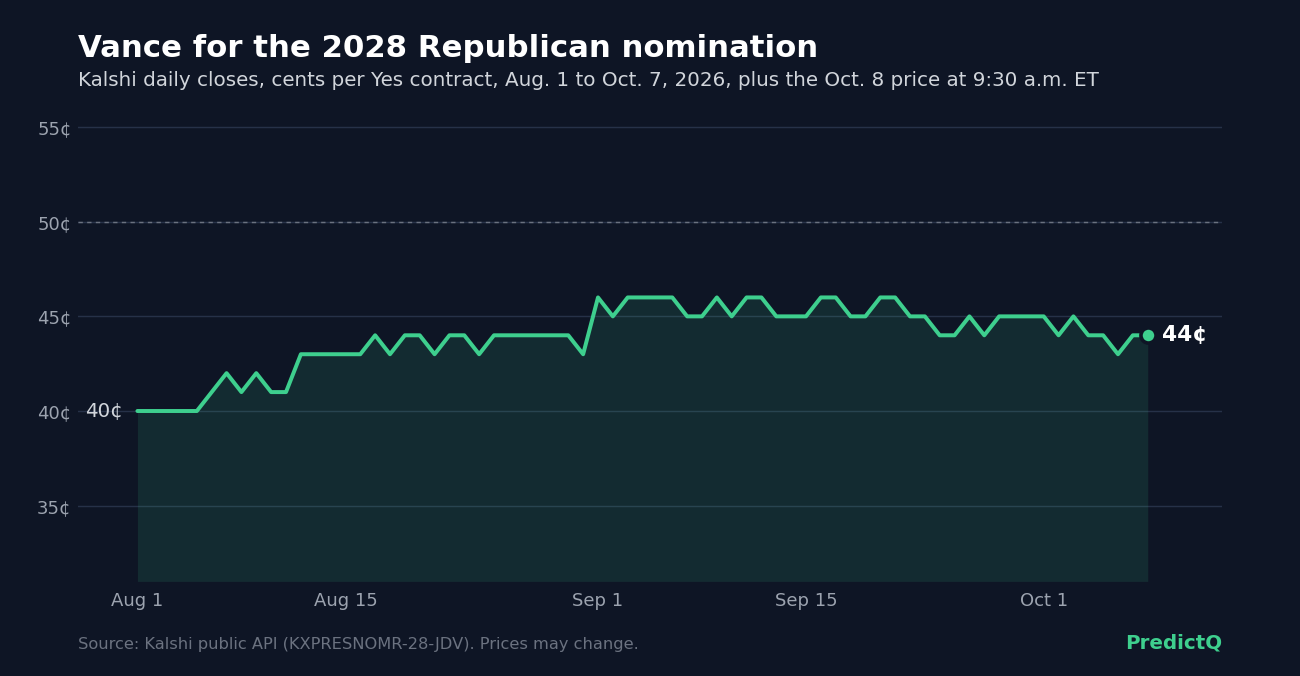
On the Republican side, Vance is 44 cents for the nomination, down a cent on the week and off the 46 he closed at in early September. Rubio is second at 17.
What moves the prices
Polls. NYT/Siena released five Senate polls on Oct. 3 (Talarico 51-45 in Texas, Brown 49-46 in Ohio, Hinson 48-47 in Iowa, Peltola 50-43 in Alaska, 45-45 in Kansas); Fox News polled Texas (Talarico 51-49), Iowa (Turek 49-47) and Michigan (El-Sayed 50-49); Marist released Maine (Jackson 51-47) on Oct. 6. The generic ballot sits at Democrats +7.8 in RealClearPolling's average and +8.9 in Nate Silver's.
Debates. Iowa debated Oct. 7 and goes again Oct. 13. Michigan and Georgia debate Oct. 8, Maine has three more on Oct. 8, 13 and 15, and Alaska debates Oct. 15. Texas has none. Talarico accepted three proposed dates, Paxton has not confirmed any, and Talarico does a CNN town hall Oct. 14.
Ad money. AdImpact counted $994.4 million in congressional ads in September, $596.8 million Republican and $397.6 million Democratic, with about $1.1 billion reserved through November. Texas swung hardest. Republican spending there rose $134.8 million month over month and turned a $27.1 million Democratic edge in August into a $61.3 million Republican one. Per Punchbowl News on Oct. 5, the Senate Leadership Fund is putting $14 million into Kansas and adding money in Maine, Iowa, Ohio, Alaska and Michigan, and it pulled out of North Carolina, which Punchbowl called "an admission that the race there is trending away from the GOP." Reporters treat these moves as a window into private polling, and Kansas is the one to watch. SLF's money arrives the same week Cook moved the race to Toss Up, and NYT/Siena had it tied.
Who's showing up where. Trump's schedule had San Antonio on Oct. 7, and has Youngstown Oct. 12 with Husted, Michigan for Rogers around mid-month, and Alaska later in October with Vance and Sullivan. Obama is set for a Detroit rally Oct. 24 with El-Sayed. The pattern is Ohio, which gets the president twice in ten days plus Vance in between, in a race where the Democrat is 64 cents. We haven't seen reporting that ties any of these stops to internal polling, so read the schedule as where each side is spending its scarcest asset and nothing more.
Early voting. Ohio opened in-person early voting Oct. 6. Georgia starts Oct. 13, Iowa Oct. 14, North Carolina Oct. 15, Texas and Alaska Oct. 19, and Michigan Oct. 24. No results come out before election night, but in states that report returned ballots by party registration, those counts are the first hard numbers on turnout, and we'll watch whether the prices react to them.
If the polls miss again, which way
Nate Silver's Oct. 1 post has the polls unbiased in 2008, 2010, 2018 and 2022, overrating Republicans in 2012, overrating Democrats in 2014, 2016, 2020 and 2024, and overrating Republicans by a lot in the 2025 New Jersey and Virginia races. By Silver Bulletin's numbers, the polls' average bias toward Democrats was 3.0 points in 2016, 4.7 in 2020 and 2.9 in 2024, while 2025 carried a 6.1-point bias toward Republicans. The generic ballot's record is better than the presidential polls'. RealClearPolling's final average was D+7.3 in 2018 against a D+8.4 result and R+2.5 in 2022 against R+2.8. Today it sits at D+7.8.
Can you predict this year's error from the past ones? G. Elliott Morris ran the regression and found the relationship indistinguishable from zero; subtracting the 2014-2020 bias from 2022's Senate polls would have made every one of eight key races worse. If you think 2016 through 2020 is the template, take three to five points off every Democratic polling lead: Maine's four-point Marist lead shrinks to a tie or worse, Iowa's two-point Fox lead flips, and Kansas's tie becomes a Republican lead. If you think 2025 is the template, the polls are underselling Democrats and the 63-cent Senate price is below where that scenario lands.
The markets' own box score
Markets had the presidential call right in 2020 and 2024, wrong in 2016, and the 2025 governors right by wide margins. The midterm record is the one that applies here, and it includes a miss. On Nov. 1, 2022, PredictIt had Republicans at 73 cents to take the Senate and 90 cents to take the House. Republicans won the House 222-213 and Democrats kept the Senate 51-49. Kalshi's own calibration paper, published in August, covers 2.2 million markets since 2021 and reports accuracy rising from 88 percent three months out to 97 percent at close. An independent arXiv paper on 353 million trades found political prices sit closer to 50 than they should. That's a pattern measured across many markets, not a verdict on any one contract on this board, and the 2022 miss is the reminder that a 73-cent price still leaves 27 cents of room for the other outcome.
When these contracts pay out
The settlement dates are the thing to know before holding anything through a close count. Kalshi's House and Senate control contracts expire Feb. 1, 2027, and settle on media consensus, with the President pro tempore's party as the fallback for the Senate and the Speaker's party for the House. The seat-count brackets settle on the chamber's composition the same day. The individual Senate race contracts resolve on who is sworn in for the term beginning in 2027, carry an expected expiration of Jan. 4, 2027, and can also be determined early on a consensus of media projections. The settlement guide on Oct. 27 walks through what each of those means for a position held through a recount.
Next week's board adds a "last week" column from today's closes, a movers list with the best explanation we can source, and a consistency check that adds up the state markets against the control market.
This article includes links to PredictQ partners Kalshi and Polymarket. We may earn a commission if you use our partner links. It doesn't cost you anything extra, and it helps keep the lights on here. Nothing in this piece is investment advice or a trade recommendation. Prices, odds, and entry counts can change. Availability depends on the platform, product, and your location; check each platform's age and eligibility requirements before trading.