
There's something uniquely humbling about putting your predictions in writing before an election. Once the votes are counted, there's no hiding from the scoreboard.
In poker, I constantly preach process over results to my students. A good decision can produce a bad outcome, and a bad decision can produce a good one. Prediction markets are no different. The question goes beyond whether we picked the winner. Did our reasoning justify the price we paid?
With the midterms behind us, it's time to check the receipts, revisit our reasoning, and see what we got right, what we got wrong, and what we can learn from both.
Texas: Riding Talarico's Coattails
Our first approach was to look beyond the highest-profile Democratic race in Texas, where James Talarico's Senate campaign was generating considerable attention. Could that enthusiasm carry over to lesser-known Democrats further down the ballot?
We identified six statewide races available on Kalshi (explore markets on PredictQ) and went through them one by one, comparing each Democrat's market price with their standing in the polls. We weren't simply looking for candidates who could win. We wanted candidates whose polling suggested a more competitive race than their market price implied.
Two stood out: Attorney General candidate Nathan Johnson at 28 cents and Comptroller candidate Sarah Eckhardt at 16 cents. Both were within striking distance in the polling while offering underdog prices. Johnson also had another factor working in his favor. He was competing for the office being vacated by Ken Paxton, whose controversies and unpopularity gave us another reason to question whether the market was accounting for the political environment.
The process paid off. Both Johnson and Eckhardt pulled off their upsets, rewarding anyone who recognized the potential value in their underdog prices. While Talarico's coattails were our starting point, the opportunities didn't end with Texas. What other overlooked candidates might benefit from a nationwide Democratic wave?
The Blue Wave: Beyond One Candidate's Coattails
Our next opportunity kept us in Texas, but with a broader thesis. Gina Hinojosa, trading at 39 cents in the governor's race, offered a combination of Talarico's momentum and a potential nationwide Democratic wave, with strong Hispanic early polling numbers adding to our conviction.
In Indiana's 5th District, JD Ford was trading at just 19 cents. Traditionally safe Republican territory, the district caught my attention after hearing concerns about incumbent Victoria Spartz's campaign operation. Was the market taking its Republican history for granted? On election night, with roughly half the votes counted and Ford trading near 90 cents, I decided to lock in the profit. My sale executed at 87 cents, still a substantial return.
Finally, Annie Andrews at 30 cents offered a reverse-coattail opportunity in South Carolina. Following Lindsey Graham's death, his sister Darline was appointed to his Senate seat, but questions about her experience suggested that a famous political name wasn't necessarily an advantage.
Our Best Call Wasn't About Picking a Winner
Our favorite opportunity this election cycle had almost nothing to do with predicting a winner. Instead, it came from anticipating how other traders might react once the votes were counted. That brought us to Jon Ossoff and the 2028 presidential market.
Our thesis wasn't that Ossoff would become president, or even that he'd run. It was that a convincing Senate victory could create exactly the kind of attention prediction markets tend to reward. Ossoff's reputation as a compelling speaker, combined with a strong social media operation, made a viral victory speech a realistic possibility.
There was another layer to our thinking. Once election-night positions settled and traders collected their winnings, where might that money go next? With the midterms behind us, we suspected attention would quickly shift toward 2028, with Ossoff suddenly featuring prominently in that conversation.
We entered around 11–12 cents with a specific plan: buy before the election, let the anticipated attention drive the price higher, and sell into that excitement before the headlines faded.
That's exactly how it played out. Ossoff's price climbed as high as 23 cents, exceeding even our expectations. Following the original plan, I sold half my position into the rally, locking in a profit while keeping the remaining half in play.
The real edge wasn't predicting Ossoff's political future. It was anticipating how the market would react to his success before that reaction was reflected in the price.
When the Process Didn't Pay Off
Of course, not every thesis survived election night.
In Texas, we identified Ken Paxton at 33 cents against James Talarico. We knew he was an underdog, but Texas hadn't elected a Democratic senator since 1988, suggesting its Republican history might offer more value than the market implied. Ultimately, that history wasn't enough.
Iowa was another miss. Ashley Hinson traded around 59 cents despite competitive polling and a Republican voter-registration advantage of roughly 180,000 at the time of our analysis. But the lower Republican turnout and Democratic-leaning independents we anticipated elsewhere worked against us here, helping Josh Turek prevail.
Finally, David Jolly at 22 cents was another potential beneficiary of the Democratic wave. Florida remained Republican, although Jolly lost by just over a point in a state Trump carried by roughly 13 points in 2024. We correctly anticipated a political shift but overestimated its magnitude.
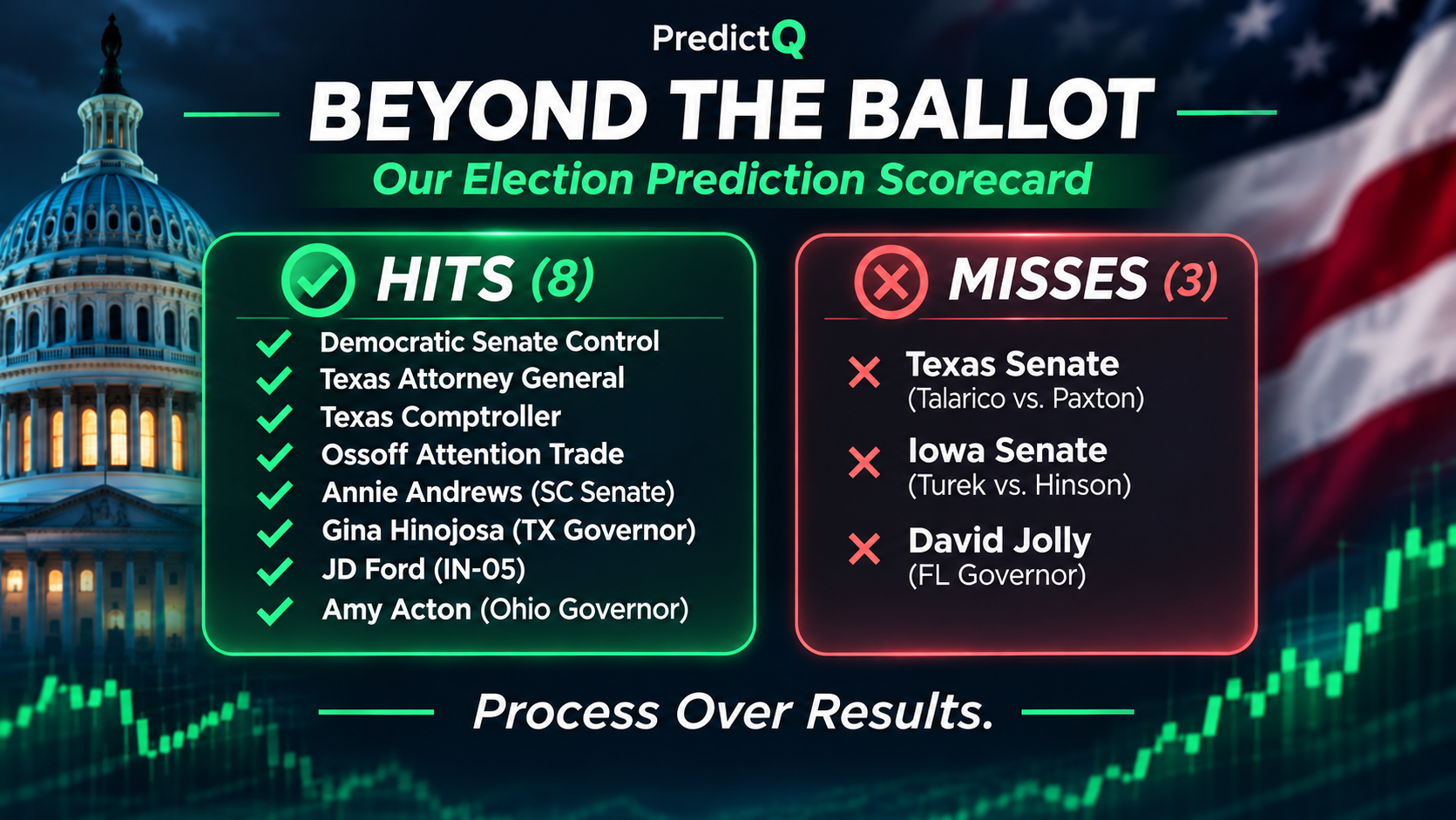
The Final Scorecard: Process Over Results
Our election-night scorecard stands at eight wins, three losses, and one position still open. Some of our successes came from identifying overlooked underdogs; our favorite came from anticipating the market's reaction to Ossoff's victory.
That one open position is Marco Rubio for the 2028 Republican nomination at 18 cents. We anticipated that a difficult Republican midterm could generate negative headlines for frontrunner JD Vance and redirect attention toward Rubio. So far, that expected shift hasn't clearly materialized, despite recent speculation that Rubio could step down from his Cabinet position to pursue a presidential run.
The goal isn't to be right every time. It's to consistently find opportunities where our reasoning gives us an advantage over the market's price.
With the midterms behind us, we'll be watching markets surrounding potential Cabinet departures, congressional investigations, impeachment developments, and the evolving 2028 presidential field. New headlines will create new opportunities, but only if we can distinguish genuine mispricing from the market's usual noise.
Finding a reason to trade is easy. Finding a reason the market is wrong is much harder.
This article includes a link to PredictQ and discusses our partner Kalshi. We may earn a commission if you use our partner links. It doesn't cost you anything extra, and it helps keep the lights on here. Nothing in this piece is investment advice, and prices, odds, and entry counts can change.