
A week ago this morning, Kalshi had Democrats at 76 cents to win the Senate and the Democrats-above-52-seats bracket at 55. We wrote that the market was no longer pricing a Democratic Senate as a coin flip that lands on 51 but as a sweep with a thin tail of near-misses, and that the question for the night was whether a quarter was too much or too little to pay for a Republican polling error that had shown up in three straight presidential years and not in the last two midterms.
It was too much, by a lot. Democrats won the Senate with 54 seats and lead the two races still open, flipped every Republican-held seat on our board, and are at 254 House seats with NBC's model projecting 259. The story of the night was the long shots: a 35-cent contract on the Texas governor's race, a 39-cent contract in South Carolina, and a 16-cent contract in Mississippi all paid, or are about to. The last of the series grades the board, contract by contract, then looks at the upsets, the weighting question we raised about the final Times/Siena polls, and how long each venue took to pay.
Every result is the Associated Press count as reported by NBC News on the morning of Nov. 11, with Alaska at 84% counted and Mississippi at 98%. Every price is Kalshi's price on the morning of Nov. 3 unless it says otherwise.
The Board, Graded
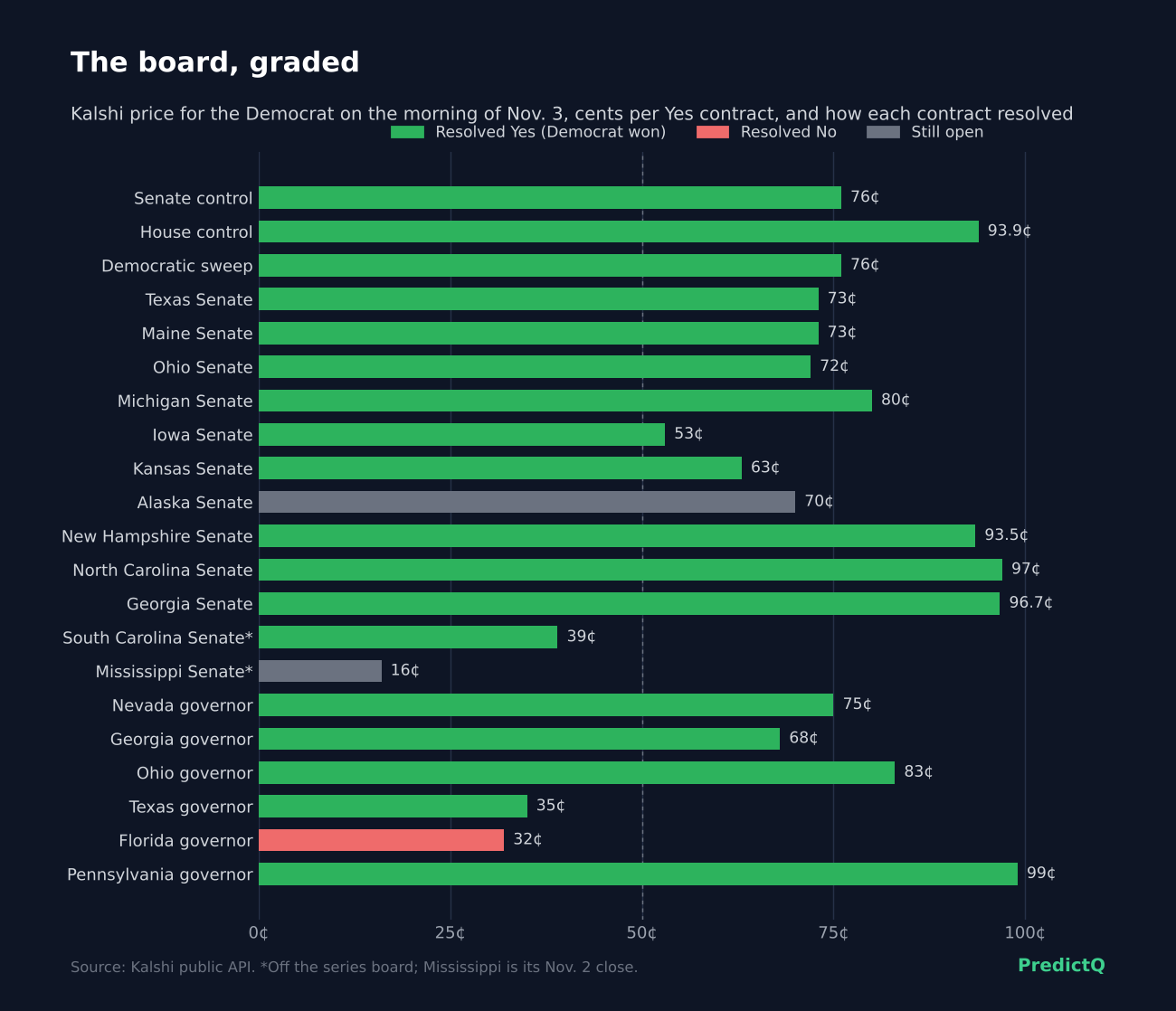
Of the 21 contracts in the chart, 19 have settled, 18 of them for the Democrat. The one Republican win, the Florida governor's race, was the cheapest Democratic contract on the series board at 32 cents, so the market had that one right too. Alaska and Mississippi are still open, and the Democrat leads both.
Senate control, Democrats | 76¢ | Yes | 54 seats, two open |
House control, Democrats | 93.9¢ | Yes | 254 seats called, NBC estimates 259 |
Democrats sweep both chambers | 76¢ | Yes | |
Democratic House, Republican Senate | 20¢ | No | |
Republicans sweep both chambers | 6.5¢ | No | |
Democrats above 52 Senate seats | 55¢ | Open, priced 98 | 54 and counting |
Democrats above 249 House seats | 27¢ | Open, priced 98 | 254 and counting |
The two seat-count brackets haven't settled because Kalshi settles them on the chamber's composition on Feb. 1, 2027. Both trade at 98 cents.
Texas | James Talarico (D) vs. Ken Paxton (R) | 73¢ | Talarico | 55.1-43.0 |
Maine | Troy Jackson (D) vs. Susan Collins (R) | 73¢ | Jackson | 53.1-46.9 |
Ohio, special | Sherrod Brown (D) vs. Jon Husted (R) | 72¢ | Brown | 50.0-45.2 |
Michigan | Abdul El-Sayed (D) vs. Mike Rogers (R) | 80¢ | El-Sayed | 52.5-45.5 |
Iowa | Josh Turek (D) vs. Ashley Hinson (R) | 53¢ | Turek | 50.6-46.4 |
Alaska | Mary Peltola (D) vs. Dan Sullivan (R) | 70¢ | Open | Peltola 49.0-47.2, 84% in |
Kansas | Adam Hamilton (D) vs. Roger Marshall (R) | 63¢ | Hamilton | 51.0-46.0 |
New Hampshire | Chris Pappas (D) vs. John E. Sununu (R) | 93.5¢ | Pappas | 55.9-42.2 |
North Carolina | Roy Cooper (D) vs. Michael Whatley (R) | 97¢ | Cooper | 58.8-39.0 |
Georgia | Jon Ossoff (D) vs. Mike Collins (R) | 96.7¢ | Ossoff | 59.0-41.0 |
Governors: Nevada's Aaron Ford (75 cents) won 51.6-44.0, Georgia's Keisha Lance Bottoms (68) won 54.3-45.7, Ohio's Amy Acton (83) won 52.3-44.4, Texas's Gina Hinojosa (35) won 52.8-45.7, Florida's David Jolly (32) lost 48.7-50.0 to Byron Donalds, and Pennsylvania's Josh Shapiro (99) won 60.4-38.3.
What the Market Got Right
The direction of everything. In the final week before the vote, eight of the ten Senate races on the board moved toward the Democrat, North Carolina held, and only Alaska moved the other way. Every move was in the right direction, and the week-of repricing, which looked like it might be an overreaction to the Times polls, undershot.
The sweep. On Oct. 27 the Democrats-above-52 bracket closed at 38 cents and the 50- and 51-seat brackets, the narrow-majority outcomes, were 23 cents between them. By Nov. 3 the top bracket was 55 and the narrow ones were 15. The chamber is at 54 with two Democratic leads outstanding. The move out of the coin-flip brackets and into the sweep bracket was the best call on the board.
The House. Control at 94 cents was settled, so we said the seat brackets were the real House question. Democrats above 249 was 27 cents, the most expensive bracket for a second week. NBC has 254 called and estimates 259.
And the forecasters. Decision Desk HQ's final forecast, per The Hill, gave Democrats 84% for the House and 65% for the Senate. Kalshi had them at 94 and 76. The market was more confident than the model on both chambers and right on both.
The Upsets
One number describes the night. Of the seven contracts in this piece priced below 60 cents for the Democratic outcome on the morning of the vote, six paid or are priced to. The exception is Florida's governor's race, which Jolly lost by 1.3 points. Democrats won Senate seats in states Trump carried by double digits in 2024, as NBC put it, and flipped five governor's mansions in Trump states. The board priced those as long shots. The wave carried them anyway.
Texas, twice. Talarico's 73-cent Senate contract was the most-traded Senate market in the country, at 46 million contracts, and paid on a 12-point win that no public poll had. Down the ballot, Gina Hinojosa's contract against three-term Gov. Greg Abbott was 35 cents, the biggest miss on the board in either direction. The Fox News poll two weeks out had Abbott up 52-47, and Hinojosa won by seven. A 35-cent contract that pays isn't a market failure on its own; a third of them should. But the two Democrats finished within five points of each other and the market had them 38 cents apart. It treated Texas as one state for the Senate and a different state for the governor's race, and it was the same state all the way down the ballot.
South Carolina, Andrews at 39. Off our board, and in hindsight that was the mistake. Annie Andrews' contract had 11 million contracts traded by the end, more than Maine, and sat at 39 cents the morning of the vote on a race no major rater had in play. She beat Lindsey Graham 51.1-46.6. The contract's election-night low was 24 cents, which means the market got less sure as the early returns came in and then had to reverse all of it.
Mississippi, Colom at 16. Also off the board, and the longest shot of the night. Scott Colom's contract closed Nov. 2 at 16 cents, closed at 8.8 cents at midnight on election night, and closed at 95 cents 24 hours later. He leads Cindy Hyde-Smith 49.1-48.8 with 98% counted, and the market has him at 99.6 this morning. If the lead holds, a contract that traded under a dime after the polls closed pays a dollar.
Kansas and Iowa, the coin flips that weren't. Kansas went from 40 cents to 63 in the final week and Hamilton beat Roger Marshall by five. Iowa went from 44 to 53 and Turek beat Ashley Hinson by four. Both repricings were right and both were too small. Down the ballot in Iowa, off our board, Rob Sand won the governor's race 55.5-44.5.
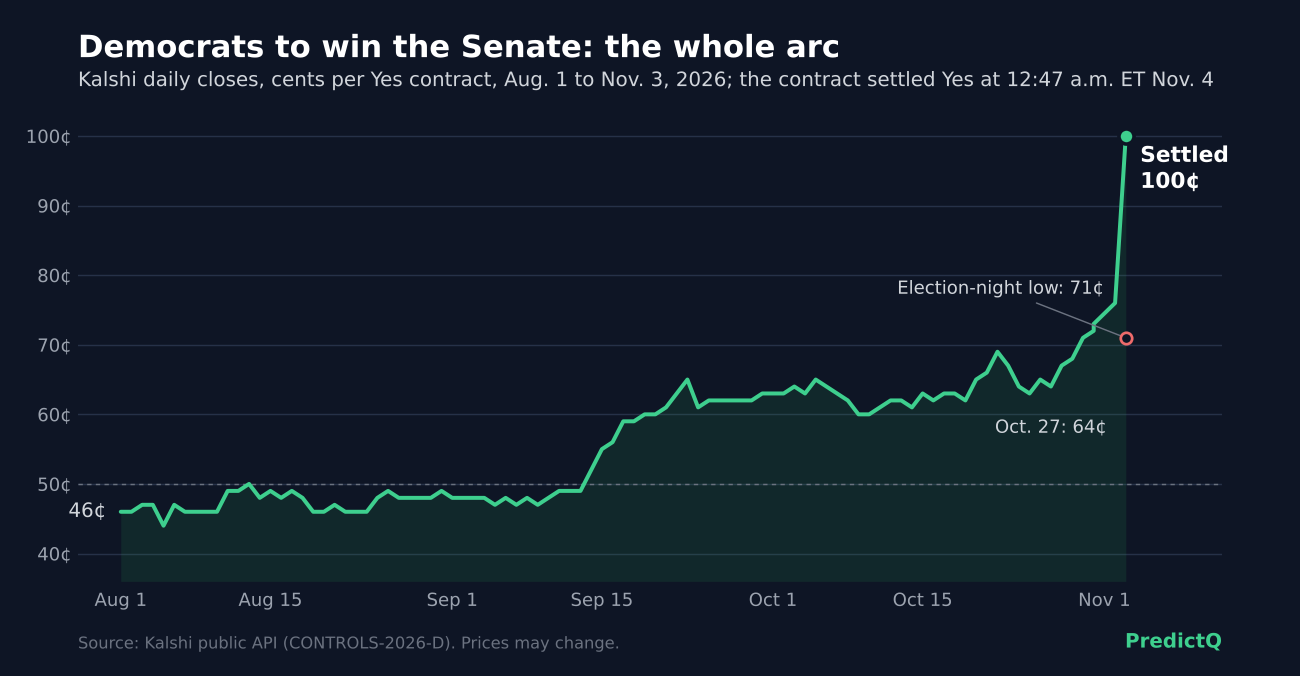
The election-night dip. The Senate control contract opened the day at 76 cents and traded as low as 71 before the calls came in. Texas touched 69, Ohio 71, Michigan 74, Maine 67, Kansas 61, and Iowa 48. All of them settled at a dollar within hours. The early returns, which lean toward whichever party cast more mail and early ballots, moved every race on the board the wrong way before the Election Day vote corrected it. That's the pattern Zachary Donnini's timeline warned about for the 7:30 states, and it showed up everywhere.
The Times Weighting Question, Answered
A week ago we spent a section on the methodology footnote in the final Times/Siena polls: the Times had moved to a new weighting scheme built to find non-responding Trump voters, and under its old scheme the same polls would have shown Democrats further ahead, by 16 in Michigan instead of 11, by 6 in Alaska instead of 2, and by 9 in Texas instead of 7, per The Hill, and by roughly double in Kansas and Ohio, per Talking Points Memo. Nate Cohn framed it as a choice: trust the new method, built on 2024's miss, or trust the old one, which had been accurate in 2018 and 2022.
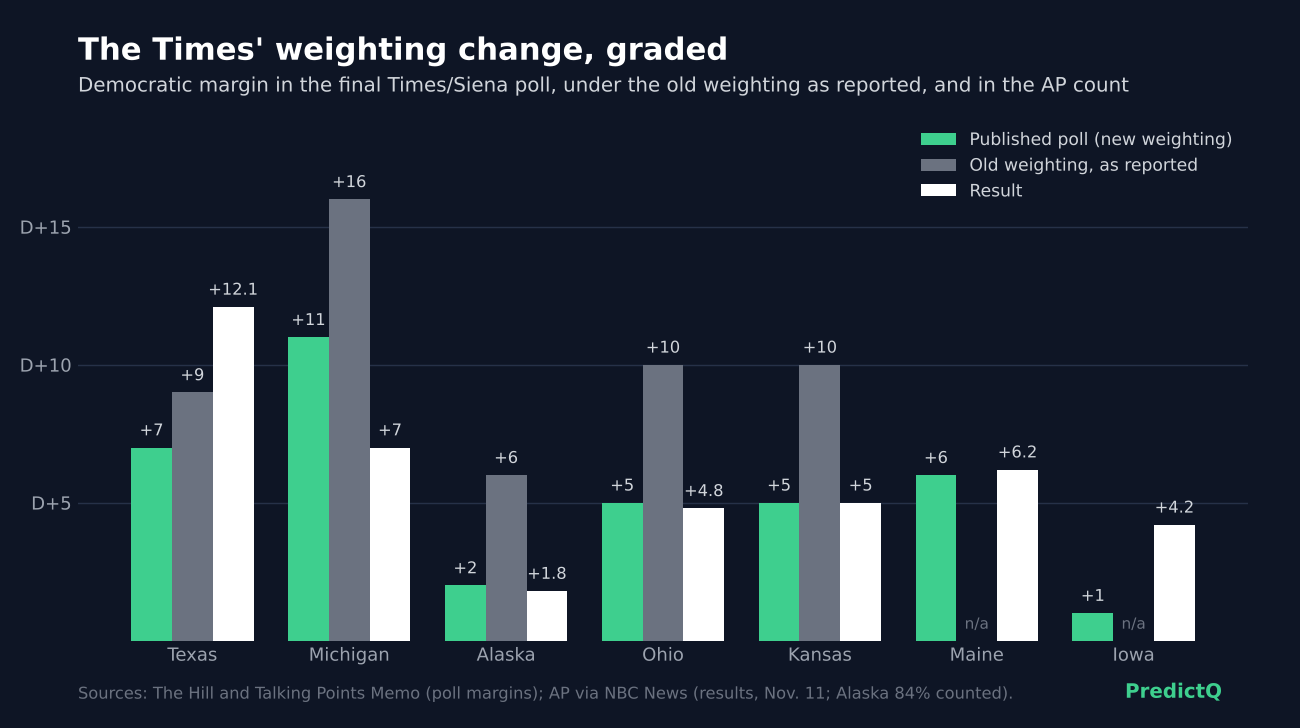
The new method was closer. In Michigan, Ohio, and Kansas, the three states where the correction cut the Democratic lead the most, the published numbers were within a point of the result in Ohio and Kansas and four points high in Michigan; the old weighting would have been five to nine points high in all three. In Alaska, the published 2-point lead is within a point of where Peltola stands with 84% counted, and the old method's 6 would have been well off. There's no state in the set where the old weighting would have beaten the new one by more than two points, and three where it would have lost by five or more.
That's the opposite of what the "polls underestimate Democrats in midterms" reading predicted, and we gave that reading a fair hearing. The Times' correction for 2024 did not overcorrect in 2026. The polls as published were, on this set, about as accurate as a set of state polls gets, and where they missed, they missed in both directions. The Democratic wave didn't come from a polling error. It came from the polls being right in states where nobody believed them.
How Fast Each Venue Paid
Part four laid out the settlement rules. Here's how they ran.
Georgia Senate | 7:43 p.m. | 8:28 p.m. | 45 min |
New Hampshire Senate | 8:23 p.m. | 9:00 p.m. | 37 min |
North Carolina Senate | 8:30 p.m. | 9:01 p.m. | 31 min |
South Carolina Senate | 10:03 p.m. | 11:11 p.m. | 68 min |
House control | 10:39 p.m. | 1:03 a.m. | 2 h 24 min |
Texas Senate | 10:59 p.m. | 11:35 p.m. | 36 min |
Ohio Senate | 11:15 p.m. | 11:44 p.m. | 29 min |
Kansas Senate | 11:29 p.m. | 11:58 p.m. | 29 min |
Senate control | 11:44 p.m. | 12:47 a.m. | 63 min |
Iowa Senate | 11:47 p.m. | 12:08 a.m. | 21 min |
Maine Senate | 12:52 a.m. | 1:34 a.m. | 42 min |
Michigan Senate | 2:31 a.m. | 3:04 a.m. | 33 min |
All times Eastern, Nov. 3 into Nov. 4. CBS's call times are from its live results page; Kalshi's are the settlement_ts field on each market's record in its public API. CBS is one of the eight outlets in Kalshi's rule, and it's used here as a single reference clock, not as the trigger: we didn't pull call times from the other seven, so the lag column measures minutes after CBS, not minutes after the fourth call.
The race contracts settled 20 to 70 minutes after CBS's call, which is consistent with the four-of-eight rule: Kalshi waits for a fourth designated outlet, and the outlets don't all call at once. The control contracts took longer, an hour for the Senate and almost two and a half for the House, which also fits, since the networks were slower to project chambers than individual races.
One note on the rule itself. The four-of-eight language is in the contract terms Kalshi's API links for every contract in this table, the SENATEPARTY terms for the race markets and the CONTROL terms for the chambers, as fetched Nov. 11. Neither document carries a version date, so we can't show the text was identical on election night. Kalshi's newer candidate-level Senate contracts use a different trigger: the Georgia one it filed with the CFTC on Oct. 27 settles on one of seven outlets, with Decision Desk HQ off the list. The party contracts on our board are not that product.
Polymarket's control markets, which resolve through UMA's optimistic oracle with a two-hour challenge window, took longer. Per the umaEndDate field on its Gamma API, the Republican-control Senate market resolved at 2:47 a.m. ET and the Democratic one at 5:53 a.m.; the House pair resolved at 4:57 a.m. and 8:06 a.m. That's two to seven hours after Kalshi, and in line with the 2024 presidential market.
Maine, which we flagged for its ranked-choice count, settled at 1:34 a.m. on Jackson's first-choice majority.
Still Open
Alaska. Peltola leads 49.0-47.2 with 84% counted, a lead that has widened as the late count has come in. The state's ranked-choice tabulation is Nov. 18, and the Kalshi contract, which was 70 cents a week ago, is 99. It's the only race on the series board that hasn't resolved.
Mississippi. Colom leads by three tenths of a point with mail ballots and provisional ballots still being processed. Counties certify Nov. 13. Mississippi has no automatic recount, so a challenge would need a court order. Kalshi has Colom at 99.6.
The seat-count brackets. Both top brackets are priced like settled contracts but can't settle until Feb. 1. The House count can still move as the last districts are called, but NBC's estimate of 259 clears the bracket's floor of 250 with room.
California's Prop 40. The billionaire tax, which Polymarket had at 26.5 cents to pass on Election Day on $4.7 million of volume, failed, and the market resolved No on Nov. 10.
What the Series Showed
Ten weeks ago the Senate control contract was 46 cents. It first closed above 50 on Sept. 14 and was 76 the morning of the vote. No price on the board moved against the eventual outcome for more than a few days, and the two that stayed low into the final week, Texas governor and South Carolina, were races no poll had either. Where the market fell short was the tail: it priced a sweep correctly and underpriced how far the sweep would reach.
The settlement guide held up, and the seat-count brackets gave a better read on the size of the wave than the control contracts could. The one caution we'd carry forward is the election-night dip: the early returns moved every contract we checked the wrong way, and anyone pricing off early-vote composition alone would have sold the bottom.
Thanks for following along. The board is still live on PredictQ, and the 2028 markets are seeing more volume every day.
This article includes links to PredictQ partners Kalshi and Polymarket. We may earn a commission if you use our partner links. It doesn't cost you anything extra, and it helps keep the lights on here. Nothing in this piece is investment advice or a trade recommendation. Prices, odds, and entry counts can change. Availability depends on the platform, product, and your location; check each platform's age and eligibility requirements before trading.