
The Football Gold model creates an independent price for every NFL game. It combines our own power ratings (25%), a situational model covering weather, rest, location and scheduling (25%), and a composite of publicly available power ratings (50%). We turn the projected spread into a win probability, then compare it with the quoted market.
The approach produced a 66-52-3 record in 2025, a 56% win rate excluding pushes and a gain of 8.5 units. In 2026, it’s currently 30-18 (62.5%) win rate and a gain of 12.5 units. The broader modeling process has also helped produce five Circa Millions cashes in the past five years, including two Top-100 finishes in 2025. Those are our reported results, not a promise about what comes next.
PredictQ record: 14-7, +12.86 units
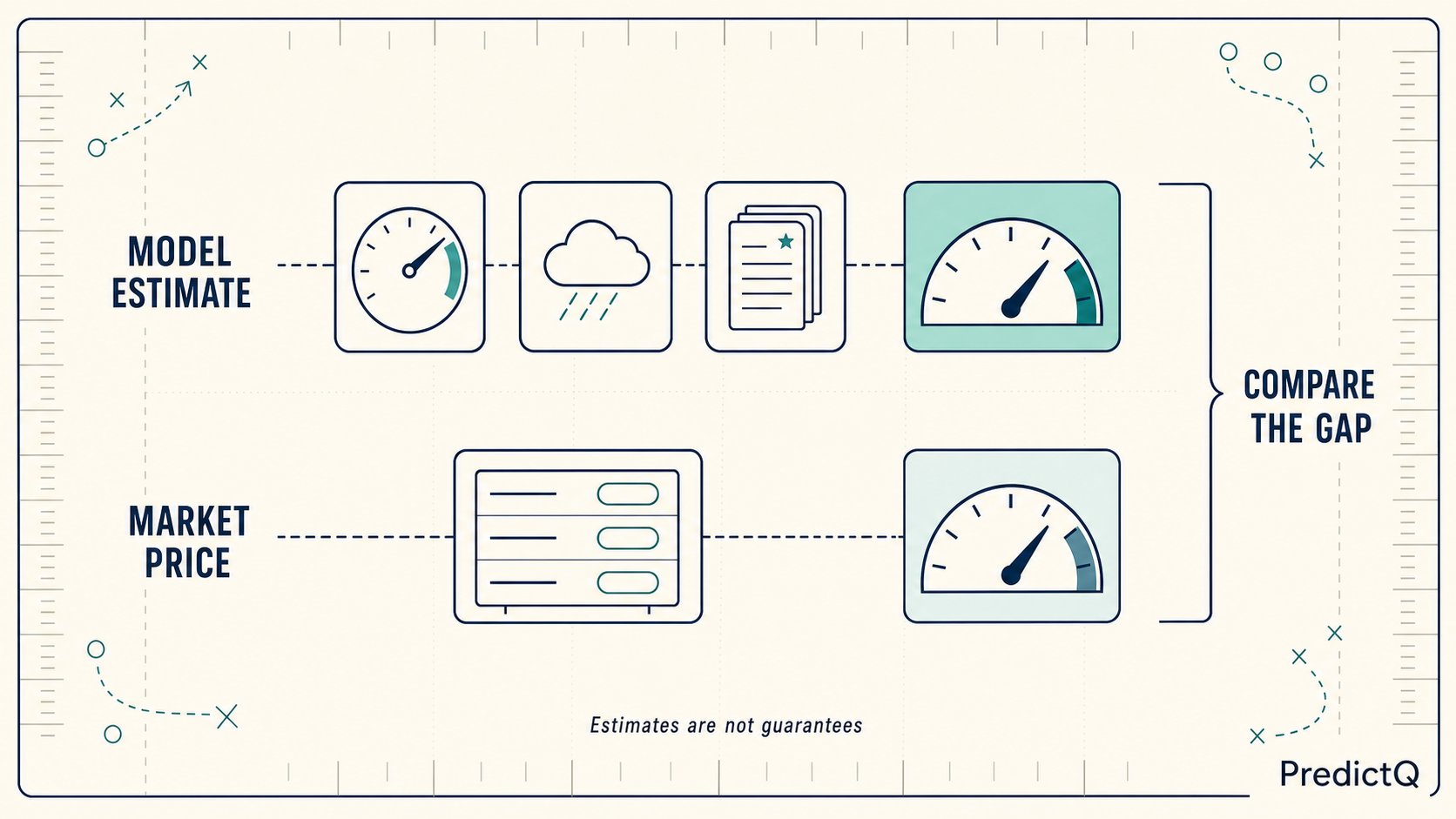
We're looking for games where our model sees a team's chances differently than the market. Picking the winner is only part of it. The price matters.
The comparisons below pair the best available prediction-market prices from our Week 9 snapshot with the model's estimated probabilities.
This week, five teams stand out: the Colts, Eagles, Saints, Bengals, and Buccaneers.
There's a theme across this week's selections. Several teams are being priced based on their records or recent performances, while our model sees a different picture. Indianapolis and Philadelphia have been two of the NFL's most disappointing teams, but both have large gaps between their projected win probabilities and the market. Cleveland, meanwhile, might be the league's strongest regression candidate despite its winning record.
Scheduling also plays an important role. New Orleans is coming off a bye with a substantial rest advantage, Cincinnati gets a small rest advantage in an international matchup, and Tampa Bay faces a Chicago team playing on a short week. Not all five teams are particularly appealing on the surface, and there are legitimate reasons to question several of them. But that's why we're comparing probabilities rather than simply picking which team looks better.
Indianapolis Colts vs. Dallas Cowboys
Football Gold Composite: Colts 50%
Quoted market probability: 30.8% at The Score
Model gap: 50% − 30.8% = 19.2 percentage points
This is our largest pricing gap of the week. It also calls for caution. Indianapolis has been a mess recently. The Colts' performance against Jacksonville was particularly concerning. It's fair to question how much fight this team has left. The possibility of Jonathan Taylor being moved before this game adds uncertainty.
But Dallas hasn't exactly inspired confidence, either. The Cowboys were just out-gained by nearly 200 yards in an embarrassing home loss to Arizona, and their defense has now allowed at least 20 points in 15 consecutive games and 24 of 25 under Brian Schottenheimer. Dallas has the offensive talent to be better than its 3-5 record. Execution and coaching decisions remain a problem.
The situational picture is complicated. Dallas is playing its third road game in four weeks and coming off an overtime game, both negatives in our model. But our scheduling model gives the Cowboys a substantial 13-day rolling net rest advantage. That's difficult to ignore. Dallas has also shown some underlying improvement, with its yards-per-play differential sitting at +0.6 over its last three games.
Indianapolis will have Daniel Jones starting, but the Colts' offensive ceiling remains questionable, especially if Taylor is unavailable. Our composite makes this game essentially a coin flip, compared to a market that gives Indianapolis just a 30.8% chance to win. That's an enormous disagreement, even if the Colts' recent performance makes this one particularly uncomfortable.
Philadelphia Eagles vs. New York Giants
Football Gold Composite: Eagles 47%
Quoted market probability: 39.1% at Kalshi
Model gap: 47% − 39.1% = 7.9 percentage points
Philadelphia might be the hardest team in football to evaluate right now. The Eagles have been a complete mess offensively, averaging just 4.3 yards per play over their last three games, the third-worst mark in the NFL during that stretch. Their defense hasn't been much better, allowing 5.9 yards per play recently after previously sitting at 5.5. The offense's inability to sustain drives has also put tremendous pressure on the defense, particularly late in games.
But a quarterback change could shift the picture this week, with Joe Milton expected to replace Tanner McKee. McKee has struggled badly, and while Milton brings his own concerns, particularly with turnovers, he should at least give Philadelphia more opportunities to create explosive plays.
The Giants are coming off a bye and have a massive 21-day rolling net rest advantage, one of the largest our scheduling model has identified this season. That's a legitimate concern for Philadelphia, especially considering how poorly the Eagles have been playing. New York also has some uncertainty in its backfield, with Tyrone Tracy on injured reserve and Cam Skattebo dealing with a hamstring injury.
I'm not convinced New York is quite as good as its position in the standings suggests. Our composite makes the Giants only a slight favorite and gives Philadelphia a 47% chance to win compared to 39.1% on the board. The Eagles are difficult to trust, but the market might be overreacting to their recent struggles.
New Orleans Saints vs. Cleveland Browns
Football Gold Composite: Saints 67%
Quoted market probability: 60.6% at The Score
Model gap: 67% − 60.6% = 6.4 percentage points
Cleveland might be the most misleading 5-3 team in the NFL. The Browns are the only team with a winning record and a negative point differential, sitting at -34 through eight games. Our expected-wins model puts Cleveland at just 3.14 victories, suggesting this is a team that has performed much closer to 3-5 than its actual record. Its net yards-per-play differential is exactly zero, another indication that the Browns have been closer to average than their record suggests.
The road performances are especially concerning. Cleveland has an average scoring margin of -8.6 points away from home compared to +3.0 at home, and this will be its third consecutive road game and fourth in five weeks. The Browns are also dealing with uncertainty at quarterback, with Deshaun Watson in concussion protocol and Shedeur Sanders potentially in line to start.
New Orleans has a substantial scheduling advantage. The Saints are coming off their bye, and our model gives them a 14-day rolling net rest advantage, one of the stronger situational setups of the week. New Orleans has its own problems, particularly an ineffective rushing attack that contributed to the departure of run game coordinator T.J. Paganetti during the bye. The Saints also have a long-standing tendency to start games slowly, although Cleveland hasn't been any better, going 0-7-1 outright in first quarters this season with an average margin of -6.5 points.
Neither team is particularly trustworthy, but Cleveland's underlying performance and difficult travel schedule make this an appealing spot for New Orleans. Our composite gives the Saints a 67% probability of winning compared to 60.6% on the board.
Cincinnati Bengals vs. Atlanta Falcons
Football Gold Composite: Bengals 66%
Quoted market probability: 60.8% at DraftKings
Model gap: 66% − 60.8% = 5.2 percentage points
This week's international matchup in Madrid features two teams with very different strengths and weaknesses. Cincinnati's offense remains one of the most dangerous units in football when Joe Burrow, Ja'Marr Chase, and Tee Higgins are operating at full strength. Burrow was outstanding against Tennessee, but the Bengals nearly gave the game away because of turnovers that repeatedly handed the Titans favorable field position. That's been a recurring concern for Cincinnati, and its defense remains a significant liability.
Atlanta is coming off a difficult performance against Tampa Bay, although I wouldn't read too much into one game. The Falcons were pushed around defensively, particularly against the run, but that might not be as significant against a Cincinnati offense that relies much more heavily on Burrow and its receiving talent.
The schedule complicates things. Cincinnati is coming off an overtime game, which is generally a difficult turnaround, particularly with international travel involved. However, our scheduling model gives the Bengals a six-day rolling net rest advantage, providing a modest counterbalance.
This isn't a matchup where Cincinnati's defensive issues can simply be ignored, but I trust the Bengals' offensive ceiling considerably more than Atlanta's ability to consistently keep pace. Our composite estimates Cincinnati's probability at 66%, compared to 60.8% on the board.
Tampa Bay Buccaneers vs. Chicago Bears
Football Gold Composite: Buccaneers 33%
Quoted market probability: 29.0% at ProphetX
Model gap: 33% − 29.0% = 4.0 percentage points
Tampa Bay might be one of the most interesting teams in the NFL right now. The Buccaneers are just 3-5, but they have a +27 point differential and 4.65 expected wins in our model, making them one of the league's strongest positive-regression candidates. Their defense has improved sharply, too. Tampa Bay has improved from -0.059 EPA per play allowed in Weeks 1-4 to -0.247 over Weeks 5-8, while increasing its pressure rate from 28.7% to 35.7% despite slightly reducing its blitz frequency. Since Week 5, opposing quarterbacks have produced a league-worst -9.1% completion percentage over expected against the Buccaneers.
The running game has taken a step forward, too, with Bucky Irving ranking fourth in the NFL in rushing yards and surpassing 100 yards in three of his last four games. Tampa Bay has dominated Carolina and Atlanta on the ground, and the offensive line is playing considerably better than it was earlier in the season.
But Chicago is a very different challenge. The Bears have looked like a legitimate championship contender since Caleb Williams returned, and they haven't trailed in any of their last three games. The addition of Jeffrey Simmons has already made a significant difference defensively, and Dennis Allen's unit looked outstanding against Seattle. Chicago can generate offense in several ways. That's a difficult matchup even for Tampa Bay's improving defense.
The Buccaneers have some injury concerns, particularly YaYa Diaby's sprained MCL and Emeka Egbuka's uncertain availability. We also don't know exactly how healthy or effective Baker Mayfield is right now because Tampa Bay has barely needed him to throw over the last two games.
Chicago is playing on short rest after Monday Night Football, which provides a small situational advantage for the Buccaneers. Our composite gives Tampa Bay a 33% chance to win compared to 29% on the board. The Bears are deserved favorites, but Tampa Bay's underlying performance suggests the gap between these teams might be smaller than the market believes.
Final Thoughts
The biggest theme this week is that recent results and actual team quality aren't necessarily telling the same story.
Indianapolis and Philadelphia have been difficult to watch, but our model sees both matchups as much more competitive than the market suggests. The Colts represent our largest pricing discrepancy of the season so far, although their recent performance makes that number worth examining carefully. Philadelphia has a quarterback change that could introduce some much-needed offensive upside, but the Giants' enormous rest advantage is a legitimate concern.
New Orleans might have the most favorable situational setup of the five. Cleveland's record appears significantly better than its underlying performance, and the Browns are facing another difficult road trip against a Saints team coming off a bye. Cincinnati has the offensive firepower to create separation against Atlanta, although the international setting and the Bengals' defensive issues introduce some uncertainty.
Tampa Bay is perhaps the most intriguing team of the group. The Buccaneers' defense and rushing attack have improved dramatically, and their record doesn't reflect how well they've actually played. Chicago might be one of the best teams in football, but our numbers suggest Tampa Bay deserves a little more respect than it's receiving.
That's why we don't treat every model edge equally. The numbers identify where the market disagrees with us. The matchup analysis, injuries, scheduling, and underlying efficiency metrics help determine whether that disagreement is justified.
As always, these are estimated probabilities, not guarantees. Prices can change quickly, and fees can affect the actual cost of a position. The goal isn't to predict every winner. It's to consistently identify opportunities where the available price is better than our estimate of a team's true chances.
This article includes links to PredictQ partner ProphetX and discusses Kalshi and DraftKings Predictions. We may earn a commission if you use our partner links. It doesn't cost you anything extra, and it helps keep the lights on here. Nothing in this piece is investment advice. Prices and entry counts can change.