
Justin Herzig has spent the better part of two decades figuring out how to beat whatever game is in front of him. It started with 100+ Yahoo Pro redraft leagues a year, moved into daily fantasy and then second-half DFS, and got him called "the best fantasy football player in the world" by Rolling Stone. His read on why he keeps winning is simple: every couple of years, the place where his edge lives shifts, and he goes where it went.
Right now that's prediction markets. Justin has been following the space since the Augur days, and once Polymarket and Kalshi got real regulatory clarity, he went all in, co-founding PredictQ with Cameron MacMillan. Brian Hartman sat down with him two days before the Week 2 Sunday slate to talk about what DFS taught him that transfers, where market bias actually comes from, the Josh Allen position he was sitting on, a process mistake from Thursday Night Football, and what he'd tell someone starting with $500.
Watch and Listen to The Interview Here - Read Below
What Made Justin Believe in Prediction Markets
Brian: What's the moment prediction markets went from something interesting to something you had to build around?
Justin: "I've been interested in prediction markets dating back to the Augur days. That was almost a decade ago. Early Augur was peer-to-peer sports betting — similar to what we're talking about now, but very much before the regulatory aspects. It was just a little before its time. It's basically what we did in college within our friend group. You find out what the Vegas odds are, and then you see if people want to take opposite sides when we go to our Saturday night games.
"So when Polymarket and Kalshi started getting actual regulatory clarity — which is obviously substantially more than before — it was easy to see why prediction markets were going to be such a better user experience. We can get into all those details around the limiting and the pricing and the cash-outs. But at its most basic level, I learned my simple idea of 'two people betting against each other' is very different from how these are set up. Here you need to know about making versus taking, order books, and liquidity. And there are so many sites popping up — how do you know which site to be using?
"That's where PredictQ comes in. I was looking for a site to help me understand all of that, and nothing really existed. You find a couple of sketchy Discords, some Twitter content, a podcast here and there. But there wasn't the site we've grown accustomed to, starting in the poker days and then in the DFS days. That's why we're building PredictQ, and why I focus so much on the prediction market side of things."
Brian: Does it scratch the same itch you get from fantasy, or is this something completely different?
Justin: "I actually put out a tweet about a week ago that every two years or so, where I'm spending my time — where I feel like my edge is — has shifted. Early days, that was doing 100-plus Yahoo Pro leagues, redraft style. Then you get DFS, then different forms of DFS and second-half DFS. For me, I just enjoy solving that puzzle and figuring out how you beat this new game. It came natural for me with prediction markets. There's a lot we can apply from a DFS, poker, sports betting, peer-to-peer background, and there's still so much more that needs to be learned in this space. I always like figuring out what's next. How do we solve this game? How do we beat it? How do I stay sharper than my opponents?"
Finding an Edge vs. Following the Market
Brian: What did you learn from fantasy and high-stakes contests that's transferred into prediction markets?
Justin: "The DFS game has evolved so much. Right now there's a lot of groupthink around what sites and content are putting out — and not just from the DFS sites like ETR. We're all getting the same blurbs. We're all reading the same coach-speak and the same reports. So with prediction markets, it's understanding where the groupthink is, where it's maybe being double counted, and when the right times are to fade it.
"The NFL Draft was a great example. We were all hearing the same murmurs, and there were a lot of times you could see the price was being double counted because a report had come up multiple times — but it all linked back to the same initial source. In DFS that's huge, because you need to know where the field is going and how to get contrarian. In prediction markets it's also important to understand why the price is what it is, why the market is leaning toward the side it is, and then figure out: is that actually the sharp side, or is it a signal-versus-noise conversation?
"I'll also throw out thinking in probabilistic outcomes. For people in the DFS, best ball, fantasy sports space, that's come natural to a lot of us. But when you talk to friends outside the space, a lot of people treat any outcome as 50/50. It's either yes or no. We have more of that mindset of: even though I believe something's going to happen, you still have a range of outcomes.
"With prediction markets that's especially pertinent, because we're not just picking a player to score a touchdown or be a great pick for the year. It's at what price do you want to do it. Think about it like best ball portfolio management. Emeka Egbuka was a great play — great sophomore season coming, love the offensive line, love Baker being healthy. But you can't be price agnostic, and when he got to a price this year, I just didn't get much of him.
"In a prediction market, use the Fed rate hike as an example. Everyone was pretty confident it was going to happen, but eventually it got up to 89 cents. You have to at least expect there's some range of outcomes — some probability it doesn't actually happen. So you shouldn't still be buying at 89, 90, 91 cents. When you do your historical analysis, you can say, 'Well, it did happen, so I should have been buying all the way up to 99.' But process-wise, that's not how we should be thinking about it. A lot of people listening come from that DFS and fantasy background and understand those components, and I think they give you a leg up."
Brian: There's so much emotion that rides into this — the fandom, the biases. Being able to find edges over that resonates.
Justin: "There are some good examples. Take the World Cup. One of the highest-volume games we saw was England versus Mexico, and it's known as one of the most free money events that happened. No matter how many models or how sharp it was, England should have been the favorite at that price. There was just so much money coming in on the Mexico side that there was a level of bias. Where does that come from? Maybe a level of underdog aspect. But a lot of it comes from the fact that Texas and California are the two states with the largest populations that don't have legal sports betting — but they have access to prediction markets. And it turns out they're also very close to Mexico, with very strong Mexican populations. So it makes sense there was bias in the market, likely driven heavily by people from those two states.
"Even today I saw a tweet from someone trying to understand why markets kept being lower on teams like the Patriots than they expected. The conclusion people landed on is that in Massachusetts you can't do sports prediction markets. It's not just that one state — Florida maybe has its favoritism, and you definitely see it in Vegas toward the local teams. Whether or not that's actually true, intuitively it makes sense, and at a more macro level we definitely see that pattern."
What Fantasy & DFS Taught Justin — and What He Had to Unlearn
Brian: What have prediction markets forced you to unlearn?
Justin: "Being able to exit positions was a big one, and figuring out how to price that. Previously, you make your bet and maybe you get a cash-out. I've always known cash-outs have been horrible odds — we've calculated them somewhere between 20% and 30% off fair market. So I never even had to think about cash-outs, because I just knew it was always bad. Now, depending on the liquidity, a lot of these markets let you exit in-game or in-season on futures. I'd never had to mentally price that. Now that's a major position I need to consider when I'm getting into any market.
"Another is always having to adjust to new prices. In best ball, ADP changes. In DFS you start the week knowing what a player costs, and it stays constant. Prediction markets are very different — you see the fluctuation, and you get the historical data to see where it came from and figure out why it moved. It's not just figuring out a snapshot price. It's figuring out where I'm comfortable and for how long. Am I comfortable until it gets to a new price that no longer means it's a good value or a good position for me?
"The last one is managing multiple sites and platforms. Early days of DFS, I was on three, four, five different sites. More recently it's been mainly one, maybe two. Here we're seeing a proliferation of prediction market sites. First off, now is the time to take advantage of these sign-up offers and bonuses. You can get a few hundred dollars just by using a new site and making that first trade or that $10 deposit — all the things we saw in sports betting and DFS. Go to PredictQ, we have sign-up offers right now, and you can immediately see what the best ones are.
"Once you're on the sites, you start realizing each one offers different markets. Within markets that are the same, there are different prices and different levels of liquidity. Are you going to have five or ten tabs open? Or are you going to be casual and just use one? As a company, we're trying to make that process as easy as possible. On our sports page right now, we'll show you the best prices. We've got a new UI coming that gives a better view into the order book and liquidity. And eventually we'll have on-site trading, where you just tell us, 'I want Rashod Bateman over four receptions,' and we'll give you the actual best price and route it for you to the best prediction market based on liquidity and price."
Building PredictQ
Brian: What was the problem you kept running into that made you start PredictQ?
Justin: "It started with my own experience using prediction markets. Then you start seeing research that 70% of prediction market users lose money. That got me out talking to a whole bunch of users. I don't know who the winners and losers are, but I could get a general sense of their experience. It was pretty quick to hear from the people who were losing, because they'd willingly tell you. And it wasn't that they felt they got the bad side. The number one reason was they were confused. They didn't understand the space because it was so different from 'I just go choose a team at -110.' Here there's the order book, liquidity, whether you can sell before resolution, market making versus taking. There's a lot more of a financial market aspect you need to learn.
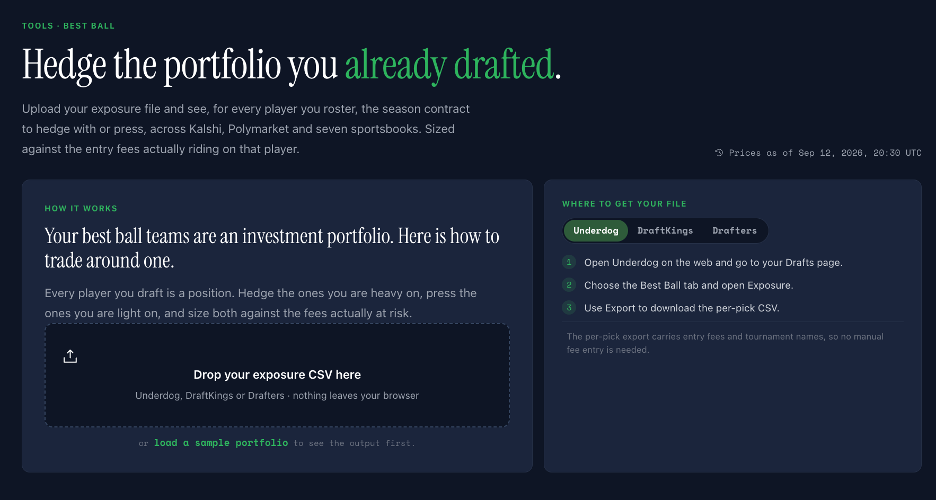
"So I group the key problems into three buckets. One is discovery: how do I find the markets? In sports betting you know what game you want and it's easy to find. But a lot of people didn't know fantasy markets exist. That's why we built the best ball hedge tool — input your best ball portfolio, your DFS players, your fantasy players, and immediately find where you can hedge or double down on your conviction. Those markets don't just show up, especially across multiple platforms.
"Two is research and analysis — the data and tools that really sharp people are making. How do we democratize access to that? We've got some tools on the site and we'll have more. But a large part of what we want to do is connect traders with the builders who are building really cool stuff. We're not going to build all of it, and there are some really sharp, smart people out there.
"The last one is price and liquidity. Best price has always been important — people know that from sportsbooks and DFS. But now it's price and liquidity, and the price is often moving. You need to know when you're willing to make the trade and how to find it quickest, especially in-game. So: discovery, research and analysis, and finding the best price with liquidity at the price you want. That's the experience we want for our users."
Brian: What's something on PredictQ right now you wish more people were using?
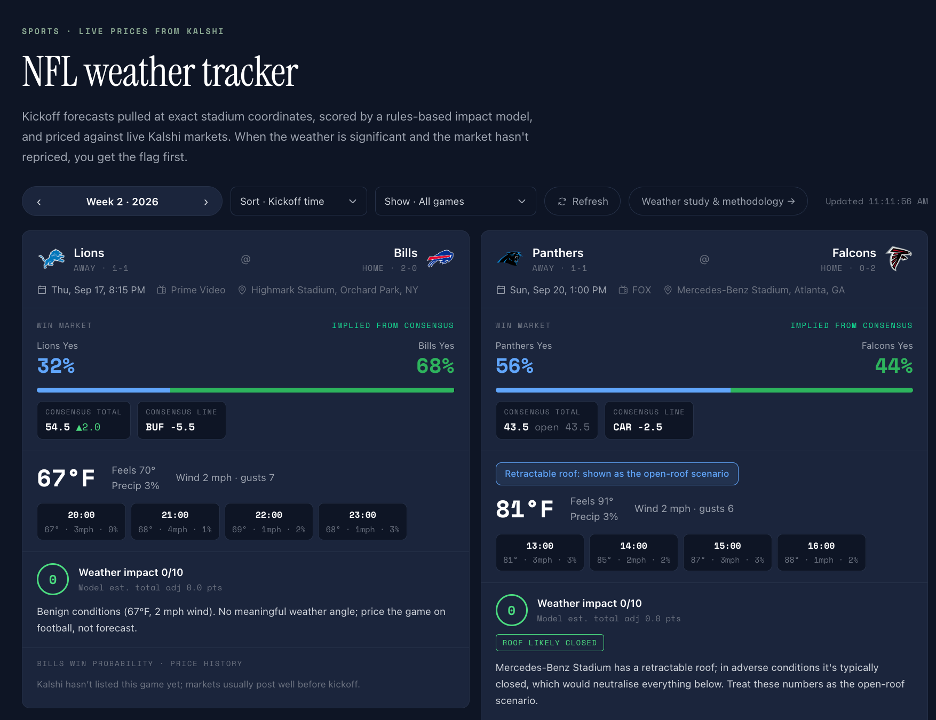
Justin: "I'll just say what I've been using the most. Today is Friday, September 18th, two days from a big NFL slate, and there's a lot of talk about the weather. You do your Thursday night show with Kevin Roth. There's a free tool on the site that shows you the actual weather forecast, and also how those types of weather have historically impacted games. Then you can click right through, and if you want to get into the prediction markets, we'll show you the price and where there might be some edge. It's about supporting and complementing your existing routine, whether that's DFS, fantasy, or prediction markets.
"The best ball hedge tool is another. Upload your portfolio and you can see where the markets are for those players — and those markets are live all season because you can trade in and out of them. We're just trying to keep building things people think are valuable."
Using Prediction Markets for Football
Brian: Walk me through a recent position you took.
Justin: "The ones I've had my head buried in the past week or two are the weekly fantasy markets for players to finish number one at their position in fantasy points. There are also top-five markets per position. The liquidity isn't great, but in my opinion that's more of a feature than a bug. It's an opportunity right now. Look at the touchdown markets on Polymarket — millions in liquidity and the split between yes and no is like one cent. There's no edge. That makes for fun sweats, and if you want a touchdown market you should go there because you'll probably get better prices than anywhere else. But is it somewhere I have an edge? No.
"The fantasy markets, because there's not much liquidity, give us two ways to play it. One, you can be a hawk. Watch the market and look for hanging lines. The majority of prices I won't like. But occasionally someone posts something — a bot does, or someone who just wants the no side — and you disagree with it, so you take it. It can't support a ton of people, because you have to stay hawkish on it. But you can be the taker who finds where it differs from your fair price.
"Two, if all the markets are way off price, you can go quote it yourself and have the best price available for anyone looking to take. It's similar to taking over an entire DFS head-to-head slate, where if people wanted to play, they had to play against you.
"To make it real: Jahmyr Gibbs going into this week. Before the Thursday night game, you could get yes on him at something like 30% to 33% to finish RB1 this week. Yes, he's probably projected to be the best or second-best running back just about every week. But his likelihood of actually finishing there was not that high. We priced it around 14% to 16%. So I'm not going to take Gibbs at 33, which means I'm getting 3-to-1 when I should be getting closer to 6 or 6.5-to-1. Instead, I can go quote no. If I think fair is 16% and the market's giving 33, I can quote at something like 30 cents or even 25 cents. There's still enough of a gap that it's profitable for me if someone takes it, but it's also a better price than what's currently available. If someone really wants Gibbs, instead of paying 33 cents they're paying 25 — they're getting 4-to-1. They get the better deal. But in my mind the price is still 16%, so I'm getting the better deal too.
"A lot of people look at these non-liquid markets and say, 'This is dumb, there's nothing out there, the prices are ridiculous, I'm going to ignore it.' Take it another layer. Wait for a good price to show up, or be the person who offers a better price that still isn't great — and you can win on that side."
Brian: Is there a specific one you've taken recently, at a specific price?
Justin: "Last night was the Josh Allen game. I was taking a lot of Josh Allen as that game was going on. Going into the slate, fair price for him to finish QB1 was maybe 12%. As he gets a very strong start — a rushing touchdown, then a second rushing touchdown — right now, depending on the site, he's somewhere between 90% and 95% to finish QB1 on the week. My average price is somewhere around 45%. So I'm getting substantial value. Today I've actually started selling out of some of my position at around 90%. If he doesn't finish first, I would have gotten 10-to-1; if he does, 2-to-1. Selling lets me lock some of that in at a price where I don't feel I'm giving up value, because I think he's probably closer to 90%, maybe 92%, to finish there. If I can get 90, I get a little extra value."
Where Traders Get Into Trouble
Brian: Give me an example of one where you were wrong.
Justin: "I'm wrong a ton, especially on markets where I'm buying yes at low prices for high returns — more often than not those don't hit. But you're probably looking for a process mistake. Same game, Thursday Night Football, Lions versus Bills. I ran my models with about a minute and a half left in the first half, and there was strong value on Jared Goff to finish with fewer than 24 completions. I was figuring out where I could get it and at what price I wanted in, and I was pretty excited. Qualitatively, there were a lot of reasons. The Lions had struggled to begin with. Maybe there's an offensive line–defensive line mismatch. If it's a blowout, they take Goff and his pass catchers out in the middle of the fourth quarter. There was a lot to like, plus the model liked it.
"What I missed, while I had my head in the computer, is they got the ball back and he had three completions before the end of the half. Those three killed any edge I had. Three out of 24 — that's something like 15% off the top of my head. That's a substantial change, and I didn't account for it because I was too busy worrying about the price, the order book, liquidity, and where I could get the best price. That's a learning lesson: these things can swing so quickly, and I need to keep my head on a swivel."
Brian: Does that change anything in your process?
Justin: "It's tough. Obviously I can wait for the half to end, and then I feel a lot more confident in my model and projections — but I'm slower, and any value that was there might already be taken. From a process standpoint, I need to keep running things with a little extra time, but I need to be better at keeping an eye on the game and building in a level of randomness — the possibilities of what can still happen in that last minute or two. My model is accounting for halftime because that's what I'm telling it, when in reality there's still time left and things can still happen."
Finding Mispriced NFL Markets
Brian: What's one NFL market right now you disagree with?
Justin: "I'll go back to the Josh Allen one. I think he put up around 40 points. For the most part, people have just said, 'I'm ignoring this market, he's got it.' Everything else in that market is at 1%, which, to be honest, is accurate. But I just checked, and he's at 97% on Kalshi right now. In my opinion, that's wrong. If you look at how frequently other QBs can actually outscore 40 — yeah, it's rare. But I've got it somewhere around 90%.
"So I'll take a look and decide whether to start offering a better price, and if people want to take it, we'll see. Sometimes what I'll actually do is go a little beyond what I think fair price is, in a small amount, just to see where people are buying. That information gives me a better sense of what the market feels the true fair price is. And if people are willing to buy at 89, a lot of times they'd be willing to buy at 91. You can ladder your way up. The 89 attracts them to the market, but they see there's only a small amount of liquidity — maybe $10 at 89 — and if they want more, they can get $50 at 92. A little carrot. But I want to draw them to that 92, where I think there's actually more fair value on my side."
Brian: I'm looking at 40.82 points, and historically that holds as the top QB score around 91% of the time. At 35 it held about 69% of the time; at 43 it's 96%, at 45 it's 98%.
Justin: "And that's on an average week. We also need to account for the fact there are no byes this week, so you have more teams. We'll see what the weather does, but in general, earlier in the season you get friendlier weather, a little more high-scoring games, a little healthier teams. So even a model built on historical data gives me the average week. I still need to account for the more unique aspects of this week."
Brian: What's something you think the markets have overreacted to through the first two weeks?
Justin: "The Rams. You see the loss to San Francisco, you see the Myles Garrett injury, you've got Davante Adams looking bad, and the market has dropped them from 17% to win the Super Bowl to around 12%. Five points doesn't sound like much, but five compared to 17 is a pretty large drop after one game. A lot of that can be explained. It was the Australia game — there's so much wonkiness with that, the travel plans. The Garrett injury isn't good, but I think he's back around Week 6, and I don't have concerns about the Rams missing the playoffs. Maybe it hurts their home-field and divisional aspects, but all else equal I'm still expecting this team to be clicking come playoffs. And with Davante Adams, reports are now saying he was actually sick for the Australia game, so maybe that explains the lower usage. It's easy to talk yourself into the Rams not being good because they didn't look good and things aren't going well. But I think that's too much of an overreaction."
Brian: Pick one football market you're interested in this weekend and walk me through how you're evaluating it.
Justin: "Specifically through a prediction market lens, the in-game aspect is so crucial, and there's edge in the unique cases. Let's use the Ravens. Pregame, I'm looking at the various projections and understanding how the market is treating it. When I say projections, I mean fantasy and player projections, but also how the market is pricing each of the various props. Then you look at the team reports, and there was a quote from Lamar about how his guy is going to get a lot more targets — talking about Rashod Bateman. So you have a narrative: Lamar and Bateman are very close, most likely no Zay Flowers — we won't know for sure — and definitely no Ja'Kobi Lane. So there's a Bateman opportunity.
"I've been using PredictQ to see where the best markets and prices are for Bateman, and come Sunday I'm going to have all those markets up. This is a 1 p.m. Sunday game, so there are fewer eyeballs on it. An island game, a night game — everyone's watching and reacting immediately. On a random Sunday at 1:00, the larger algorithmic traders still have their order books filled, but the sharps who are watching can't watch every game. So I'm focusing on that first drive. How many first reads does Bateman actually get? Which other receivers are out there? Depending on whether you have someone like Elijah Sarratt out there, some receivers compete for targets more than others. Or is this just going to be lean on Mark Andrews?
"You can't really evaluate those things in real time with normal sports betting. If he gets those first-read targets, the narrative is correct, Lamar's being honest, and they really are building the game plan around Bateman — I don't think the markets will react quickly enough if you're watching and want to jump in. Or the opposite: it's baloney, Bateman doesn't get any first-read looks, and the market built it up too much ahead of time."
Brian: Is there a price where you're no longer interested?
Justin: "That's what I'm about to figure out. I already know the pregame projections. I have an in-game model that adapts to the score of the game and how the players have done, and projects their future value. What it's missing are the inputs I just discussed — is he getting the first-read looks, how much usage. Targets and completions go into it, but it's more than that. If Bateman gets two targets on the first drive but you can tell the first read was Mark Andrews or whoever else, that's probably a sign it was a little flukier, and maybe the market's overreacting. Those things can always be used, but they're more valuable in an unknown situation like this one, because of the injuries."
Starting Prediction Markets With $500
Brian: Someone discovers prediction markets tomorrow with $500 in the account. What's the first thing you'd tell them?
Justin: "You touched on the first one. Definitely, 100%, go get the sign-up offers. It is free money right now, and this won't be available forever. These companies have marketing dollars and they're competing for users. It's no different than what we saw in the DFS and sports betting days. Go to our page, go to the sign-up offers, and start claiming them.
"Next, we have an article on the site called Prediction Markets 101. Go read that. It'll give you a baseline familiarity with how these work and explain a lot of the terminology we talked about today.
"Third, hop in our Discord and ask that exact question. There are a lot of sharp people in there who'd be willing to help. Getting various takes will be very valuable — or put it on Twitter. Use the community.
"My more concrete, tactical advice: go to the market you're most interested in. I'm not saying you have to have edge in it — just something you really care about. For my co-founder Cameron, his first big one was who was going to be the next UF coach. He didn't have any edge. He was just really interested because he's a huge Gator fan, and that was how he came to understand how this stuff works. When you're interested, you pay attention beyond just putting a little action down. You watch the price movement because you care about the outcome. You look at the order book, which gives you more insight into what the market is thinking. You understand how it resolves and when. All of that can be learned through education and podcasts, but getting in there on something you're interested in will be most valuable."
Brian: One more before we close. What's one prediction market you wish existed that doesn't?
Justin: "One I've tinkered with previously — and Trevor on our team wrote a really good article on it — is Best Ball Mania advance rates. How likely is each player to finish with a positive or negative advance rate? Use Dalton Kincaid. His ADP moved up a round or two over the summer, so maybe at the end of the offseason he'd have been at 55 cents — 55% likely to outperform his advance rate, because you think people got him at a value. Now Dalton has those two big games. What's his current price — 65 cents, 75 cents? If you had a big bag of Kincaid, are you selling that as a hedge or a little cash-in, or doubling down on your conviction?
"Even if you're not trading it, it'd be really interesting to follow. Say he has one bad game and his likelihood drops to 45 or 40 cents, and you're like, 'No, that's ridiculous, I'm not buying that one bad game.' So you take the 40-cent price and track it throughout. I think that would be extremely interesting. And if you can't do it off Best Ball Mania, there's definitely a similar proxy for basically asking: was this player a good pick?"
Brian: Who do we have coming up on the show?
Justin: "We've got a couple of big names coming up. One is someone people know as the king of niche DFS, who's been doing some really great work in the preseason with prediction markets. Another might be the largest-volume prediction market trader in the world — hundreds of millions in prediction market trades, and not much of it in sports. So we're going to branch out and see what we can learn from them as well. Thanks for having me. I've been loving the Thursday night forecast show you and Kevin Roth have been doing."
Brian: New interviews hit your podcast feed every Monday, and Kevin and I are live Thursdays around 7:30 p.m. Eastern, an hour before kickoff, talking weather, football, prediction markets, and everything in between.
This article is an adapted interview based off a real conversation about how one trader approaches prediction markets. It is not an exact transcript, a directional prediction, a trade recommendation, or investment advice. Prices and odds discussed were quoted at the time of recording (September 18, 2026), are point-in-time, and may change. PredictQ is a marketing partner of Kalshi and Polymarket and may receive compensation for referrals.