
Peter Nickerson
9/22/26
Climate & Weather Analyst
When Should You Trade Tomorrow's High Temperature?
There is a simple tradeoff when trading tomorrow's high temperature on Kalshi, which is the earlier you enter, the less you know. The later you enter, the more the market knows too. At the market open, you are working almost entirely with forecasts. You can compare the NWS, ensembles, GFS, HRRR, historical model bias, and the market price, but none of the actual daytime heating has happened yet. That can create opportunity if the market is leaning too heavily on one forecast or ignoring a bias you have found, but it also leaves plenty of room to be wrong.
An overnight model run can shift a degree or two, clouds can show up earlier than expected, or a front can move faster or slower than forecast. By the next morning, the picture starts getting clearer. New model runs give you another look at the setup, and if several models all shift warmer or colder together, that is usually more useful than one random model jumping 2°F. You can also start watching whether the forecasts are tightening.
A spread of 94°F to 95°F tells you something very different from a spread of 91°F to 98°F, even if both groups average around the same temperature. Once the sun comes up, you get something even more useful, actual observations. Instead of only asking what the models think will happen, you can start asking whether reality is matching them. Is the station running warmer than expected? Are clouds clearing faster? Is the dew point lower? Is the temperature rising faster than the model's hourly curve? Those observations start turning a forecast into a live test.
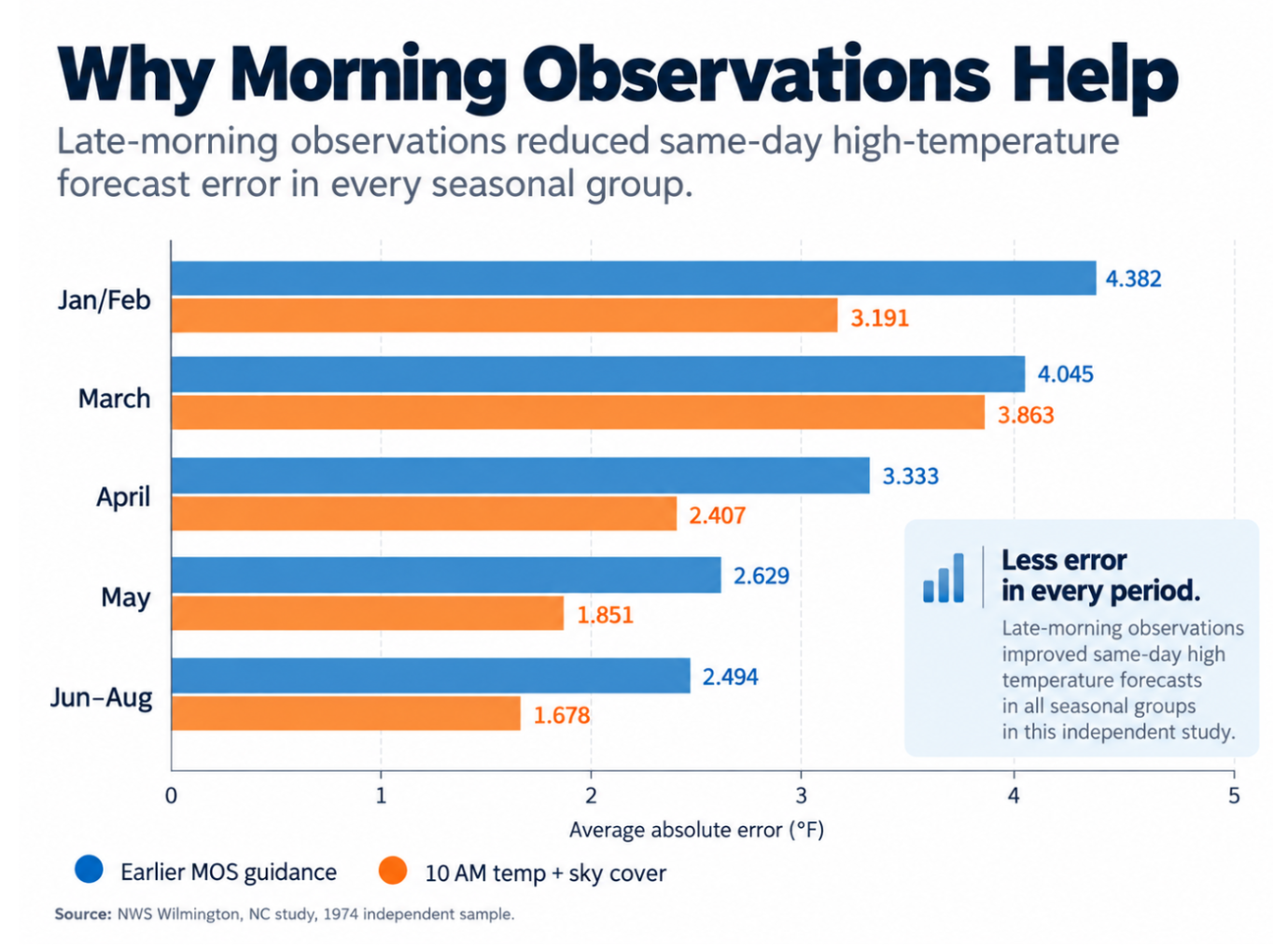
A National Weather Service study from Wilmington, North Carolina looked at whether late-morning observations could improve forecasts for that afternoon's high. Researchers used the observed 10 AM temperature and sky cover to update the forecast, and the updated forecasts had lower average error than the earlier MOS guidance in every seasonal group they tested.
During June through August, average absolute error fell from 2.5°F to 1.7°F, about a 33% reduction. In April, it dropped from 3.3°F to 2.4°F, roughly a 28% improvement. It is an older study from one location, so it does not mean 10 AM is automatically the perfect time to trade today. Modern models are much better, and every city behaves differently. But it shows why morning observations can be so valuable.
The catch is that better forecast accuracy does not automatically mean a better trade. Imagine a 95°F contract is trading at 30¢ the night before. By 9 AM, temperatures are running 2°F warmer than forecast and skies are completely clear, so the contract moves to 48¢. By 11 AM, the station is still running hot and the same contract is now 72¢. Your confidence improved the entire time, but so did the price for everyone else.
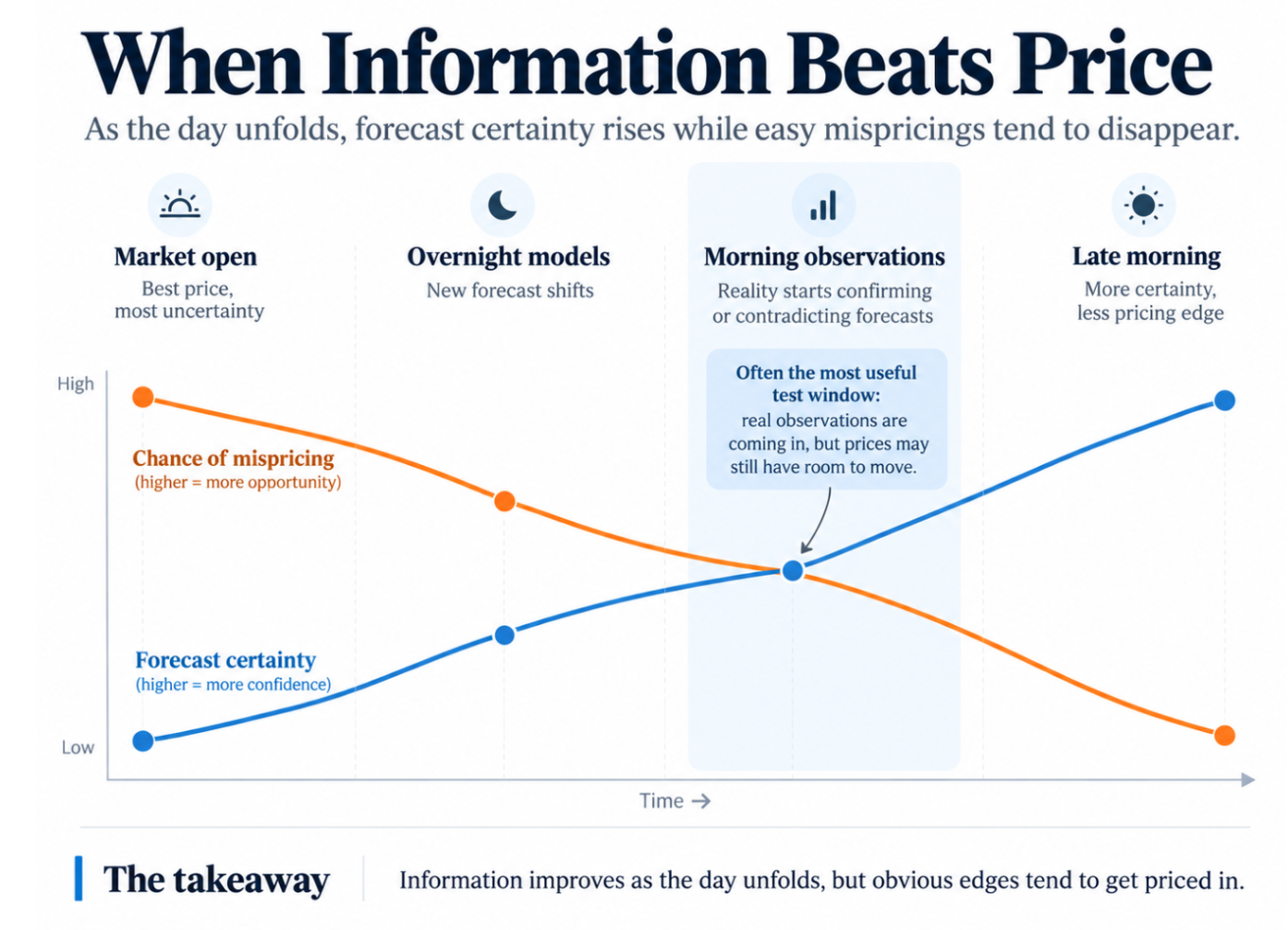
That is why waiting until the forecast becomes obvious can actually remove the opportunity you were waiting for. At market open, uncertainty is high but there may be more mispricing. By late morning, uncertainty is lower but the obvious information may already be priced in. Somewhere in the middle, you may have enough real-world data to judge whether the models are handling the day correctly while there is still enough uncertainty left for prices to move.
Market Example:
Suppose the overnight models center near 95°F and the 95°F contract is 30¢. At 9 AM, the station is already 2°F warmer than the modeled hourly curve and skies are clear. If the contract has only moved to 48¢, the new observation has improved your information while the market still has uncertainty left. By 11 AM, the same setup may be much clearer, but if the contract is already 72¢, much of that advantage has been priced in.
The important part is not that 9 AM is always better than 11 AM. It is that the value of waiting depends on how quickly the weather information improves compared with how quickly the market reacts. On a clear, stable day, early model agreement and historical bias may be enough. On a day with uncertain clouds, rain, wind, or frontal timing, the morning observations may be worth much more.
Conclusion:
The better question is not, "When is the forecast most accurate?" It is, "When does my forecast improve faster than the market price adjusts?" There probably is not one perfect time to trade every high-temperature market. The best window can change by city, weather setup, and type of edge.
That is something we can test directly. Record the market price at open, after overnight models, during the morning, and late morning, then compare both forecast accuracy and eventual trade performance at each point. Which city should we break down first? Bring it into the PredictQ community and we can compare the timing windows side by side.
This article discusses historical weather-model performance, forecasting concepts, and prediction-market research, not directional predictions, trade recommendations, or investment advice. Historical results do not guarantee future accuracy.
This article includes links to PredictQ partners like Kalshi. We may earn a commission if you use them. It doesn't cost you anything extra, and it helps keep the lights on here. Nothing in this piece is investment advice, and prices, odds, and entry counts can change.