
One of my most accomplished poker students, Brian, recently found himself in a spot that every tournament player dreads.
He'd been playing for nearly ten hours in a $1,700 buy-in poker tournament and was just one elimination away from making the money. Survive a little longer, and he'd walk away with roughly $3,000. First place, however, paid more than $350,000, and Brian had his sights set on a much bigger payday.
With a relatively short stack of chips, Brian was dealt a reasonably strong hand and faced a raise from one of the most aggressive players at the table. Folding would give him an excellent chance of securing that $3,000 payday. Going all-in would put his entire tournament at risk.
But Brian had been paying attention.
He knew his opponent was playing extremely aggressively, raising with all sorts of hands but willing to call an all-in bet with only his strongest ones. That meant Brian could expect his opponent to fold the vast majority of the time, allowing him to add significantly to his stack without even having to show his cards.
The math pointed toward going all-in. His emotions were telling him to play it safe and fold.
Brian went all-in. His opponent folded.
This is one of the most important lessons I try to teach my poker students: lean into the uncomfortable.
Even after more than ten years of coaching, I find that one of the hardest things for players to accept is that the most profitable decision isn't always the one that feels the safest. The math doesn't care how comfortable they feel.
Probability, not personal preference
Political prediction markets ask us to make that same distinction.
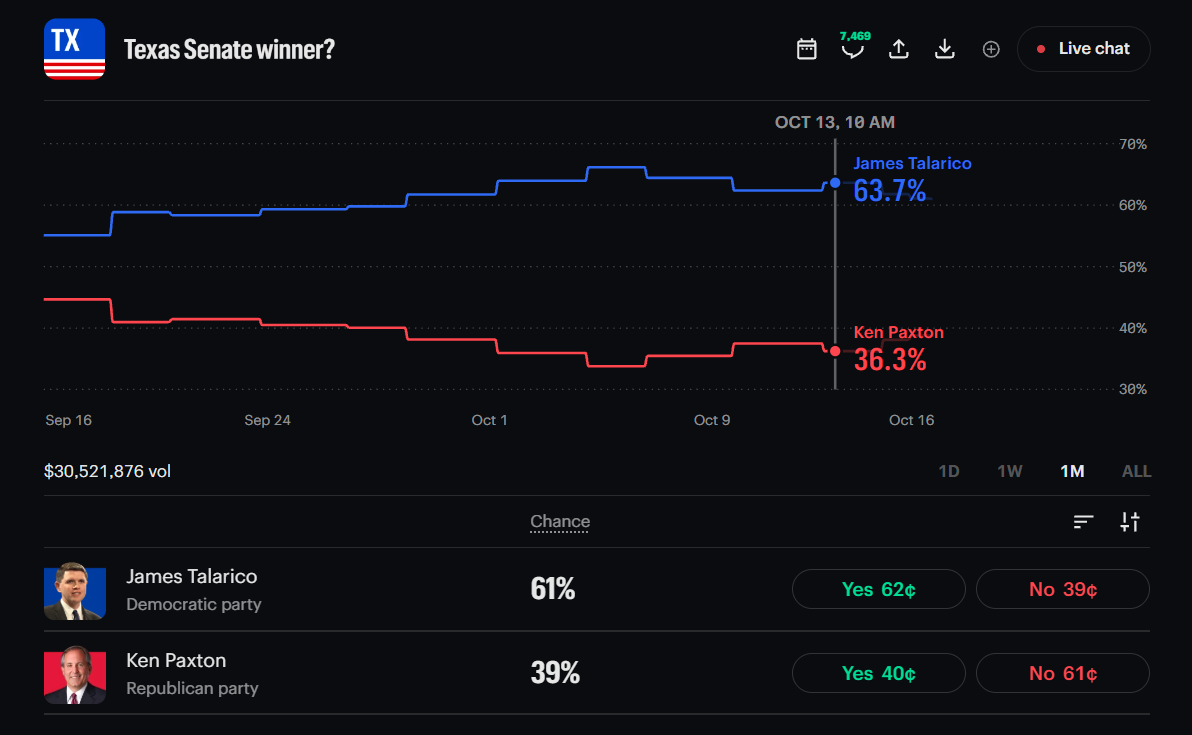
Consider the Texas Senate race, where Republican Ken Paxton has faced a steady stream of negative headlines. As of October 13, his prediction-market contract was trading around 36 cents.
For someone who dislikes Paxton or believes the criticism of him is justified, purchasing shares in his contract might feel incredibly uncomfortable. But prediction markets don't ask us whether we like a candidate, approve of their behavior, or even expect them to win. They ask us to evaluate a probability against a price.
At 36 cents, a contract could lose more than six times out of ten and still be profitable, provided its true probability of winning is higher than 36%.
But something caught my attention when I checked Kalshi on October 13.
I'd just read the latest damaging report about Paxton in The Wall Street Journal and expected his price to take another hit. Instead, I was surprised to find his contract trading higher than it had been earlier in the week.
It reminded me of something I'd noticed recently in sports betting.
On September 26, 2026, No. 4 Ole Miss traveled to Gainesville to face my Florida Gators, ranked No. 21 in the country. Yet somehow, Florida was a 3.5-point favorite.
That line immediately jumped off the page. Why was the fourth-ranked team in the country an underdog to a significantly lower-ranked opponent?
Sports bettors know this feeling. Sometimes a line just doesn't seem to make sense. And when that happens, my first instinct isn't that the oddsmakers have it wrong. Quite the opposite. They might know something I don't.
Florida went on to crush Ole Miss 52–28. One result doesn't prove the market knew something I didn't, but it was a useful reminder not to confuse a surprising line with a mistaken one.
I had that same feeling looking at Paxton's price. Why was the market assigning him a higher probability despite another round of negative headlines? Was the news already baked into the price? Were traders reacting to something else? Or was the market simply wrong? I don't know yet. But the disconnect made me want to dig deeper.
Paxton's Democratic opponent, James Talarico, almost seems like a "create-a-candidate" designed specifically to pull off an upset in Texas. He's young, well-spoken, Christian, and seemingly equipped with many of the qualities Democrats would want in a candidate trying to win over traditionally Republican voters.
But let's consider the other side
Texas hasn't elected a Democrat to the U.S. Senate since Lloyd Bentsen in 1988. That's 38 years of Republican victories, and Donald Trump carried the state by nearly 14 percentage points in 2024.
We also have a useful comparison from Trump's first presidency. In the 2018 midterms, Texas experienced unusually high turnout, with 53.01% of registered voters participating. Beto O'Rourke came within just 2.6 percentage points of defeating Republican Ted Cruz.
It was an unusually strong showing for Texas Democrats, yet they still fell short.
Paxton has survived years of political controversy, including impeachment proceedings, while maintaining a loyal base of supporters. But whether that resilience carries over to a general election remains to be seen.
An October University of Texas/Texas Politics Project poll has Talarico leading Paxton 50% to 47%. The survey ran September 25 through October 5 among 861 likely voters, with a margin of error of 3.34 percentage points. That three-point lead is within the margin of error, suggesting a competitive race rather than a clear polling advantage.
Perhaps the market has already accounted for the state's conservative lean and Paxton's political resilience. Perhaps 36 cents is too expensive rather than too cheap.
And here's where I think an important distinction comes in.
Leaning into the uncomfortable doesn't mean looking for reasons to justify a position you already want to take. It means being willing to make a decision that feels uncomfortable when the evidence actually supports it.
That's true whether we're talking about a poker tournament, a football game, or a political election.
The decision before the result
But there's another important wrinkle in prediction markets. We don't necessarily need to predict the final outcome correctly to make a profitable decision.
Suppose we purchase Paxton contracts at 36 cents, believing his actual chances are higher than the market suggests. If those contracts eventually rise to 50 cents, we have a choice. We can hold until the election, or sell our shares for a roughly 39% profit before fees, without ever needing Paxton to win.
Of course, selling isn't automatically the right decision. If we still believe those contracts are undervalued at 50 cents, holding may offer greater expected value. Just as in poker, what matters is making the best decision with the information available, not simply celebrating a favorable short-term result.
For more on valuing an exit, read Justin Herzig's Why I’m Forever Done with Futures Bets on Sportsbooks.
The goal isn't to be right every time. It's to consistently make decisions where the price is better than the actual probability, even when those decisions don't feel particularly good in the moment.
This article includes a link to PredictQ partner Kalshi. We may earn a commission if you use it. It doesn’t cost you anything extra, and it helps keep the lights on here. Nothing in this piece is investment advice, and prices, odds, and entry counts can change.