
Last week, most of the board moved toward Democrats. This week, it moved back. Kalshi's Senate control contract closed at 64 cents last Tuesday, traded down to 60 on Friday and Saturday, and was 61 cents as of Tuesday night. The Democratic sweep contract lost five cents. Iowa gave up six cents, Michigan and Ohio three, Texas two, and the Texas governor contract lost seven cents in a single day. Nothing on the board flipped, however - the favorites are the same as they were last week, just priced a little lower.
The week's loudest story was one the market mostly shrugged at. James Talarico left the Texas Senate trail with the flu after a Sept. 30 virtual appearance and wasn't seen in public again until Oct. 9, at the Austin City Limits festival. In between, Trump called him "missing in action" at an Oct. 7 San Antonio rally for Ken Paxton, Paxton's campaign put out missing-person posters, and right-wing accounts pushed a theory, denied by the campaign and by the clinic they named, that the flu was cover for something worse. Kalshi's Texas contract closed at 67 cents on Oct. 6, and 66 two days later. The drop to 62 came Oct. 9, the day he came back, and it has since climbed to 65. Trafalgar's poll, fielded during the absence, had him up 47 to 44. Then on Oct. 12 the Wall Street Journal reported that Paxton spent New Year's Eve 2024 in Dubai with two men under federal healthcare-fraud indictment, one of whom had donated to his campaign. If that story moves the race, next week's column will show it.
This article is part two of a five-part series that will go through Election Day. The board below is the same one we set up last week, with the Oct. 6 close alongside today's price so the week's change is a full week. New this edition, as promised: a movers list that puts each big move next to the polls, ad money and resource decisions in the same window, and a consistency check that adds the state markets up against the control market. The settlement guide comes Oct. 27, the election-morning edition Nov. 3, and the Scoreboard a week after that. If there's a race you want on the board, tell us at @PredictQmkt. Between editions, every market here is live on PredictQ. Prices may change.
The Big Board
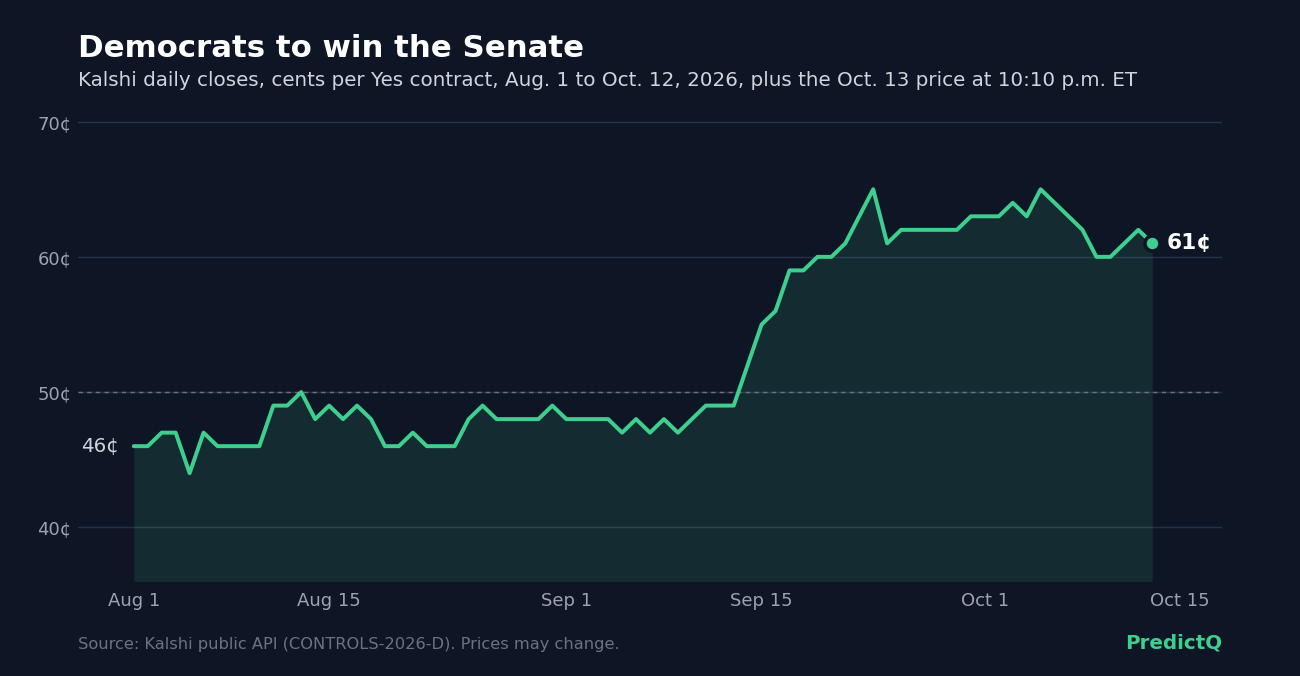
Democrats are 61 cents to win the Senate and 90 cents to win the House in our Oct. 13 Kalshi snapshot. The House contract slipped one cent from the Oct. 6 close of 91. The Senate fell three cents, and the sweep contract fell five. Polymarket's corresponding contracts were quoted at 63.5 and 90.5 cents in the same edition. Prices may change.
Senate control, Democrats | 61¢ | 64¢ | -3 |
House control, Democrats | 90¢ | 91¢ | -1 |
Democrats sweep both chambers | 60¢ | 65¢ | -5 |
Democratic House, Republican Senate | 30¢ | 28¢ | +2 |
Republicans sweep both chambers | 10¢ | 9¢ | +1 |
Republican House, Democratic Senate | 1¢ | 1¢ | 0 |
The generic ballot didn't follow the board down. Nate Silver's average sits at Democrats +8.8 as of Oct. 12, a shade under its cycle high of +9.1, and his page notes Republican support has been trending down since late September. Whatever moved the Senate price this week, it wasn't the national number. It was the states.
The consistency check
Democrats need a net gain of four Senate seats. Seven of the ten races on our board are Republican-held (Texas, Maine, Ohio, Iowa, Alaska, Kansas and North Carolina), and three are Democratic-held (Michigan, New Hampshire and Georgia). Treating the displayed Democratic prices as rough probability estimates, the seven potential pickups add up to 0.65 + 0.57 + 0.60 + 0.40 + 0.74 + 0.37 + 0.96 = 4.29 seats. For the three Democratic-held seats, the implied losses are (1 - 0.68) + (1 - 0.90) + (1 - 0.95) = 0.47. Subtract those and you get 4.29 - 0.47 = 3.82 net seats, against a target of four.
That's a rough expected-seat calculation, not a forecast or a probability of Senate control. It ignores races outside this board and treats market prices as probability estimates. Using the Oct. 6 figures, the same calculation is 4.37 - 0.43 = 3.94 net seats. This week's 3.82 is 0.12 lower. That decline points in the same direction as the control contract's move from 64 to 61 cents, but it doesn't validate the 61-cent price. To estimate the chance of gaining at least four seats, we'd need a joint model of the race outcomes, including how they move together.
The movers, and what was happening around them
For each move of three cents or more, here's what the polls, the ad money, and the party committees were doing in the same seven days. Where we can't tie the move to anything, we say so.
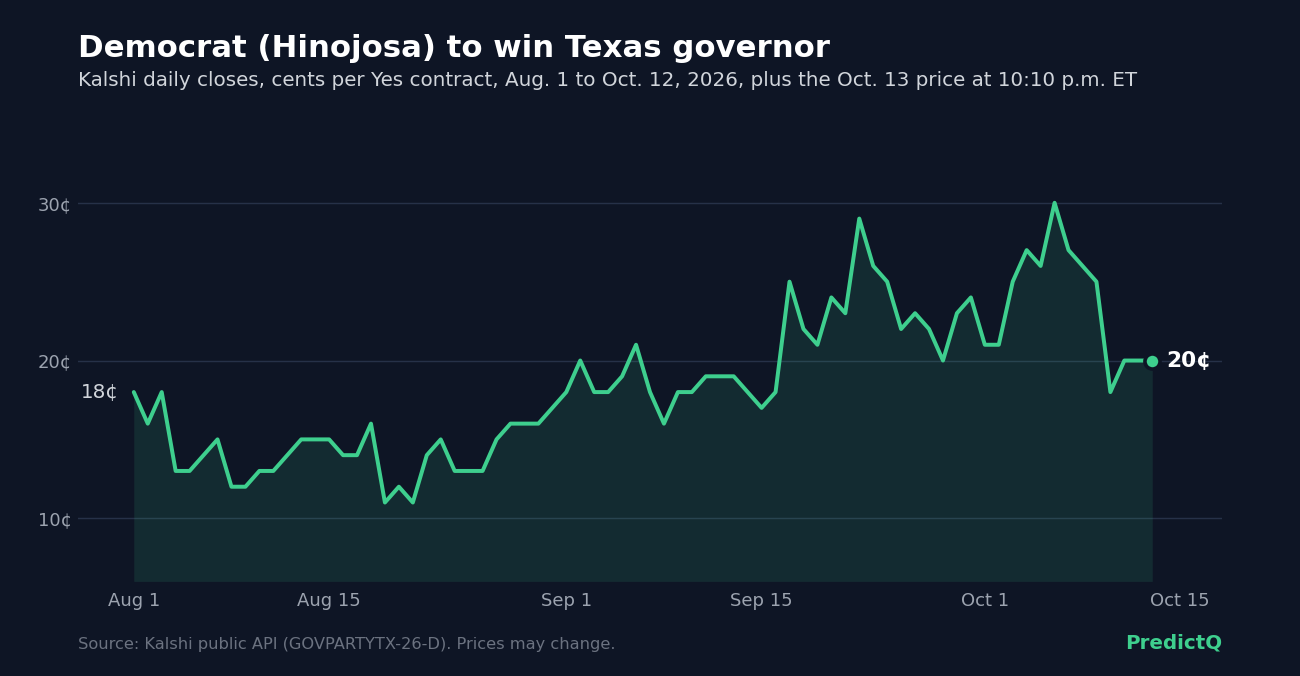
Texas governor, Hinojosa 30 to 20 (-10). Gina Hinojosa, a Democratic state representative since 2017, is challenging Gov. Greg Abbott's bid for a fourth term. This was the biggest move on the board, and the recent polls weren't unanimous. The two most recent polls cited from the RealClearPolling page had Hinojosa ahead: YouGov by one (Sept. 28 to Oct. 5) and NYT/Siena by three. A UMass Lowell poll released Oct. 8, fielded Sept. 18 to 28, had Abbott up 48-44. The contract fell from 30 on Oct. 6 to 18 on Oct. 10 before settling at 20. Money was part of the week's backdrop. On Oct. 7, the Democratic Governors Association made its first investment in the race, $1 million, after more than 70 Latino Democratic leaders had asked it for $10 million. J.B. Pritzker added $1 million of his own. Abbott, who started the cycle with $100 million, had about $18 million on hand at the end of September against Hinojosa's $4 million, and launched a $12 million ad buy on her property tax record on Oct. 2. Abbott also skipped Trump's Oct. 7 San Antonio rally for a hospital dedication about 330 miles away, which Democrats criticized. CBS put the spending gap between Abbott plus his allies and Hinojosa at roughly 10 to 1. Our read is that the funding gap could help explain why traders were more skeptical than some polls. The DGA's $1 million investment was 10% of the requested amount. That context doesn't prove what caused the price move, or whether 20 cents is the right price.
Democrats sweep both chambers, 65 to 60 (-5), and Senate control, 64 to 61 (-3). We can't isolate a single event. A Democratic sweep requires winning both the House and Senate, so the sweep contract shares exposure to Senate outcomes. Both contracts fell during the same week as several Senate state markets.
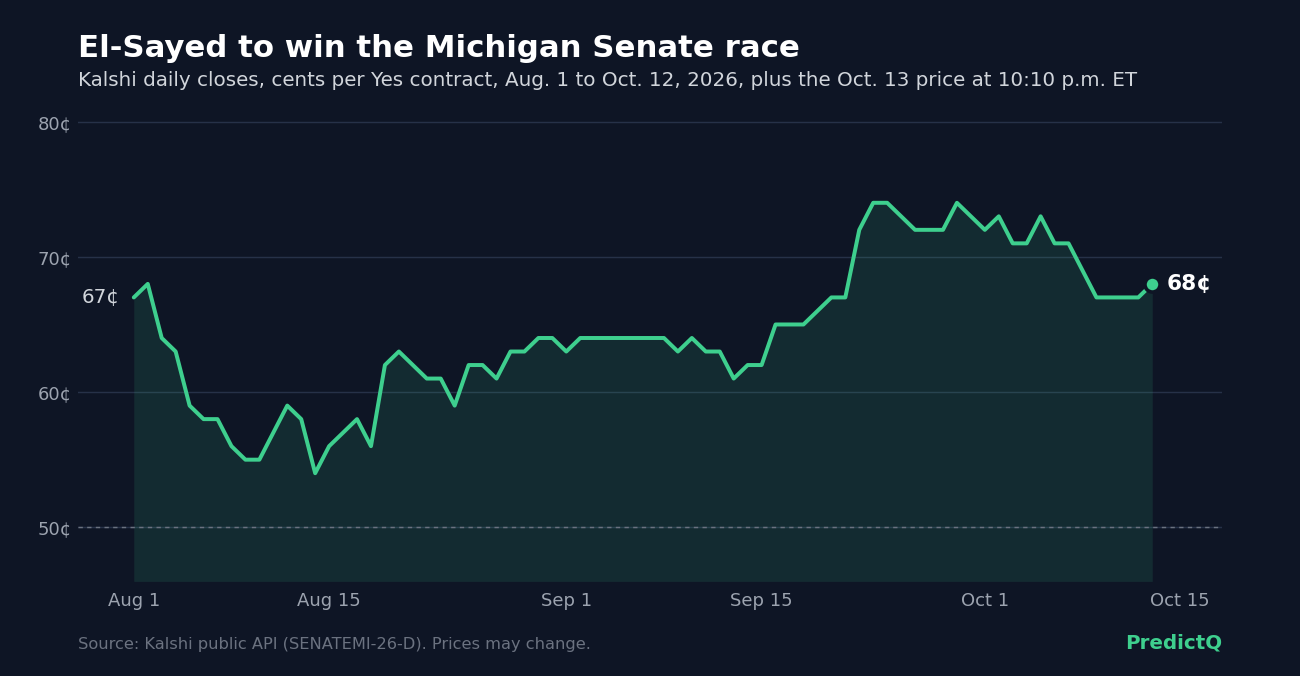
Michigan Senate, El-Sayed 71 to 68 (-3). Abdul El-Sayed, the former Detroit and Wayne County health director who finished second to Gretchen Whitmer in the 2018 governor's primary, faces Mike Rogers, the former congressman who was also the Republican nominee in 2024. The first debate was Oct. 8 in Grand Rapids. The contract closed at 69 that night and 67 the next day, and it was 68 Tuesday night. Kalshi's Oct. 9 write-up described a fall from 73 to 67 cents around the debate. The polls cited for the window showed small El-Sayed leads: Quantus 48-47 (Oct. 5 to 6), InsiderAdvantage 48-46 (Oct. 9 to 10), and Wedgewood 53-47 (Oct. 8 to 9). The race also drew attention for Trump's attacks on El-Sayed and his praise of Rogers's debate performance. Reported spending exceeded $200 million, with Republican-aligned outside groups outspending El-Sayed's allies about two to one since the primary. Those events provide context, not proof of what moved the market. The contract fell during debate week while the cited polls continued to favor El-Sayed. That's a divergence to watch in the other debates.
Iowa Senate, Turek 46 to 40 (-6). Josh Turek, a state representative since 2023 and a two-time Paralympic gold medalist in wheelchair basketball, faces Republican Rep. Ashley Hinson. Here the polls and the market moved together. Emerson has Hinson up 47-45 (Oct. 5 to 6) and CNN has her up 45-43 (Sept. 29 to Oct. 5), after a September in which Turek led more polls than he trailed. RealClearPolling's average is Turek +0.6 as of Oct. 6, so the race reads as a tie in the polling and a 40-cent Democrat on Kalshi. The first debate was Oct. 7 in Des Moines, with the candidates clashing over the Iran war, tariffs and costs. The second was Oct. 13, and the contract went from 42 in the afternoon to 40 by 10 p.m.
Texas Senate, Talarico 67 to 65 (-2). Talarico, a Democratic state representative, faces Attorney General Ken Paxton. Four polls landed in the window and they split. ReconMR/Siena has Talarico up 48-44 (Oct. 5 to 8), Trafalgar has him up 47-44 (Oct. 6 to 8), and both Quantus (Oct. 9 to 11) and UMass Lowell (fielded Sept. 18 to 28, released Oct. 8) have it tied at 47 and 45. RealClearPolling's average is Talarico +2.7. On the money side, Punchbowl reported Oct. 6 that Texas PAC, the Senate Leadership Fund affiliate backing Paxton, expects to spend more than $50 million in the state, and that Senate Majority PAC is running a digital ad in Texas, its first spending there that we've seen reported. The day-by-day on the flu absence is at the top of this edition.
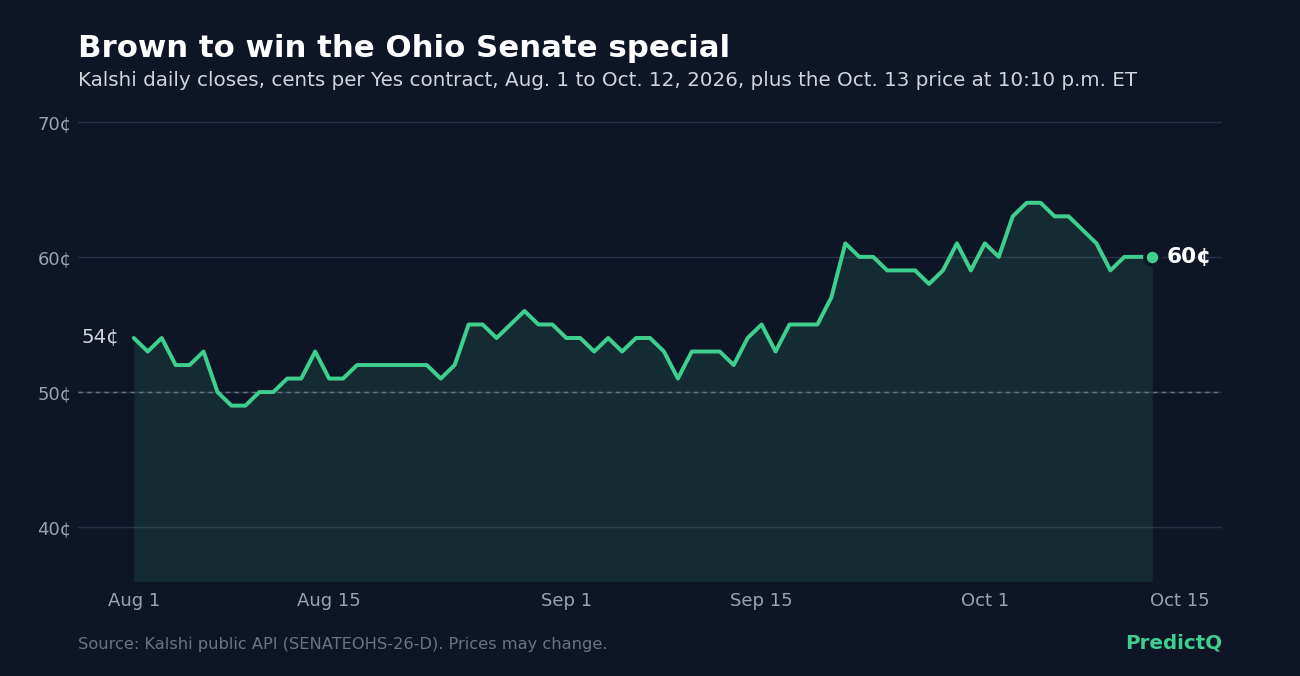
Ohio Senate, Brown 63 to 60 (-3). Sherrod Brown, who served three terms in the Senate before losing to Bernie Moreno in 2024, is running for Ohio's other seat against Jon Husted, appointed in January 2025 to fill JD Vance's vacancy. This is the one where the market and the polls disagree. CNN's poll released Oct. 8 has Brown up 49-43, RealClearPolling's average is Brown +3.1, and a CNN analysis of Ohio Secretary of State early-vote data found that in counties Trump won by 20 points or more, the Republican edge among early voters shrank from 30 points at this stage of 2024 to five, with the state at about 11 percent of its 2022 early turnout. The contract fell anyway, to 59 on Oct. 10, and sits at 60. The one recent poll with Husted ahead is co/efficient's 46-45. Trump held his Youngstown rally with Husted on Oct. 12, so next week's chart will show whether the market reads that as a plus.
Nevada governor, Ford 55 to 52 (-3). Aaron Ford, Nevada's attorney general since 2019, is challenging Gov. Joe Lombardo. The Oct. 6 close of 55 was the contract's high since early August; it has drifted a cent at a time since. We found no poll or spending news in the window to pin it on.
Ohio governor, Acton 66 to 69 (+3). Amy Acton, who ran the Ohio Department of Health from 2019 into the first months of the pandemic, faces Vivek Ramaswamy. Up while Brown was down, in the same state, in the same week. Both Democrats share the early-vote data above and the same Trump rally. We don't have an explanation for the split.
Kansas Senate, Hamilton 36 to 37 (+1). Adam Hamilton, the pastor who founded the Church of the Resurrection, faces Sen. Roger Marshall, who is seeking a second term. NYT/Siena's Oct. 3 poll has it 45-45 and the Senate Leadership Fund's $14 million is on the air. Marshall is 64. The deeper look we promised is below.
The rest of the board
Texas | James Talarico (D) vs. Ken Paxton (R) | 65¢ | 67¢ | -2 |
Maine | Troy Jackson (D) vs. Susan Collins (R) | 57¢ | 57¢ | 0 |
Ohio, special | Sherrod Brown (D) vs. Jon Husted (R) | 60¢ | 63¢ | -3 |
Michigan | Abdul El-Sayed (D) vs. Mike Rogers (R) | 68¢ | 71¢ | -3 |
Iowa | Josh Turek (D) vs. Ashley Hinson (R) | 40¢ | 46¢ | -6 |
Alaska | Mary Peltola (D) vs. Dan Sullivan (R) | 74¢ | 75¢ | -1 |
Kansas | Adam Hamilton (D) vs. Roger Marshall (R) | 37¢ | 36¢ | +1 |
New Hampshire | Chris Pappas (D) vs. John E. Sununu (R) | 90¢ | 90¢ | 0 |
North Carolina | Roy Cooper (D) vs. Michael Whatley (R) | 96¢ | 97¢ | -1 |
Georgia | Jon Ossoff (D) vs. Mike Collins (R) | 95¢ | 96¢ | -1 |
Maine held at 57, even with a Washington Post-Schar School poll on Oct. 9 putting Jackson ahead 50-46. The safer seats got a little less safe: North Carolina and Georgia each lost a cent, even as a YouGov/Catawba poll had Cooper up 47-35 and the Senate Leadership Fund stayed out of North Carolina. New Hampshire held at 90 with St. Anselm showing Pappas up 51-44.
Governors: Nevada 52 (-3), Georgia's Bottoms 46 (-1), Ohio's Acton 69 (+3), Texas 20 (-10), Florida's Jolly 21 (-2), Shapiro 99 (+1).
Kansas, the deeper look
Republicans haven’t lost a Senate race in Kansas since 1932. It’s on this board because NYT/Siena’s Oct. 3 poll had the race tied at 45, Cook moved it to Toss Up on Oct. 6, and the Senate Leadership Fund put $14 million into a state it hadn’t planned to spend in, pulling money out of North Carolina to do it. Hamilton’s contract rose from 30 cents on Oct. 1 to 37 on Oct. 13. That’s still a wide gap for a race the polls call a tie: at 37 cents, the market has Hamilton winning a little more than one time in three. Polling error may be part of the reason. Last week’s polling-error section noted that the final 2024 averages understated the Republican by four points in Texas and two in Ohio, and a tied Kansas poll with a miss that size is a Marshall win. The price alone doesn’t tell us that’s what traders are thinking, though. The test over the next two weeks: if the polls stay tied and the contract stays in the high 30s, traders are discounting Kansas polls. If it climbs toward 50, they’ve started to believe them.
What we're watching this week
Debates. Iowa's second was Oct. 13. Maine had one scheduled Oct. 13 and has another Oct. 15. Alaska debates Oct. 15. Talarico's CNN town hall is Oct. 14, with no Texas Senate debate scheduled. Michigan's debate moved the market three cents with the polls flat; we'll see if the others do.
Early voting. Georgia opened Oct. 13, Iowa opens Oct. 14, North Carolina Oct. 15, Texas and Alaska Oct. 19, Michigan Oct. 24. Ohio's first week produced the party-registration numbers in the Brown entry above. We'll track whether Georgia's and North Carolina's do the same and whether the prices notice.
The money. Texas PAC's $50 million-plus for Paxton and the DGA's next move in the governor's race are the two to watch. The Democratic committees have now put money into both Texas races; the question is whether it's enough to show up in the ad counts.
Early-vote composition and prices. Ohio is the first test of something we flagged last week: the party makeup of early voters is the first hard turnout data of the cycle, and the Brown contract fell during the week it came out. One week isn't a pattern. Three would be.
This article includes links to PredictQ partners Kalshi and Polymarket. We may earn a commission if you use our partner links. It doesn't cost you anything extra, and it helps keep the lights on here. Nothing in this piece is investment advice or a trade recommendation. Prices, odds, and entry counts can change. Availability depends on the platform, product, and your location; check each platform's age and eligibility requirements before trading.