
Thirty days in, and the clock finally ran out. Well, the first clock did anyway.
The standard Funding Predicts challenge allows 30 days to hit the profit target. If you're above breakeven with a week left, they will throw you an extra 15 to make it happen. So, I have 15 days left to speedrun the entire challenge with almost no room for error. $70.21 of room to be exact, thanks to the trailing drawdown. One bad $100 ticket and the diary turns into an obituary... please get ready to pour one out.
Here’s where I stand: the scoreboard, the longshot problem, the math of a comeback with no room to take a real swing, and my plan for the last 15 days.
A quick note on the numbers: every price and P&L below comes straight from my Funding Predicts trade log. Prices are Polymarket prices, since that's the book the challenge mirrors. Pass rates come from my own simulation of the challenge rules, not from Funding Predicts or PredictQ.
New Here? The Challenge in 60 Seconds
A prop firm (short for proprietary trading firm) lends you capital to trade with once you prove you won't light it on fire. Funding Predicts is the first one built around Polymarket, and PredictQ paid for their $50K evaluation. It’s a simulated account priced from public Polymarket data, not a live account. The challenge: make $3,000 in 30 days without breaking a rule. The 30 days are up, so now I’m in overtime.
The rules that matter this week:
$2,000 max drawdown, trailing. The floor sits $2,000 below my best end-of-day balance and only moves up. Mine is parked at $49,786.79. Touch it and it's over. (The lava floor.)
$1,000 daily loss limit. Doesn't matter anymore. I'd fall through the floor about $930 before I got there.
35% consistency. No single day can be more than 35% of my total profit. Remember this one when we get to the comeback math.
The extension. Used. There's no second one
The Scoreboard: Down $143, $70 of Room
Balance: $49,857 (-$143)
Full-unit record: 52-44 (54%)
Every ticket: 54-54
Longshots: 2-12
Drawdown floor: $49,786.79, which leaves $70.21 of room
Left to target: $3,143
Days left: 15 (the extension)
Full-unit plays are my standard-size tickets. Longshots are the small fliers I sprinkle on the side.
How are you supposed to know you’re in the good ol’ days before they’re gone? To be fair, I didn’t expect October’s 18-5 to last. I just didn’t anticipate November punching me in the face the way it has.
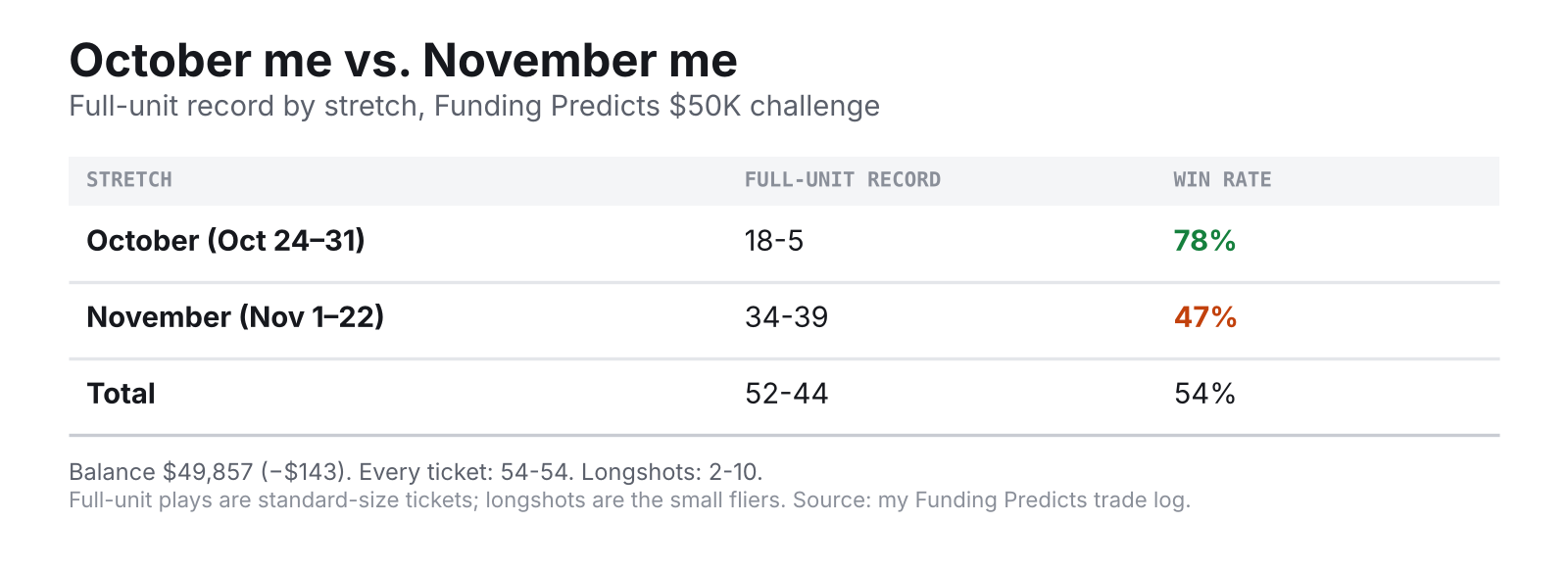
This week, the account slid another $157.16, from $50,014.16 to $49,857. The lava floor went from $227 of room beneath my feet to a terrifying $70. On paper, that’s just a slow leak, not a free fall. But with this little room, a slow leak can end me just the same.
My best trade this week was a nice 3-leg Moneyline NBA combo (Hawks, Thunder, Cavs) that didn’t make me sweat. My worst trade also didn’t make me sweat, but that’s because the New Mexico Lobos got blown out as soon as the ball tipped off against Wichita State. Why do I keep on trying to make College happen for me?
At my usual 55¢ entries, I would need to win about 55% to break even. In November I've won 47%. That's the whole story in two numbers.
The Longshot Problem: 2-12
Twelve fliers, two dubs. I am showing a tendency to live trade on pre-game favorites if they get behind early. It worked when I chased Texas in the fourth quarter against Missouri, but I got burned last night when I thought the Jags could mount a comeback against the Giants.
Last entry I bragged that fliers stayed fliers (small size, $50 or less). They did. They just also lost.
With $70 of room, longshots are the only tickets that can still move the needle:
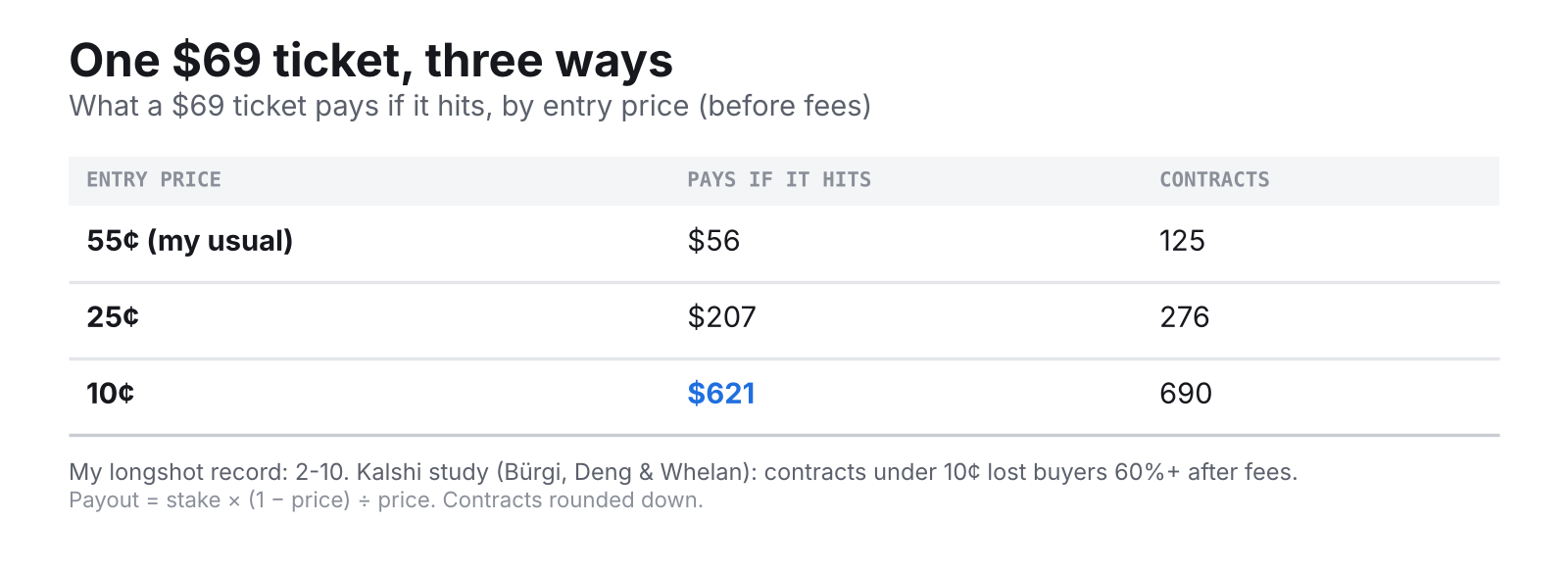
The math is begging me to buy lottery tickets. My record is begging me not to.
And it's not just me. A study of Kalshi by economists at University College Dublin (Bürgi, Deng and Whelan) found that buyers of contracts under 10¢ lost more than 60% of their money after fees. Longshots are overpriced on average, for everyone, but that’s just a result from the study’s Kalshi sample, not a forecast for every market.
Three Roads to $53K From $70 of Room
One thing, and really the only thing, works in my favor: the floor is parked until I close above $51,786.79. So every dollar I win right now is a dollar of breathing room. The catch is I have to win first, with tickets small enough that one loss doesn't end it.
I broke it down into three roads I can take to bring me back. Here's what each one takes (simple math, before fees):
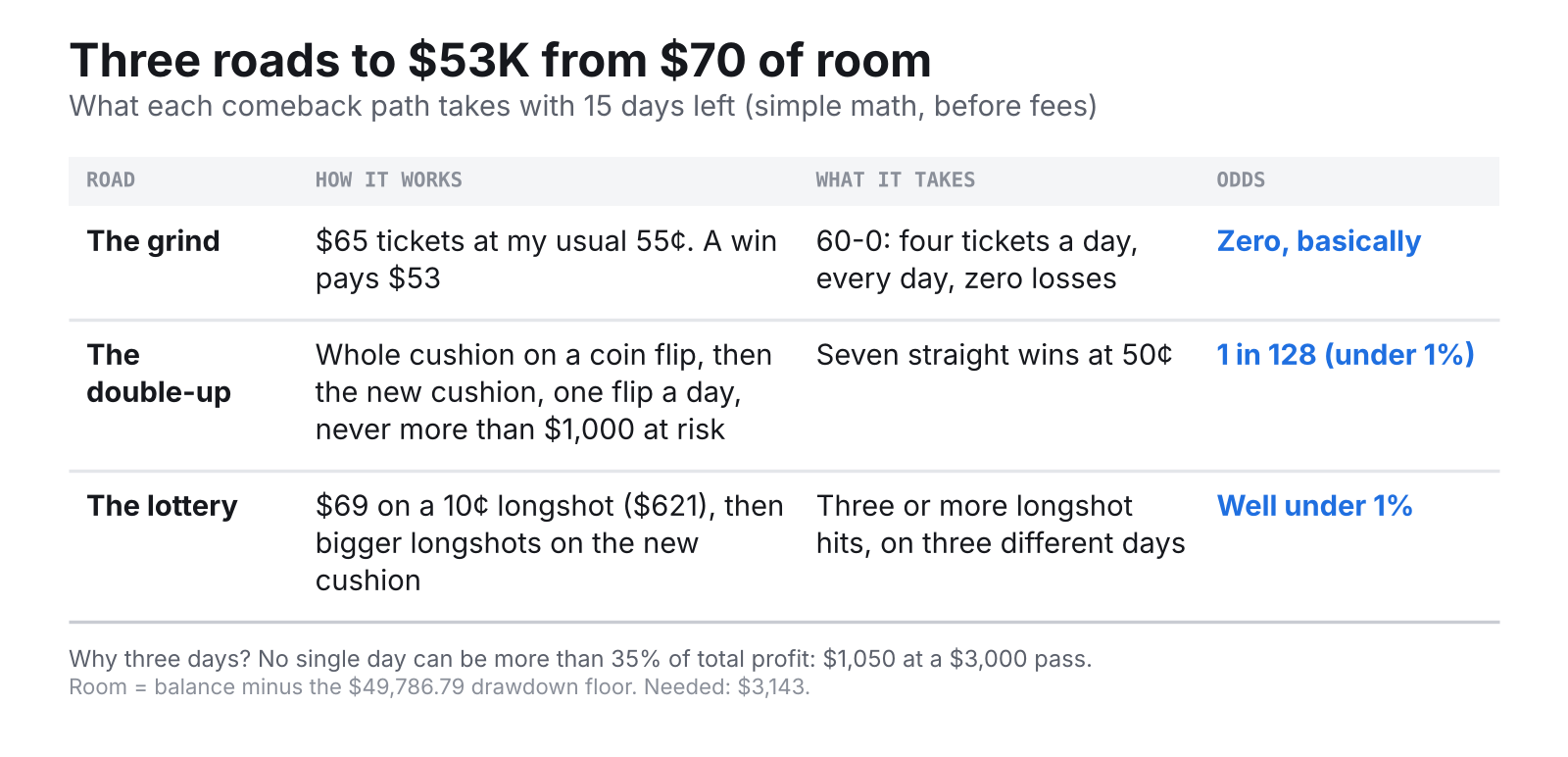
Since the challenge states that no single day can be more than 35% of the total profit, no single ticket can save me at this point. With a $3k target, my biggest win in a given day can only be $1,050.
Not a great spot to be in. The grind is too slow, the double-up is pretty much nailing a seven-leg parlay, and the lottery has to run through my 2-12 record on longshots. I’m going to have to get creative.
My Road: $10 Longshots
My only real chance is a mix of all three roads. No $69 lottery ticket, and no $100 ticket that can end it in one loss. I'm rebuilding the cushion $10 at a time, on longshots.
A $10 ticket at 10¢ buys 100 contracts. If it hits, that’s $100 back minus the $10 stake, or $90 in profit before fees. That more than doubles my cushion. A miss costs $10, so I can survive six in a row. The seventh ends it.
My longshot hit rate so far: 2 for 12, or 17%. That's enough at 10¢ and 15¢. It's not enough at 20¢ and up.
I ran this plan through the sim: $10 longshots priced 10¢–15¢, up to four a day, for 15 days, at fair odds.
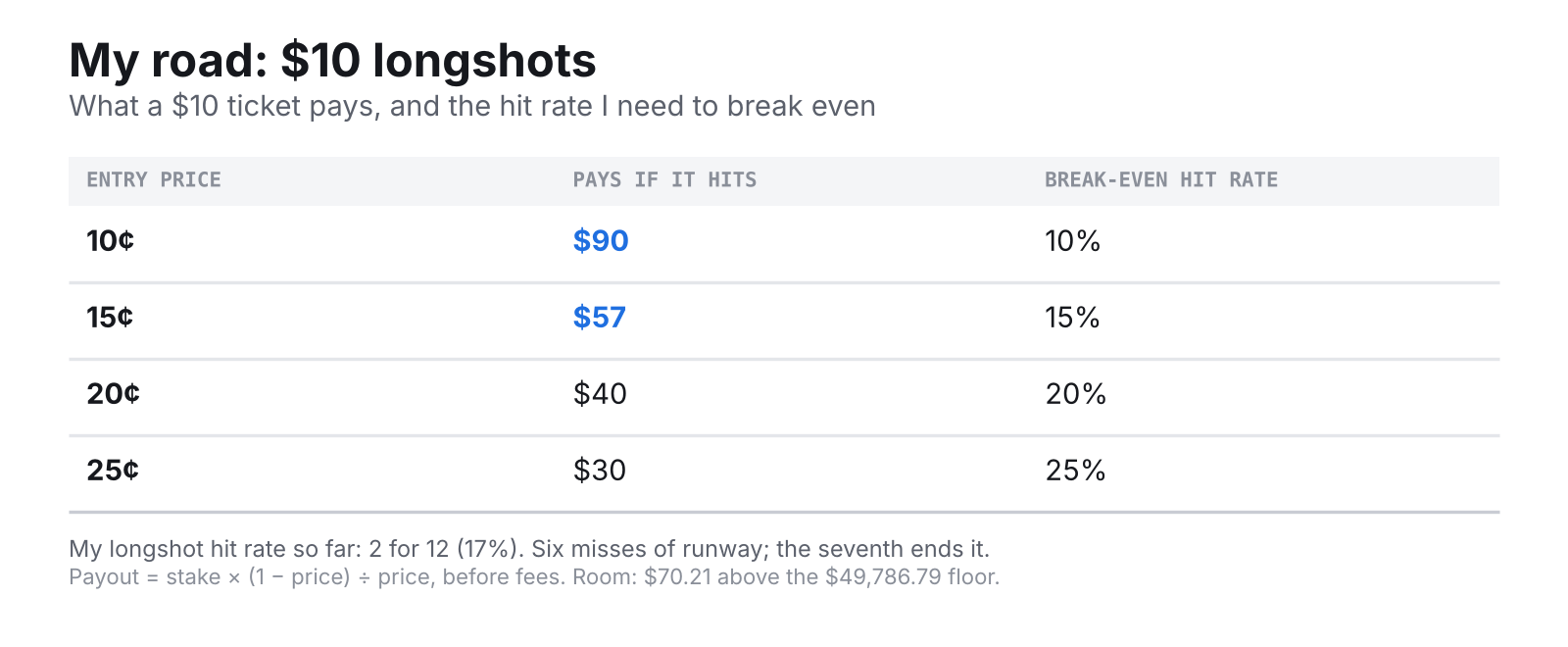
So, $10 longshots might buy me time and a real shot at doubling the cushion. They’re just not the way to come all the way back and pass. So the plan has three stages:
Rebuild: $10 longshots until I have about $200 of breathing room.
Grind: regular tickets, capped at room minus $20, until I have about $500.
Double up: one flip a day to $53K, so no single day breaks the consistency rule.
Sounds easy, right?
The Final Stretch: The Swing Factors
A new room rule. No ticket bigger than my room minus $20 (for fees and a bad fill). At $70.21, that's a $50 max. The old rule said $100, which means betting the whole challenge on one ticket.
Win first, size later. Every dollar I win is a dollar of room until I'm back above $51,786.79. Back to $100 tickets only at $500 of room, which means a balance of $50,286.79.
$10 longshots to rebuild. No more $69 swings. Every longshot is $10, which gives me six misses of runway, and I stick to 10¢–15¢ prices, where my 2-for-12 hit rate is good enough to break even. Regular tickets come back once the room is over $200, still capped at room minus $20. Combos (parlays) will be my new bread and butter.
One game, one ticket. Still the rule. The Pelicans still owe me $469.74.
The honest goal. The sim puts my odds of passing at about a 1-in-100 shot now. So the real goal for the last 15 days is simple: trade like October me, follow every rule on the card, and if the lava floor gets me, make sure it's on a ticket I had every business placing.
Let us know in the Discord: can $10 longshots rebuild the cushion, or am I just bleeding slower?
Funding Predicts evaluation and funded accounts are simulated and priced from public Polymarket data. PredictQ paid for the evaluation. This series documents my own experience with it and isn’t an endorsement of Funding Predicts. Pass rates come from my own simulation of the challenge rules, not from Funding Predicts or PredictQ. My sizing, math, and plan may not be profitable and aren’t meant as a strategy guide for anyone else.
This article includes a link to PredictQ partner Polymarket. We may earn a commission if you use it. It doesn't cost you anything extra, and it helps keep the lights on here. Nothing in this piece is investment advice, and prices, odds, and entry counts can change.