
Nine days in the books, and the account is still breathing.
I rode Week 1 of the Funding Predicts challenge to a record of 18-8, or 69% (nice). That puts me at +$1,405.67 on the account, 47% to the $3,000 profit target. It also gave me a Sunday that reminded me that trading is not for the faint of heart.
Day 0 was the gameplan, and Week 1 was the first time the plan punched and got punched back, hard. Some of my rules held strong, a couple others bent like rubber, and one of the leaks I put in writing showed right on schedule. Here’s the full recap: the scoreboard, the trade of the week, the hold I regret and the Red Sunday that walked me toward the lava floor.
A quick note on the numbers: every price and P&L below comes straight from my Funding Predicts trade log. Prices are Polymarket prices, since that's the book the challenge mirrors. Pass rates come from my own simulation of the challenge rules, not from Funding Predicts or PredictQ.
New Here? The Challenge in 60 Seconds
A prop firm (short for proprietary trading firm) lends you capital once you prove you won't light it on fire. Funding Predicts is the first one built around Polymarket. PredictQ bought a $50K evaluation for me to trade: a practice account that trades live Polymarket prices. Pass the test and I get a funded account with real payouts. Break one rule and the account is cooked.
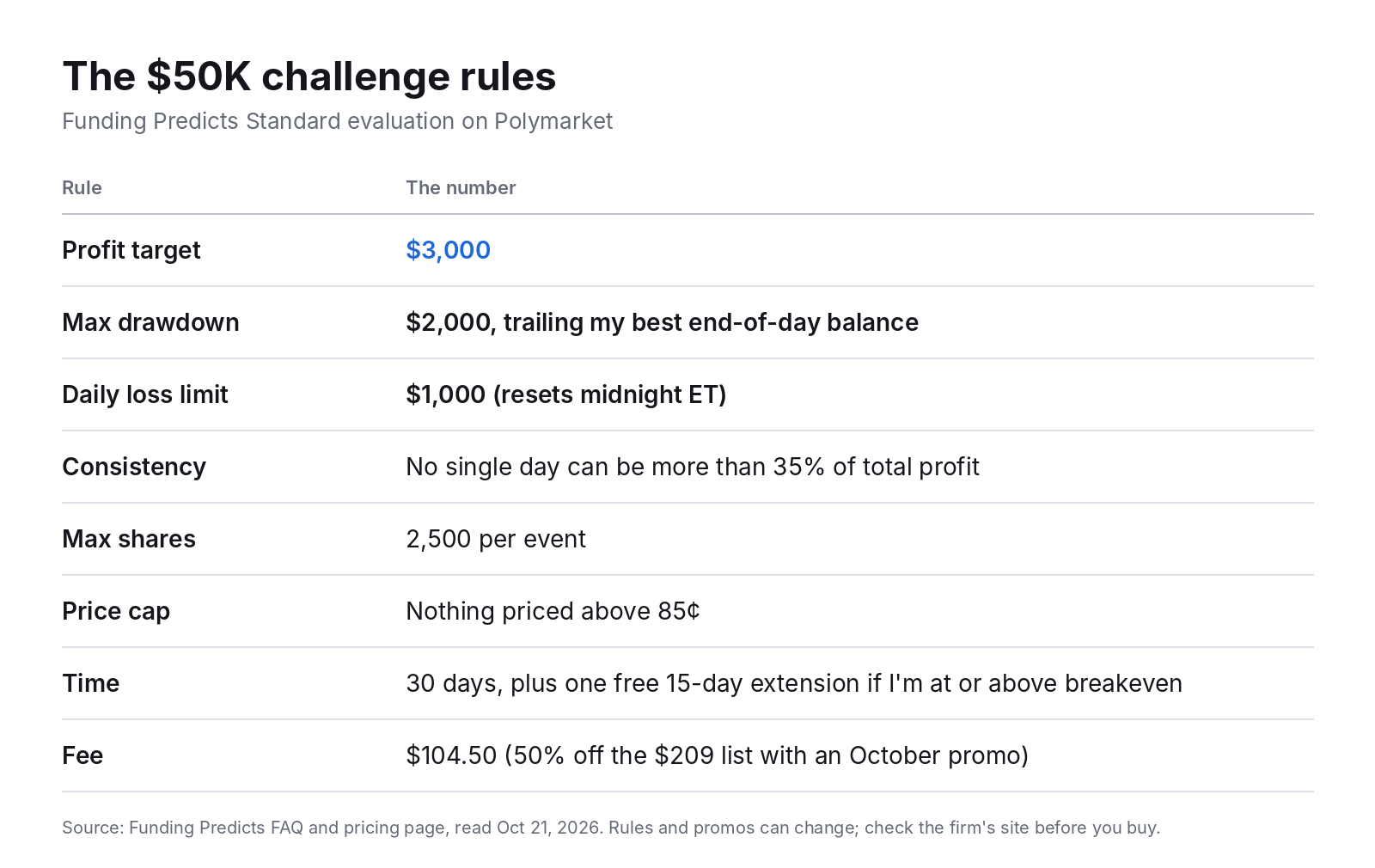
The test in one breath: make $3,000 in 30 days without breaking a rule. The rules that matter:
$2,000 max drawdown, trailing. The floor sits $2,000 below my best end-of-day balance and only moves up. Touch it and it's over. The floor is lava.
$1,000 daily loss limit. Open positions count, not just closed ones.
35% consistency. No single day can be more than 35% of total profit. At a $3,000 pass, that's $1,050.
85¢ price cap. No farming big favorites.
My personal plan from Day 0:
$250 Max loss per trade
2-4 trades per day
Coin flips over favorites
Limit Orders
Daily stop of -$500
Daily cap of +$900
The full game plan lives in Day 0.
The Scoreboard: Almost Halfway There
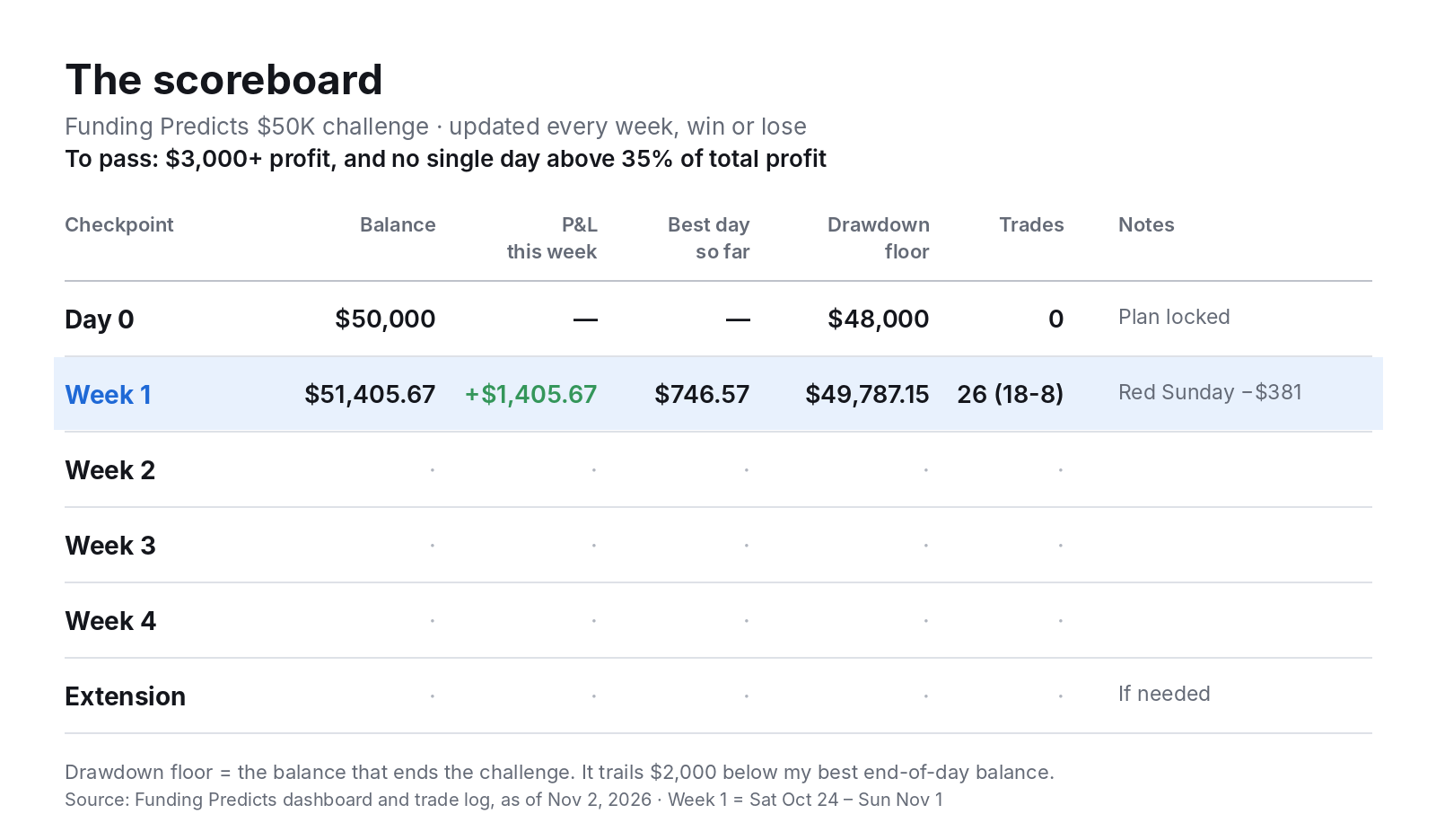
Nine trading days (Sat Oct 24 – Sun Nov 1), 26 trades, one balance line that mostly went the right way.
Balance: $51,405.67 (+$1,405.67)
Record: 18-8
Best day: +$746.57 (Sun 10/25)
Worst day: −$381.49 (Sun 11/1)
Drawdown floor: $49,787.15, which leaves $1,618.52 of room
Left to target: $1,594.33
Why 18-8 is "only" +$1,405.
My average winner made $181.65 and my average loser cost $233.06. Positions trading at 55¢ don't pay a full unit, and I sold 10 of my 18 winners early, between 86¢ and 99¢, instead of sweating out the last few cents. Losers, on the other hand, cost the whole $250. So every loss eats about 1.3 wins. My break-even win rate is around 56%, I am currently showing 69%. Comfortable certainly, but not bulletproof.
Why a Green Week Left Me With Less Room
Here’s the part that stings. The floor trails my best end-of-day balance, not my current one. My best close was $51,787.15 on Saturday, so the floor climbed to $49,787.15. Then Red Sunday knocked $381 off my balance, and the floor didn’t budge. Floors only move up.
So after a +$1,405 week, I have $1,618.52 of room. On Day 0, I had $2,000. More money, less cushion. One more bad afternoon (-$119) and my unit shrinks to $200.
One Game, Two Decisions: Panthers vs Packers
Thursday night handed the Panthers a beatdown and handed me two difficult decisions. I dont usually double up on one game, but I came into this one like Aaron Rodgers sprinting out of Metlife with the American Flag. Brimming with confidence. We all remember how that ended four snaps later, and my night almost went the same way.
Trade One, the Sell.
I bought YES on the over of 46.5 (52¢) in this one. I was pretty confident the Packers would be able to move the ball with Jacobs back against a Panthers team that just got thrashed by 43 by the Bucs just four days prior. And for the Panthers, I expected a nice bounce back from Bryce Young & co.
Flash forward to the fourth, Carolina’s looked awful. Bryce is a pumpkin seeing pressure every time he drops back, Coker is doing cardio, and they’ve put together one TD drive in 3 ½ quarters. But, right now, they have a drive going, down 27-13. Perfect. Just 7 needed to cash the ticket and the Panthers will surely get a garbage time score here. As they painfully and haphazardly moved the ball deeper into Packer territory, a revelation shone on me like God's Light on a Sunday morning. If the Panthers score here, they are going to go for two. And if the Panthers go for two, they are not getting it, because they stink. Teams going for two down 14 has become the new norm in the NFL (make it and the next touchdown wins; miss it and you still get a second shot to tie). So the over didn’t just need a struggling offense to score a touchdown, it needed a touchdown and a coinflip.
I had the trade up on my laptop as I watched Bryce find Coker for touchdown and watch my position fly up the chart. I ended up selling at 86¢ (saw a bid hanging at 94¢ but couldn’t move fast enough to grab it). My math: if the two-point try is a coin flip and there’s not much clock left for anyone to score again, 86¢ is a gift. And it was (+$158.13). They failed the two point conversion, and the total ended up 27-19, which would've had me eating a full -$250 by a half-point. That one click was a massive, $408 swing for me and the account.
Trade Two, The Hold.
The second position I bought in this game was NO on the Packers to cover -4.5. Yes, I purposefully and intentionally backed the pumpkin-led Panthers. They ended up getting the ball back down 8 with a few minutes left in the game and found themselves in a good field position, probably 15 minutes of real-time after I chose to take profit based on their ineptness. I glanced at the ticket. It was down to 43¢, a far cry from its initial 54¢, but way up on what it was showing me the past 2-3 quarters. So, do I take a $50 L and move on from TNF, or do I hold my ground and see if Carolina can do what I didn’t think they could just 15 minutes prior? I knew they couldn’t move the ball easily all night but I chose to hold anyway. -$253.45
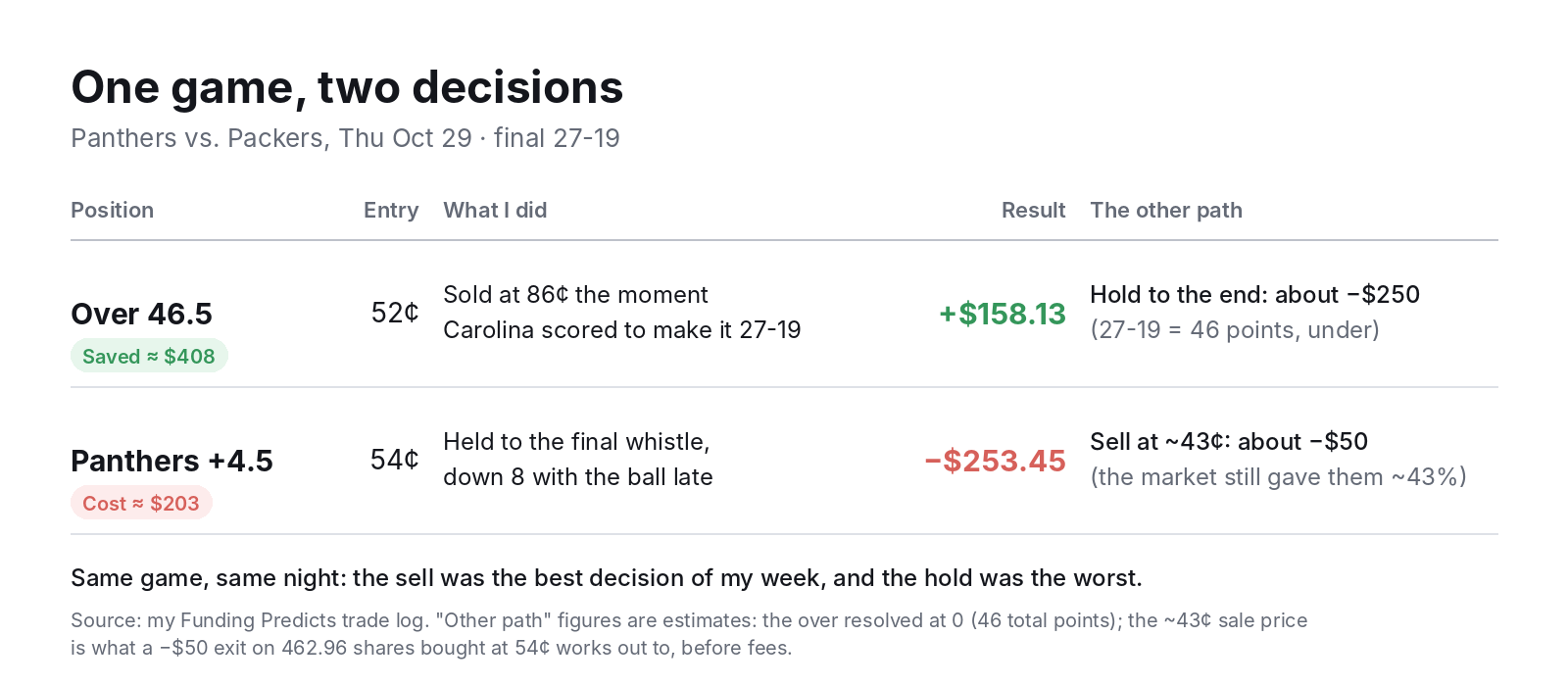
Best decision of my week and worst decision of my week, same game, same night. The difference? On the over, I asked what the market was missing. On the spread, I asked what I was hoping for. Which version of me shows up next Thursday?
The Heat Giveth (After the Heat Taketh)
Saturday, Day 1, the Heat cost me $255 on my very first trade on the account. A full unit on their moneyline against the Hornets at 58¢, plus a $5 lottery ticket at 4¢ when they were down nearly 30 (I’m not proud of the lotto shot but they did end up tying this game late just to get my hopes up one last time). -$255
Monday, I went back to the well: Heat −5.5 at 59¢. When that one went south, I tried to add $50 (got filled for $44.78) at 20¢. Yes, that’s the doubling down you’ll see in the rule check. -$294.78.
Two bets on the Heat, two losses. Down $549.78 on one team.
Four days later, the Heat were 0-4 and priced like it. But they'd shown signs of life, and I thought the board was treating them like they were already done. I grabbed the Heat moneyline vs. the Hawks at 45¢ as the underdog. They won. +$305.56, my biggest single win of the week.
I put out a confessional surrounding the Heat’s slow start and my tailing of them during this start. Check it out here to find out why I decided to back on them for a third time. It's like an angel sighing...
Jokes aside, that is the trade I want more of: a team the market is lower than I am on, a price I believe fell further than the team did, and a full unit behind the read. Is Miami turning the corner? Or will they be letting me down again in the near future?
The Rule I Broke on a Winner
Saturday night (10/24), I caught a nice live spot on Texas -2.5 at 51¢ against Ole Miss. Good read, I sold it less than 30 minutes later for +$151.41.
The problem? I only put $175 behind my conviction, not my $250 unit.
At full size, that same trade pays out about $216. I left roughly $65 on the table because I clicked buy before I was fully convinced. If a trade is good enough to take, it needs to be good enough for the full unit. If it isn’t, it needs a pass. Half-confidence sizing just turns my good reads into smaller wins.
The Red Sunday
I should’ve known something was afoot when I woke up to a violinist rendition of The Rains Castamere Sunday morning. Instead, I filled my bag with Geno Smith and Mike McDaniel and took a crossbow bolt to the chest.
Every challenge has one. Mine was Sunday, Nov 1.
Raiders vs. Jets, the Geno Smith special: −$253.45
Chargers +7.5: −$253.30
Chargers moneyline at 27¢ (a $50 flier) -$51.10
One winner, a 2.5-point Bills spread sold at 98¢: +$176.36
-$381.49, my worst day of the challenge so far. And yes, I bet on the literal winless Chargers. Twice.
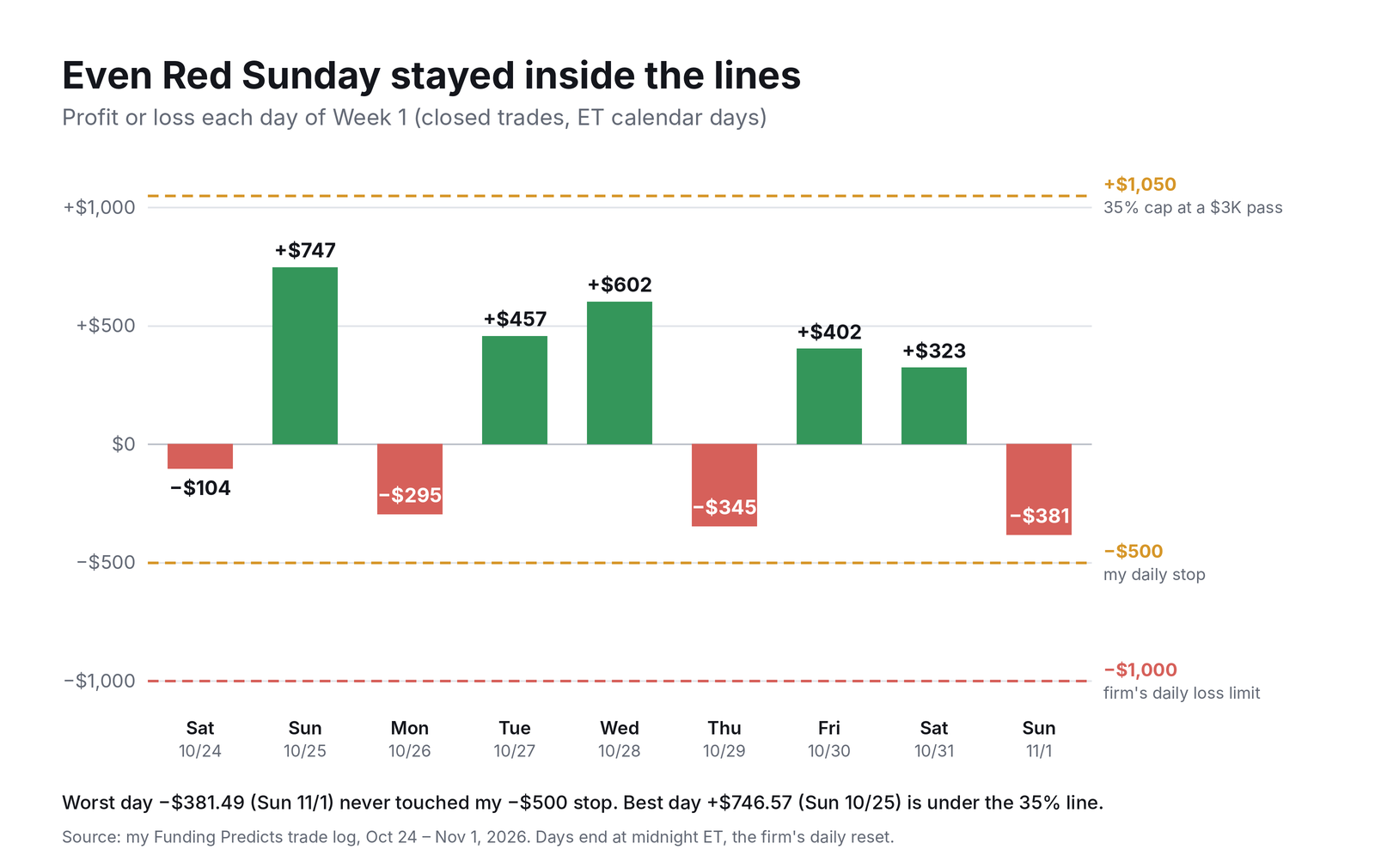
The good news though, is that I stayed inside my loss limits. My -$500 daily stop never triggered, the firm’s -$1,000 limit never came close and every ticket went in before 1PM kickoffs. No revenge trading or trying to chase the Eagles on primetime to turn a red day green. The Sunday tilt never showed up.
The Lannisters send their regards.
Rule Check: Holding Myself to It
On Day 0 I put my rules in writing, so here's the report card, straight from the trade log.
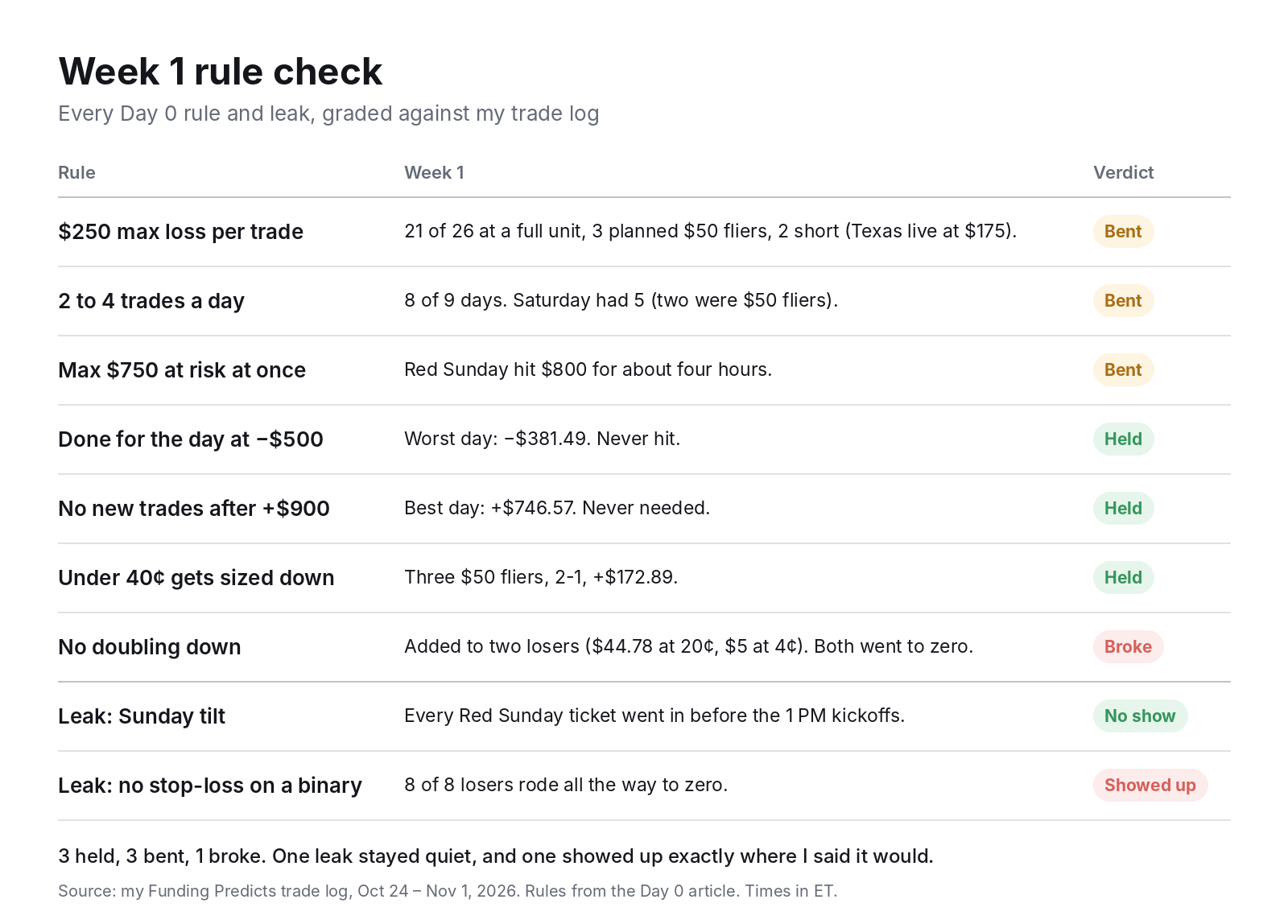
The headline: 3 held, 3 bent, 1 broke.
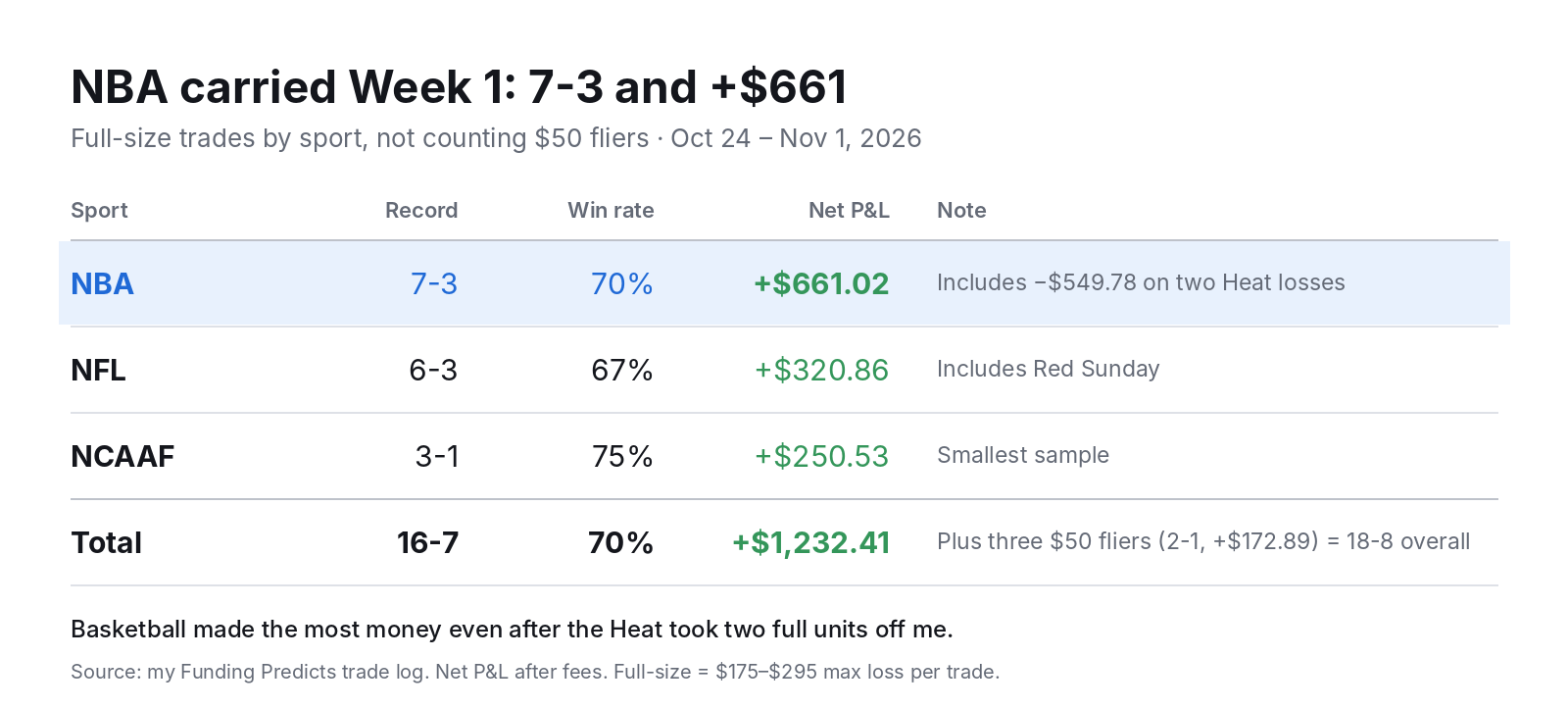
What held. I never hit my −$500 stop and never needed the +$900 profit cap. My three longshots under 40¢ were all $50 fliers and went 2-1 for +$172.89. Coin flips did the heavy lifting: entries between 40¢ and 60¢ went 16-7 for +$1,232.41.
What bent. Saturday had five trades (my max is four). Red Sunday had $800 at risk at once (my cap is $750). And Texas went in short of a full unit.
What broke. No doubling down. Twice I added to a position that was already losing: $44.78 at 20¢ on Monday, and that $5 lottery ticket on the Heat. Small money, but it's the habit, not the dollars. Both went to zero.
The leak that showed up. "No stop-loss on a binary." All eight of my losers rode all the way to zero. All eight. I called it on Day 0 and Week 1 proved it's real. Panthers +4.5 is the poster child: a -$50 exit on the table and I took a −$253.45 instead. Starting now, every ticket gets an exit price written down before I enter, and I actually use it.
What the Sim Says After a Green First Week
On Day 0, my simulation said this plan passes about 38% of the time with a real 2¢ edge. I reran the same 20,000 simulations from where I sit today: $1,405.67 banked, $1,618.52 of room, 21 days on the clock plus the free extension (15 more free days if I’m at or above breakeven).
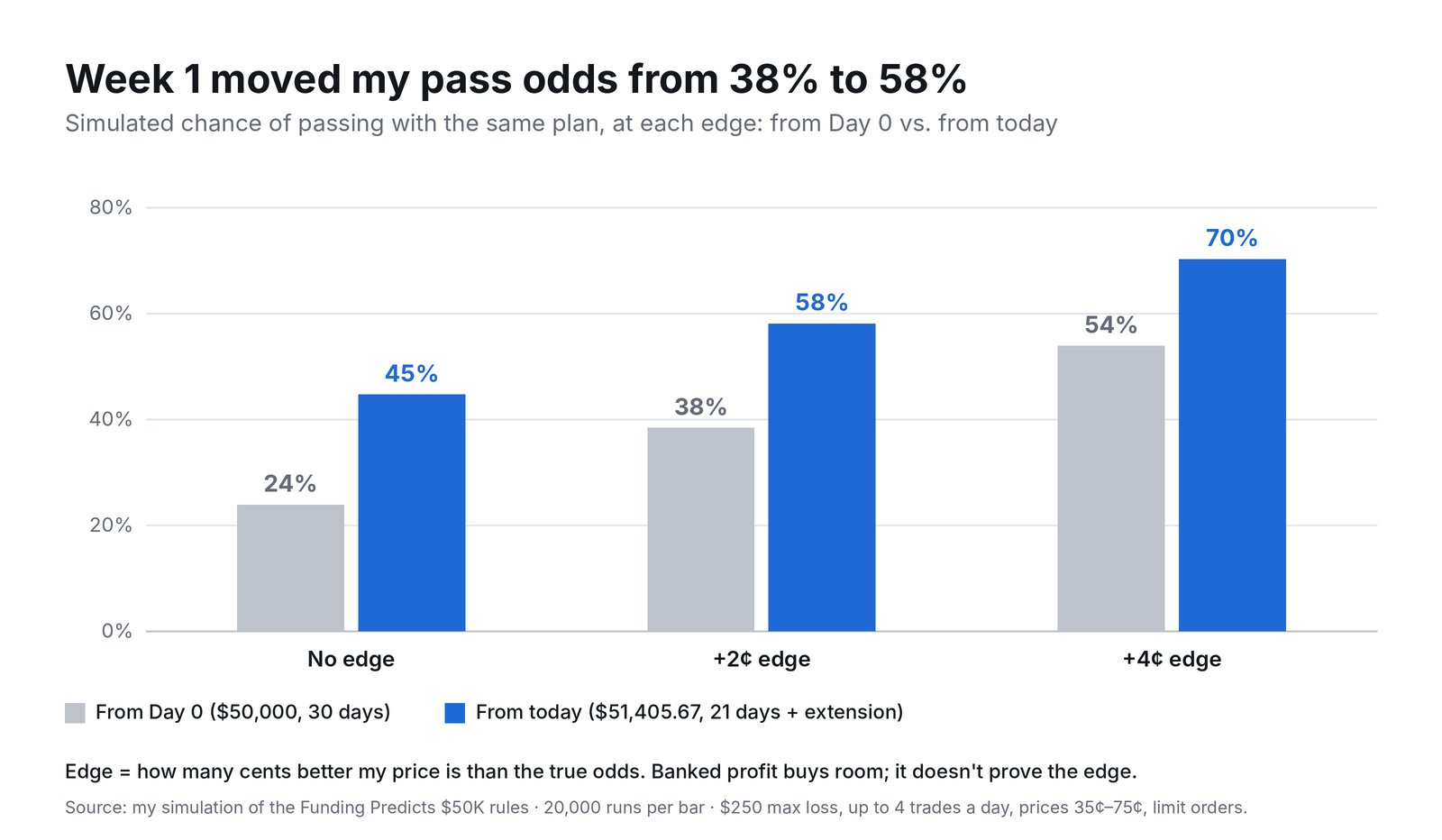
With a +2¢ edge, my odds are now 58%. Even with zero edge, the money already banked gets me to 45%.
Now the honest part. Banked profit buys room; it doesn't prove skill. My average entry was about 52¢, so with no edge at all I'd expect 13 or 14 wins out of 26. I got 18. Promising, but 26 trades is a tiny sample. Weeks 2 and 3 decide whether this is an edge or just a heater.
Week 2: The Swing Factors
The $52K line. Close a day at $52,000 and the lava floor locks at $50,000 for good. I'm $594.33 away.
The $200 trigger. My room is $1,618.52. Lose another $119 and it drops under $1,500, the point where my unit shrinks to $200. Size by room, not by account.
The hardwood. I’m 7-3 on full unit NBA trades (+$661). If that holds, basketball might deserve more of my attention than the gridiron.
My first sold loser. The exit prices are written down. Now I have to actually click sell on a loser before it hits zero.
$1,594.33 to go. That's about $76 a day over the next three weeks. No hero bets required.
Let us know in the Discord: do I pass, or is this account just waiting to get burned by the lava floor?
Funding Predicts evaluation and funded accounts are simulated and priced from public Polymarket data. This series documents a challenge purchased by PredictQ and traded by me, and is not an endorsement of Funding Predicts. Pass rates mentioned above come from my own simulation of the challenge rules, not from Funding Predicts or PredictQ. My sizing, my math, what I'm hunting and my overall plan may not be profitable and are not meant to be a strategy guide for others. The purpose of this series is to document my own experience and journey with the challenge.