
The Four Agreements, by Don Miguel Ruiz, was published in 1997 and still holds water today. The four agreements, through his eyes: be impeccable with your word, don’t take things personally, don’t make assumptions, and always do your best. Sounds good to me. My question is: Was Ruiz secretly writing for traders?
Markets don’t care about your feelings, your convictions or how right you were last time. A strong process won't guarantee a profit, but it can help you avoid turning one wrong call into a much bigger problem. Here's how I'd translate those four agreements for prediction-market traders.
Agreement 1: Be Impeccable With Your Data
Ruiz’s original agreement is about your word and being true to it. The trading version is about not lying to yourself about your record.
Ask a struggling trader how they’re doing and you’ll usually only get a highlight reel: three great calls they made that’s keeping them from hitting the “deposit” button. Very rarely will you get shown the whole story. And honestly, they may not even know the whole story themselves. Be honest with yourself and log your trades. Yes, even the losers. Especially the losers. A logged, complete trade history is the only real way to see if you have a real, repeatable edge. So many contracts resolve on binary, one-off events (an award show, an election, a single game), so it’s nearly impossible to distinguish whether you have an edge or if you’re benefitting from some “run-good” if you are not tracking each trade.
A useful log isn’t just a win/loss column either. It has the date, the market, your entry and exit, your sizing, the price you got versus where it closed, and a sentence explaining why you made the trade. Write the thesis before you know the outcome, not after your ego has edited it.
Be consistent with the log and patterns fall out of the spreadsheet: maybe you thrive in trading NFL player props but are quietly lighting money on fire chasing NHL game totals or reality TV longshots. It’d be difficult to catch that from memory, your memory is policed by your ego, and your ego is only keeping the highlight reel. The log is where your potential edge, and your leaks, stop hiding.
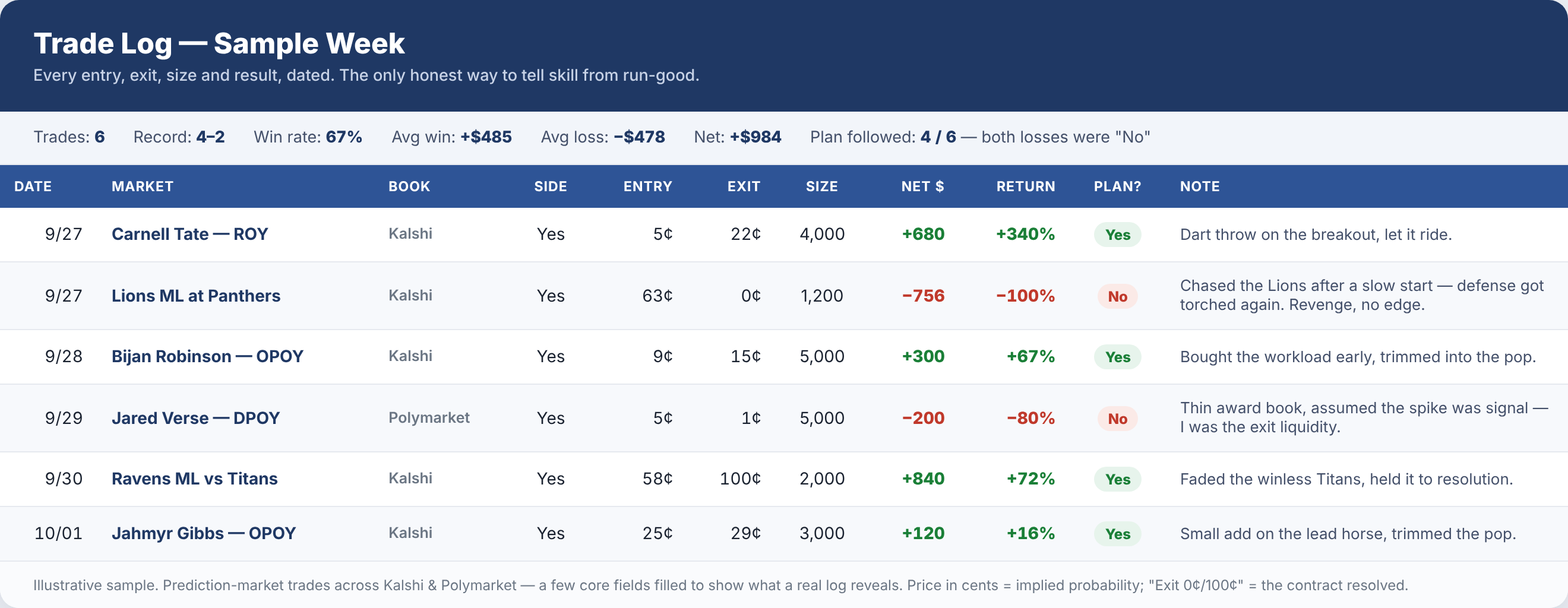
Agreement 2: Don’t Take the Market Personally
This one doesn’t need much translating from the source material. Losses are going to happen. A loss, or even a string of losses, isn’t the market deciding you’re a bad trader, just as a few wins isn’t proof that your process is sound.
We’ve all watched an outcome that looked comfortably in our favor just for it to swing violently the other way at the last second. If an event's true chance of winning is 75%, its chance of losing is 25%. The losses will happen. Don’t be emotionally attached to outcomes you believe you deserve to win. Take enough positions and the math guarantees you will eat those losses; the only variable is how you react, and if you’re ready for when they land.
The real loss isn’t just the monetary one in this case, it’s what you do next. The bad beat stings, the ego flares and suddenly you’re sizing way up on your next trade, one you might even normally pass on just to get the loss back. At that point, you aren’t trading anymore. You are seeking revenge fueled by a sense of false entitlement, and the market will always take advantage of your emotions. The market doesn’t owe you anything, even if you take a loss while having a good process. Do not take the market personally. Variance exists and no one is immune to it. Variance isn’t a message either; a string of losses doesn’t make you a bad trader any more than a hot streak makes you a good one.
This is where the log from Agreement 1 earns its keep. Compare the results with what you expected. Check your assumptions, fees and execution. If the evidence still supports your approach, stick to your risk limits rather than chasing the loss. If it doesn't, change the approach instead of assuming your problem is actually just variance.
And if you feel tilt creeping in, close the laptop. Missing the next trade is better than making it for the wrong reason.
Agreement 3: Don’t Make Assumptions
There's a familiar trap here: we invent a story about what someone else is thinking, then treat our story as fact. Swap out “others” for “the market” and you’ve found a pretty neat way to lose a bunch of trades.
A price moving doesn’t always mean what you assume it means. A contract jumps six cents, and your brain fills in the blanks: smart money knows something, the news is coming, your read was right all along. Or maybe a single large order shoved a thin book and it’s not smart money you’re following; you are the exit liquidity. Before calling price action a “signal”, ask the boring questions: Is the volume here? What information dropped and did you confirm it? Or did you just see green and invent a reason for it?
Don’t assume the “favorite” is always the safe play, or that the underdog is always dead. The market doesn’t deal in safety, it deals in prices, and the prices are typically a reflection of people’s beliefs. Don’t assume the crowd is wrong, and don’t assume they are sharp either. Do your homework. Pull the schedule, read the injury report, do the digging on why a price sits where it sits. Profitable traders develop an edge from being proactive, not reactive. Do the work, don’t assume. Homework doesn't guarantee an edge, but it does give you something better than a story you made up after watching the chart.
Agreement 4: Just Do Your Best
The last one from Ruiz is one I think people misinterpret the most. “Do your best” doesn’t necessarily mean you have to be at your peak every single day. Your best, your A-game, changes. Hopefully it gets better and appears more frequently the more you work on your process. Your best when you’re rested and dialed in is a different beast than your best when you’re tired, tilted or distracted by external factors.
For traders specifically, your best is about the decision, not just the result. You can have a well-supported read and lose, or a terrible one and win. Don’t grade yourself on a single binary outcome. Check your research, entry price, fees and position size. Those are all decisions you can control.
Doing your best also means knowing when your best isn’t great on a particular day. Some days, you’ll see the board so clearly, it may feel like it was made for you. I love those days too. Other days, you may just be dealing with life or simply don’t have a good read on anything and on those days, your best may be going small or not taking any positions at all.
Doing your best is not doing your most. Forcing action on a day you’ve got nothing works against the agreement. The goal is to put in the work, monitor your mental state, pick your spots and leave the rest alone.
Which Agreement Needs Work?
Did Ruiz write this book specifically for traders? No, probably not. But strip the agreements down and it’s easy to see how they fit in the market: keep honest records, don't trade your emotions, verify your assumptions and know what a good decision looks like on the day you're making it. Although none of that creates an edge itself, it does give you a better way to test whether one exists and offers a better chance of avoiding mistakes.
The market rewards the traders who run a strong process long enough to survive being wrong. Find a process that works best for you. Be impeccable with your data, don’t take the market personally, assume nothing, and always do your best. The P&L might just follow.