
Rain prediction markets look straightforward. Either it rains or it doesn't. But knowing that showers are forecast for a city isn't the same as knowing whether its designated weather station will report enough precipitation to settle a contract. Location, timing, and the rainfall threshold all matter, especially when market prices already imply a high probability of rain.
For November 3, 2026, nine markets in our screenshot ranged from 8¢ YES in Indianapolis to 95¢ YES in San Francisco. To understand those prices, it helps to separate two questions. Will an airport record any measurable precipitation? And will it collect at least 0.10 inches?
First, Understand What the Contract Actually Measures
The 0.10-inch threshold is useful for evaluating a more meaningful rainfall event, but it isn't the settlement requirement for the Kalshi daily rain market discussed here. The exchange specifies that a YES contract wins when its designated daily precipitation report is strictly greater than zero inches. Trace amounts count as zero, and the reporting source is The Weather Company. Even a small measurable amount matters. The November 3 Houston market rules specify that threshold and source.
A station could record 0.03 inches and settle a daily rain YES contract while still falling well short of our 0.10-inch analytical benchmark. So probabilities for 0.10 inches can't be compared directly with the prices of the daily YES contracts.
What Today's Rain Markets Are Pricing
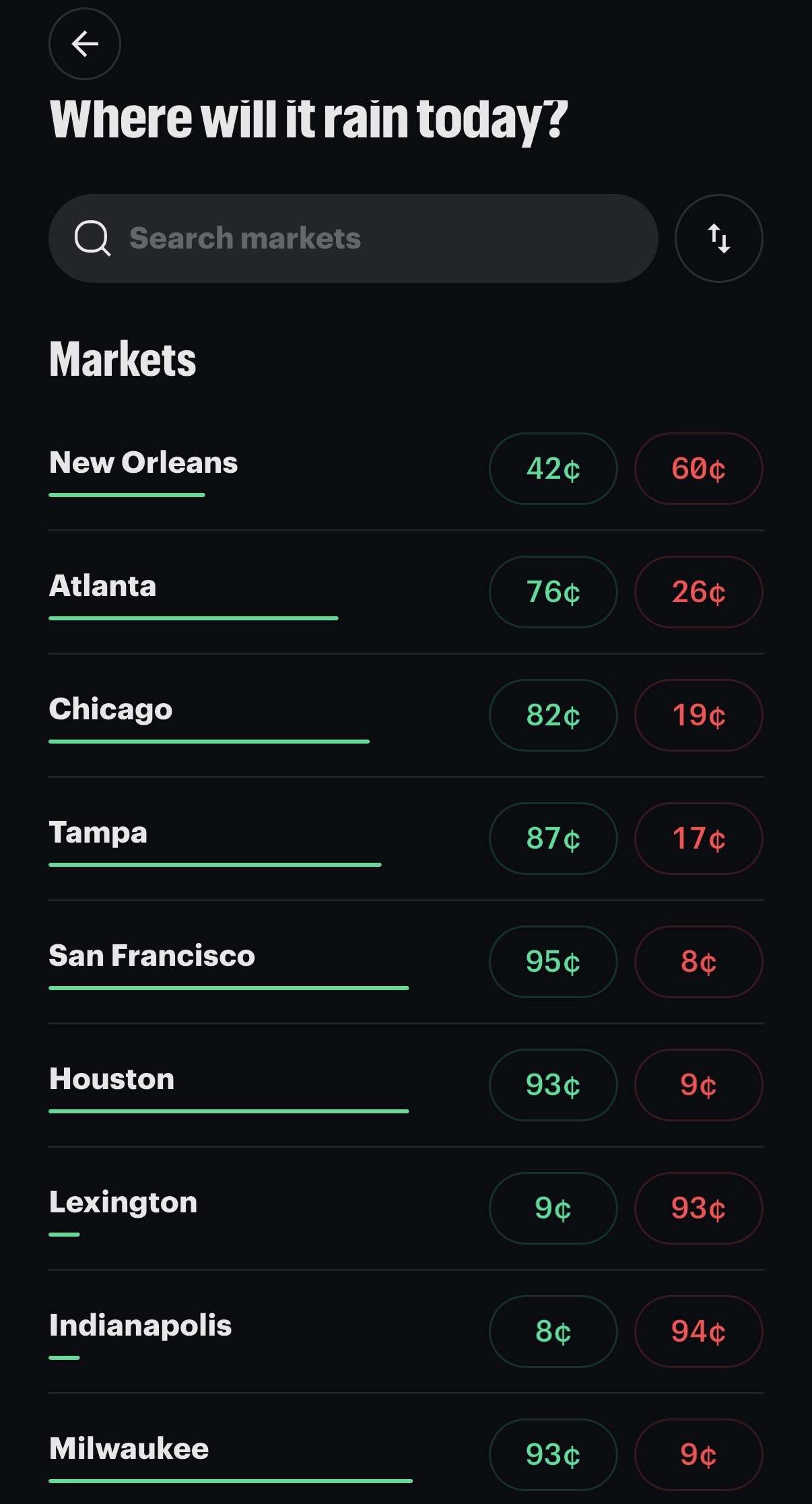
The screenshot shows San Francisco at 95¢ YES, Houston and Milwaukee at 93¢, Tampa at 87¢, and Chicago at 82¢. At the other end, Lexington and Indianapolis trade at 9¢ and 8¢. These are snapshot purchase prices, not verified current quotations, and the YES and NO sides include bid-ask spreads.
A 95¢ YES contract offers only 5¢ of profit before fees if it wins. The forecast probability needs to be exceptionally high to justify the risk. At 42¢, New Orleans offers a much larger potential payout, but also reflects considerably more uncertainty.
Neither price alone tells us whether a trade has positive expected value. That takes an independent probability estimate for the exact event being traded.
Why a Tenth of an Inch Changes the Forecast
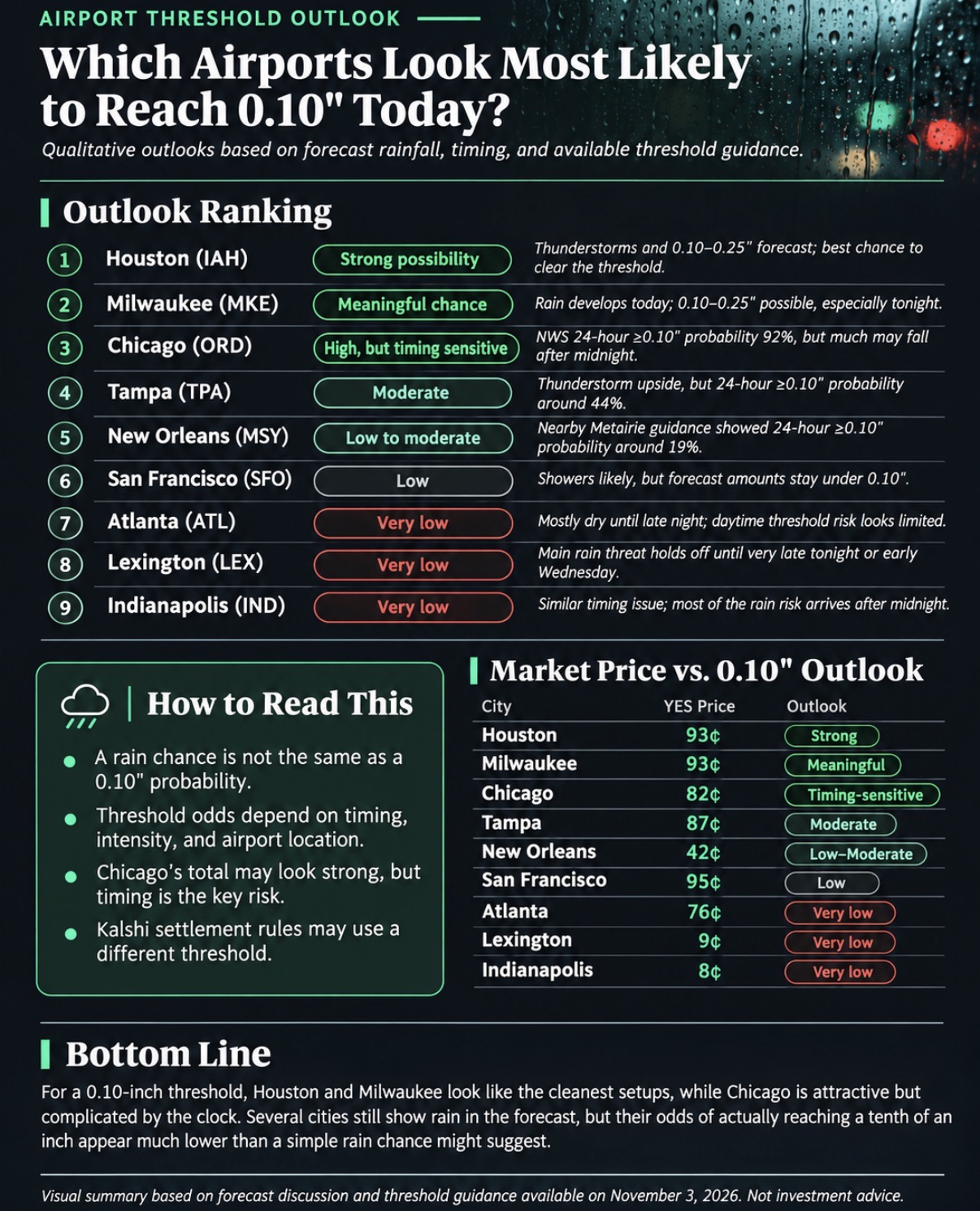
Airport forecasts show how different the two rainfall questions can be. At Houston Intercontinental Airport, the National Weather Service expected showers and thunderstorms on November 3, with roughly 0.20–0.30 inches of new rainfall possible during the day. That amount would clear both the measurable-rain and 0.10-inch benchmarks at that airport if it occurred as forecast.
There's an important station distinction here. The November 3 Houston contract names CLIHOU, which the National Weather Service identifies with Houston Hobby, not Intercontinental. The Intercontinental forecast is an illustration of the threshold difference, not a station-matched estimate for that contract.
At Tampa International Airport, meanwhile, the NWS forecast called for showers and thunderstorms but generally less than 0.10 inches, except where thunderstorms produced heavier totals.
Tampa could have a reasonable chance of recording measurable precipitation while still facing a much less certain chance of reaching a tenth of an inch. Those are related outcomes, but they shouldn't be assigned the same probability.
Timing Can Matter More Than the Daily Forecast
Chicago illustrates another risk. Earlier threshold guidance suggested a substantial 24-hour probability of at least 0.10 inches, yet much of the expected rainfall was associated with the late-night and overnight period.
A forecast extending into Wednesday morning isn't interchangeable with precipitation reported on Tuesday. Similar late-arrival concerns appeared in Indianapolis and Lexington.
Matching the observation station and the contract's reporting date comes before assigning a fair value.
Market Example: Tampa YES at 87¢
Suppose a trader sees Tampa at 87¢ YES and a forecast indicating a 60% chance of rain during the day. It would be tempting to conclude that the contract is overpriced by 27 percentage points.
That comparison is incomplete. The NWS daytime rain chance isn't a station-calibrated probability of the entire contract's settlement event, and the contract may also reflect overnight precipitation, updated forecasts, and other information.
A defensible estimate would start with the correct weather station, the full reporting window, and the chance of measurable precipitation, not the probability of 0.10 inches.
The trader could then compare historical forecasts with observed station reports and see whether an estimated settlement probability was genuinely above or below the market price after fees.
Conclusion
The biggest lesson from today's rain markets is that a rain forecast isn't yet a market probability.
A 0.10-inch benchmark helps reveal rainfall intensity and storm timing, but daily measurable-rain contracts ask a different question. The airport examples show why the expected amount matters; Chicago shows why the calendar matters.
The next step is to turn airport-specific, correctly timed forecasts into calibrated probabilities and compare those estimates against executable market prices.
Instead of simply asking, “Will it rain today?” a more useful question is, “How likely is the exact precipitation event required by this contract, and how does that probability compare with the market price?”
That distinction is what can turn an ordinary weather forecast into a more useful estimate of fair value.
━━━━━━━━━━━━━━━━━━━━━━
This article includes links to PredictQ partners like Kalshi. We may earn a commission if you use them. It doesn't cost you anything extra, and it helps keep the lights on here. Nothing in this piece is investment advice, and prices, odds, and entry counts can change. Historical results don't guarantee future accuracy