
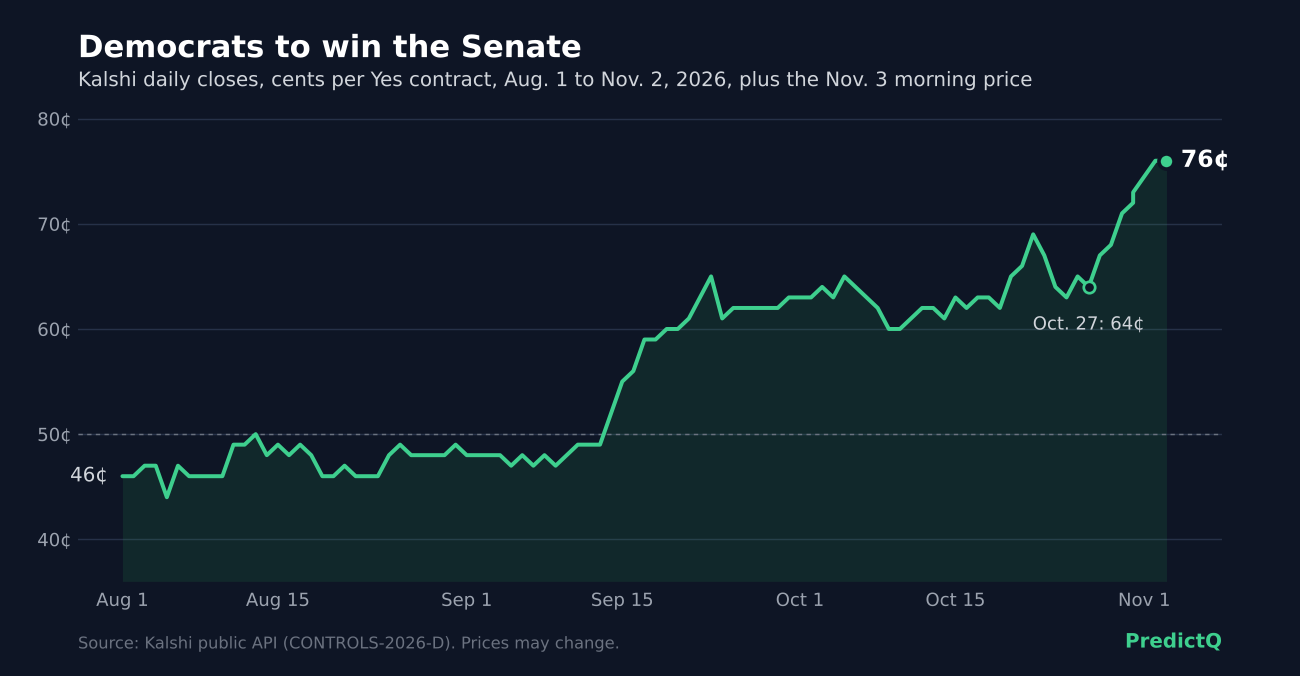
Last week the board was quiet at the top, with Kalshi's Senate control contract at 64 cents and Nevada doing all the moving underneath. This week the top moved. Democrats are 76 cents to win the Senate this morning, up 12 cents from Tuesday's close a week ago, the biggest week the control contract has had since the series started. The House contract is at 93.9, up three cents. The Democratic sweep is 76, up 13. Polymarket has the Senate at 77.5 and the House at 94.5.
The reason is no mystery. The final round of New York Times/Siena polls landed Sunday night with Democrats ahead in all seven of the Senate races the Times considers likeliest to decide the chamber, and that set off a week of blue-wave headlines. But the more interesting story is a methodology footnote the Times published with the polls, because it cuts both ways, and the board has to price both directions.
This is the last edition before the votes are counted. The Scoreboard, grading the board against the results, runs a week from today. Every market here is live on PredictQ.
Every price is Kalshi's price this morning, with each contract's Oct. 27 daily close for the week's change. Prices may change.
The Big Board
Senate control, Democrats | 76¢ | 64¢ | +12 |
House control, Democrats | 93.9¢ | 90.8¢ | +3 |
Democrats sweep both chambers | 76¢ | 63¢ | +13 |
Democratic House, Republican Senate | 20¢ | 28¢ | -8 |
Republicans sweep both chambers | 6.5¢ | 9.1¢ | -3 |
Republican House, Democratic Senate | 0.9¢ | 0.7¢ | 0 |
The Times/Siena final national poll, released Oct. 22, had Democrats up 11 points on the generic ballot, per the New York Sun. Decision Desk HQ's polling average is just under 10, per The Hill, which also reports DDHQ's forecast at 84% for a Democratic House and 65% for a Democratic Senate as of Monday. Both of those are below where Kalshi and Polymarket have the chambers.
What the Times Changed, and Why It Matters Today
In its write-up of the final polls, the Times said it updated its weighting method earlier this year and that its 2024 polls would have been more accurate on average with the new method in place. The Hill reports the Times' own comparison: run through the old weighting, the final polls would have been even better for Democrats. Michigan's 11-point lead would be 16. Alaska's lead would be 6 instead of the published 48-46. Texas would be 9 instead of 7. Talking Points Memo, reading the same chart, noted the gap isn't uniform: in Kansas and Ohio the new method roughly halves the Democratic lead, while in Texas it only costs two points, which it attributes to Texas having fewer of the non-college white voters the new weighting is designed to find.
The method, described on Columbia statistician Andrew Gelman's blog in June, weights on a "synthetic" 2024 vote, a recalled vote checked against the voter file and imputed where it can't be verified, with a modeled support score on top. The target is the thing every pollster has chased since 2016: Trump voters who don't answer the phone.
Nate Cohn's framing, as TPM quotes it, is that you can choose your own adventure. One reading is that the Times finally has a method that handles the problem that made its polls overestimate Democrats in white working-class states, in which case the new numbers are the right numbers. The other reading, and this is the one Cohn raises himself, is that Times/Siena was accurate in 2018 and in 2022 without the fix, so in a midterm you might trust the old approach, and Democrats could do even better than the published polls say. TPM's question, which Cohn doesn't fully answer, is whether a correction built for presidential-year misses belongs in a midterm at all.
Cohn also told Poynter that Trump's supporters aren't just less likely to answer surveys but also less likely to vote in midterms, which would explain why polls have been good in midterms and bad in presidential years. If that's the mechanism, a weighting fix that reaches for non-responding Trump voters in a year many of them stay home is reaching for people who won't show up.
None of that is a prediction. The Times warned in the same write-up that if nonresponse bias is worse than ever, polls could seriously underestimate Republicans again, and Nate Silver's analysis, per The Hill, has the polls overestimating Democrats in each of the last three presidential elections. Cohn's bottom line was that Democrats lead by enough to win the Senate even through a 2016- or 2020-sized miss. The seat-count markets are where you can see how the board is splitting the difference.
If the Polls Are Underestimating Democrats: The Seat-Count Edges
Start with the Senate. Democrats need a net gain of four seats, per The Hill. The seven Republican-held seats on our board are now priced at 73 (Texas), 73 (Maine), 72 (Ohio), 53 (Iowa), 70 (Alaska), 63 (Kansas), and 97 (North Carolina). Sweep all seven and hold Michigan, New Hampshire, and Georgia, and Democrats sit at 54. That is the scenario the final Times polls describe.
Kalshi's Democratic Senate seat-count market is where that scenario gets a price. The top bracket, Democrats above 52 seats, is 55 cents this morning. A week ago Tuesday it closed at 38.
Below 45 | 1.2¢ | 2.3¢ | -1 |
45 | 1.0¢ | 3.0¢ | -2 |
46 | 2.2¢ | 2.6¢ | 0 |
47 | 5.9¢ | 6.4¢ | -1 |
48 | 7.9¢ | 6.1¢ | +2 |
49 | 5.6¢ | 7.5¢ | -2 |
50 | 7.5¢ | 12¢ | -5 |
51 | 7.2¢ | 11¢ | -4 |
52 | 17¢ | 17¢ | 0 |
Above 52 | 55¢ | 38¢ | +17 |
Read the shape, not any one number. The 50- and 51-seat brackets lost nine cents between them this week and the above-52 bracket gained 17. Fifty-one and 52 together are 24 cents; above 52 alone is 55. These are last-trade prices that add up to about 110 cents, not a probability distribution, but the shape is clear: the market is no longer pricing a Democratic Senate as a coin flip that lands on 51. It's pricing it as a sweep with a thin tail of near-misses.
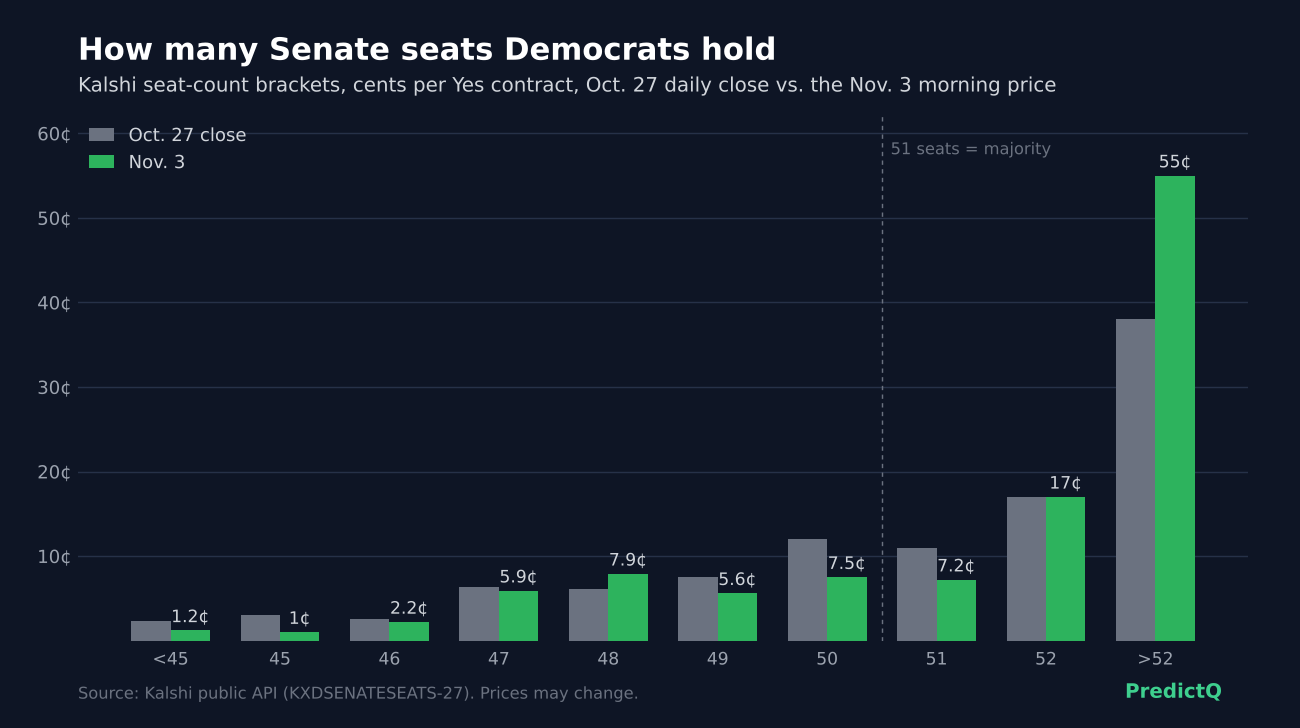
Polymarket's version is organized around Republican seats, and it says the same thing from the other side: Republicans at 47 or fewer, which is Democrats at 53 or more, is 55.5 cents there, with 48 Republican seats at 13.5 and 49 at 10.5.
On the House, the move is the same but the brackets are wider. Democrats above 249 seats is 27 cents this morning, up from 19 at last Tuesday's close and the most expensive bracket on the board for a second week.
Below 210 | 1.3¢ | 3.7¢ | -2 |
210-213 | 1.3¢ | 3.4¢ | -2 |
214-217 | 4.0¢ | 3.2¢ | +1 |
218-221 | 1.3¢ | 3.1¢ | -2 |
222-225 | 4.4¢ | 5.0¢ | -1 |
226-229 | 4.8¢ | 7.4¢ | -3 |
230-233 | 9.0¢ | 9.3¢ | 0 |
234-237 | 13¢ | 15¢ | -2 |
238-241 | 20¢ | 14¢ | +6 |
242-245 | 17¢ | 13¢ | +4 |
246-249 | 11¢ | 8.8¢ | +2 |
Above 249 | 27¢ | 19¢ | +8 |
Polymarket counts Republican seats instead, and its tails agree: Republicans below 190, which is Democrats above 245, is 44.5 cents there.
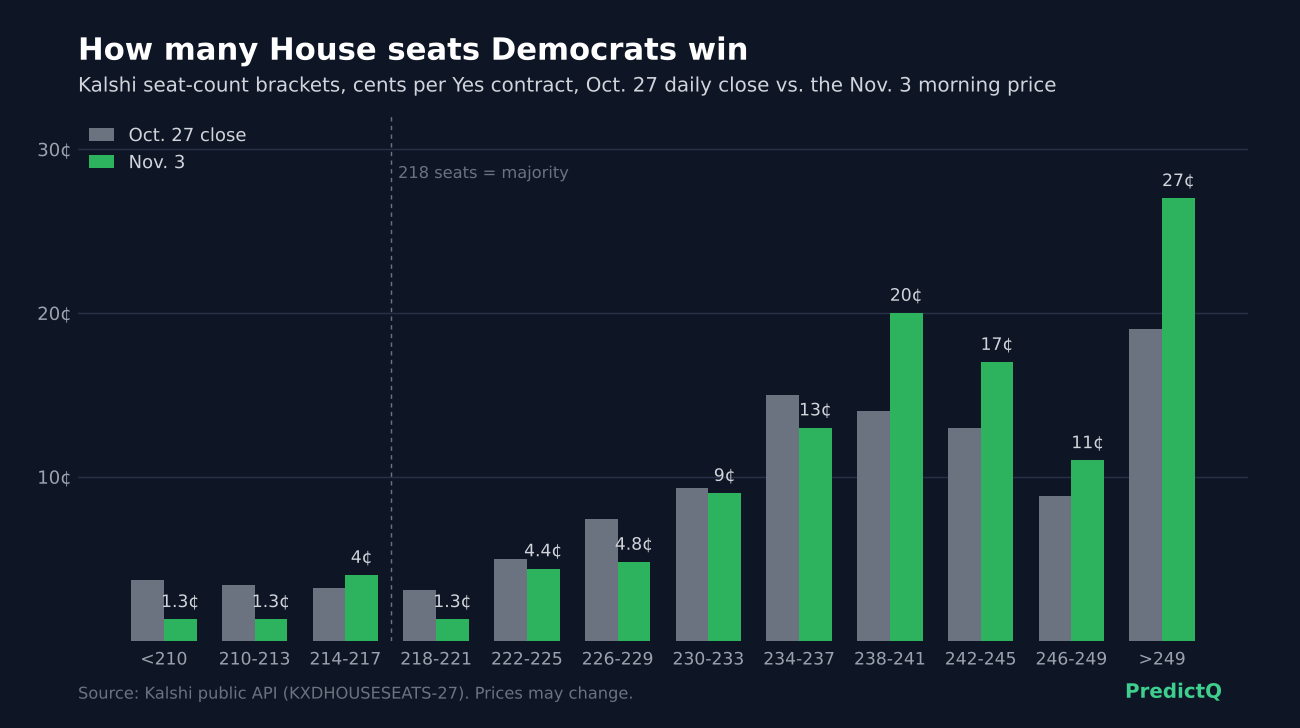
One warning: several of these brackets are thin, and in the tails the last trade can sit outside the current bid and ask. Treat anything under five cents as a range, not a point.
If the Polls Are Underestimating Republicans: What the Other Tail Costs
Now the opposite question, which is the one a lot of traders spent the last week asking. If the Times' correction is right, and the old method would have overshot by five points in Michigan and roughly doubled the real lead in Kansas and Ohio, then the published numbers are already the conservative ones, and the market's 76 cents has that baked in. But if the correction isn't enough, and the polls miss the way they did in 2020, what does the board say that costs?
Kalshi has Republicans at 24 cents to keep the Senate, Polymarket 23.5. Inside the seat-count market, the Republican-control outcomes break down as Democrats at exactly 50, which is a Republican Senate on the vice president's vote, at 7.5 cents, 49 at 5.6, 48 at 7.9, 47 at 5.9, and everything below that around four and a half cents combined. Add them up and the seat brackets price a Republican Senate at roughly 31 cents against the control contract's 24.
For scale, 48 Democratic seats is a net gain of one. For Democrats to finish there, six of the seven races priced above 50 cents this morning would have to go the other way. Iowa at 53 is the only one of the seven the board treats as a true toss-up; the next closest is Kansas at 63.
The House tail is cheaper. Republicans are 6.5 cents to hold the House on Kalshi and 5.5 on Polymarket. The seat brackets below 218 add up to about seven cents on Kalshi. Polymarket's Republican brackets from 220 up add up to about three cents, with another 1.75 in the 215-219 bracket that straddles the majority line. Those numbers haven't moved much in a week, which tells you the market never thought the House was in play and the Times polls didn't change its mind.
So where is the board relative to the polls? Decision Desk HQ's chief elections analyst Geoffrey Skelley told The Hill that the Michigan result is probably the one true outlier of the batch, that the others weren't far from existing polling, and that Republicans basically have to hope for a polling error. The market agrees on the last point and prices the hope at about a quarter. Whether a quarter is too much or too little for a polling error that has shown up in three straight presidential years and not in the last two midterms is the question the next twelve hours answer.
The Rest of the Board
Texas | James Talarico (D) vs. Ken Paxton (R) | 73¢ | 66¢ | +7 |
Maine | Troy Jackson (D) vs. Susan Collins (R) | 73¢ | 61¢ | +12 |
Ohio, special | Sherrod Brown (D) vs. Jon Husted (R) | 72¢ | 68¢ | +4 |
Michigan | Abdul El-Sayed (D) vs. Mike Rogers (R) | 80¢ | 69¢ | +11 |
Iowa | Josh Turek (D) vs. Ashley Hinson (R) | 53¢ | 44¢ | +9 |
Alaska | Mary Peltola (D) vs. Dan Sullivan (R) | 70¢ | 74¢ | -4 |
Kansas | Adam Hamilton (D) vs. Roger Marshall (R) | 63¢ | 40¢ | +23 |
New Hampshire | Chris Pappas (D) vs. John E. Sununu (R) | 93.5¢ | 90¢ | +4 |
North Carolina | Roy Cooper (D) vs. Michael Whatley (R) | 97¢ | 96.7¢ | 0 |
Georgia | Jon Ossoff (D) vs. Mike Collins (R) | 96.7¢ | 94.8¢ | +2 |
The final Times/Siena numbers in these states, per The Hill: Talarico 50-43, Jackson 51-45, Brown 49-44, El-Sayed 53-42, Turek up one, Peltola 48-46, Hamilton 49-44. Kansas is the week's biggest mover on the board at 23 cents, with Marshall at 38 after sitting at 61 a week ago. Alaska is the one Republican-held seat that moved the wrong way for Democrats, down four to 70, in a week The Hill says brought reports that Peltola's campaign had a hand in recruiting a second Dan Sullivan onto the ballot against the incumbent. Michigan rose 11 despite Rep. Haley Stevens endorsing Rogers over El-Sayed on Sunday, per The Hill.
Polymarket is within a cent and a half of Kalshi on every one of these races.
Governors: Nevada's Aaron Ford 75 (-2), Georgia's Keisha Lance Bottoms 68 (+6), Ohio's Amy Acton 83 (+6), Texas's Gina Hinojosa 35 (+2), Florida's David Jolly 32 (+6), Pennsylvania's Josh Shapiro 99 (+2).
Tonight, Hour by Hour
VoteHub's head of data science Zachary Donnini posted a timeline for the night this morning that we'd recommend over anything the cable graphics will give you.
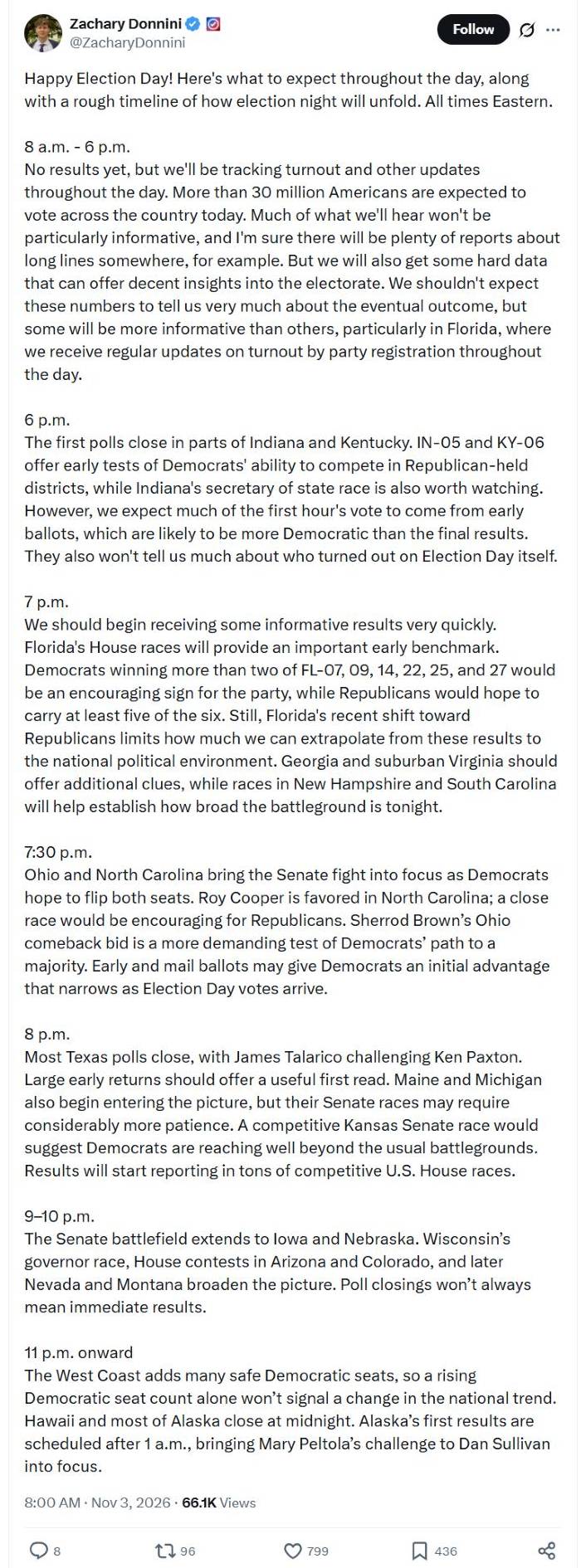
In brief, all times Eastern:
7 p.m. Florida's six House seats are the first real read. Democrats want more than two of FL-07, 09, 14, 22, 25, and 27; Republicans want at least five.
7:30 and 8 p.m. Ohio and North Carolina, then Texas, Maine, Michigan, and Kansas. Early and mail ballots will lean Democratic before Election Day votes narrow it.
Midnight on. Alaska's first results come after 1 a.m.
For settlement on each contract type, including why Maine and Alaska may not have a first-choice majority tonight and why Georgia's next date is Dec. 1, last week's guide is still the reference.
Watch It With Us
PredictQ is running a Midterms Live Sweat Show tonight at 8:30 p.m. ET, live on X and YouTube. Justin Herzig hosts, with Grayson Nichols, Jordan Cooper, and me on the panel. We'll have the board up and we'll be watching the same brackets above as the calls come in. If you've been following this series, that's the room to be in when the 7:30 states start reporting.

This article includes links to PredictQ partners Kalshi and Polymarket. We may earn a commission if you use our partner links. It doesn't cost you anything extra, and it helps keep the lights on here. Nothing in this piece is investment advice or a trade recommendation. Prices, odds, and entry counts can change. Availability depends on the platform, product, and your location; check each platform's age and eligibility requirements before trading.