
Weather can wreck a local business’s plans. A restaurant might prepare for hundreds of customers during a holiday parade, only to lose much of its foot traffic when rain arrives. An outdoor vendor could invest thousands in inventory for a Christmas market, while a landscaping or construction company might lose an entire day of work to unexpected snow.
Businesses have traditionally had limited options for protecting themselves against these losses. Kalshi’s expanding weather prediction markets offer another approach: taking positions on weather outcomes that could hurt revenue.
With new Christmas snowfall markets and weather contracts tied to local events, prediction markets could be more than a way to speculate on the forecast. They could also serve as financial hedging tools for businesses whose revenue depends on the weather. If event contracts are new to you, our guide to how Kalshi works covers the basics.
New Christmas Snow Markets
Kalshi has introduced Christmas Day snowfall contracts across 11 U.S. cities, including Philadelphia, Detroit, Chicago, Washington, DC, Denver, Milwaukee, and Boston. The lineup appears on Kalshi’s weather hub.
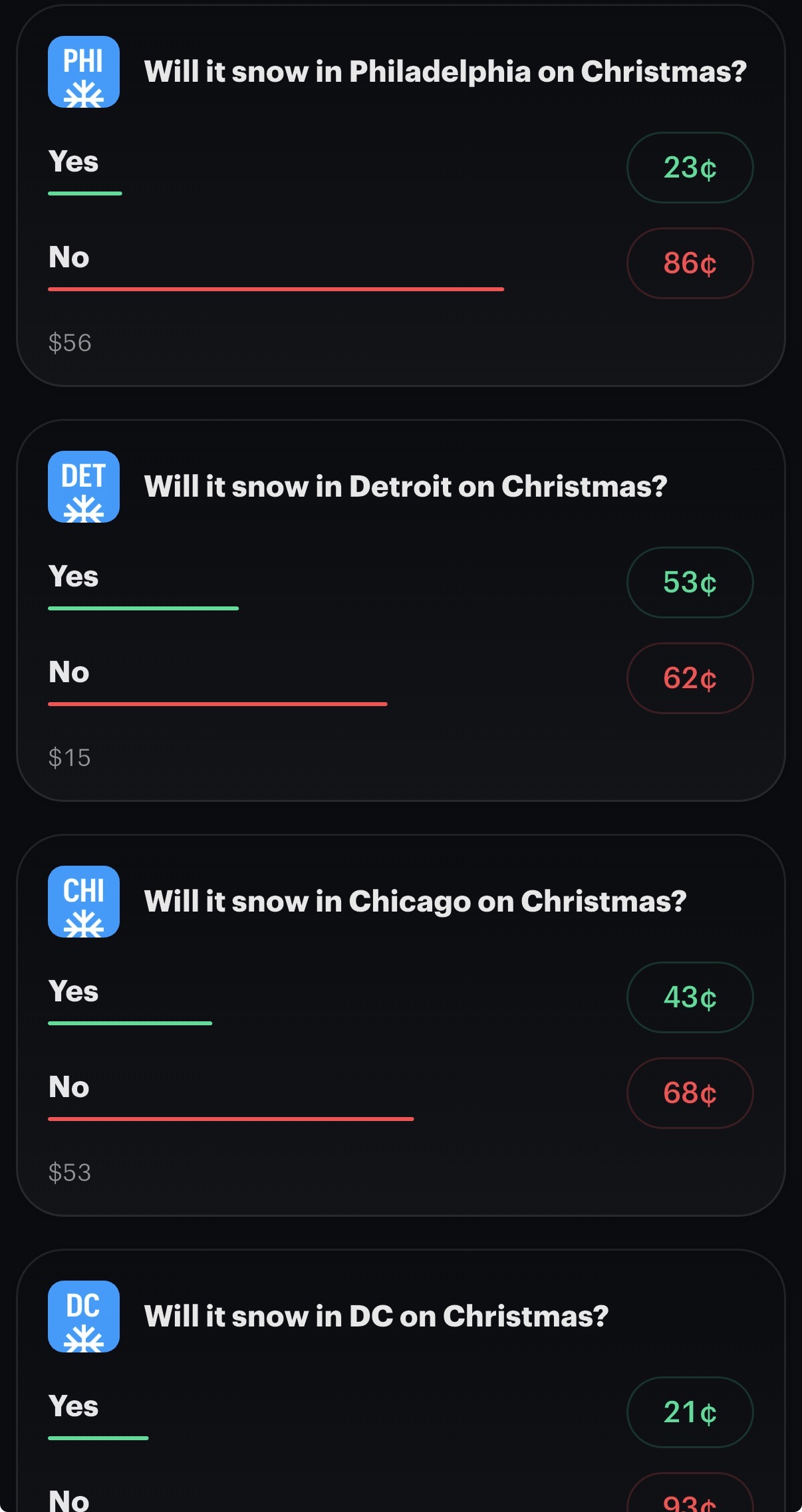
The markets ask whether new snowfall will occur at a designated weather station on December 25, 2026. Under the rules, even a reported trace of snow is enough for a YES settlement. Snow already on the ground doesn’t count.
In the market screenshots referenced for this draft, Philadelphia YES was offered at 23¢, Detroit at 53¢, Chicago at 43¢, and Washington, DC at 21¢. Those are snapshot prices, not live quotes, and prices can change.
These prices are a starting point for evaluating holiday weather risk. They aren’t necessarily estimates of severe winter weather. A few snowflakes at an airport could settle a YES contract even if conditions remain manageable for nearby businesses.
For a local business, the question is whether the contract’s settlement outcome is closely enough connected to the weather conditions that affect its revenue.
How Businesses Can Hedge Against Bad Weather
Hedging is about reducing financial uncertainty.
Consider a restaurant near Chicago’s Magnificent Mile that expects a jump in customers during the annual Lights Festival on November 21. The festival organizer lists November 21, 2026 as this year’s date.
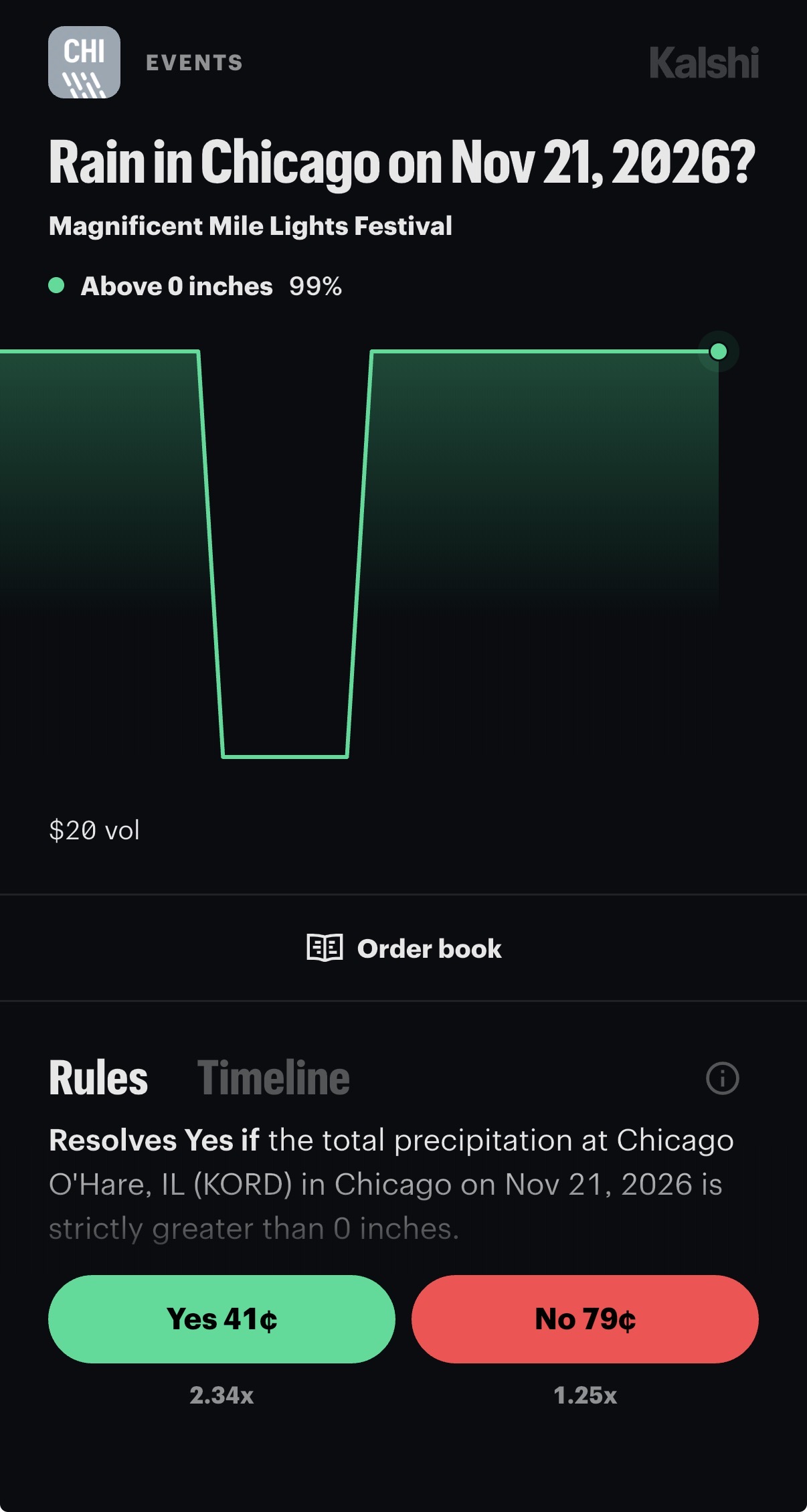
Good weather could bring substantial pedestrian traffic. Rain could discourage visitors from shopping, dining, or attending outdoor activities.
Kalshi’s event-day rain market provides a potential way to offset that risk.
In the screenshot, the November 21 Chicago rain contract is offered at 41¢ YES. Suppose the restaurant estimates that rain could reduce its operating profit by approximately $1,000.
Purchasing 1,000 YES contracts at 41¢ would cost $410 before fees. If the contract settles YES, the restaurant receives $1,000, resulting in a $590 net trading profit. If it settles NO, the restaurant loses its $410 premium.
For example, assume the restaurant earns $2,000 in operating profit on a dry event day but only $1,000 on a rainy one. Under an ideal hedge where the contract outcome perfectly matches the restaurant’s weather-related loss, the combined result would be $1,590 in either scenario.
The business sacrifices some of its best-case profit in exchange for greater financial predictability.
Actual results would depend on the contract’s settlement conditions, execution price, fees, and how closely airport precipitation corresponds to the weather experienced by customers.
Event Markets Create Opportunities Beyond Christmas
Kalshi is also offering weather markets connected to specific events, including Detroit’s America’s Thanksgiving Parade on November 26 and Chicago’s Magnificent Mile Lights Festival on November 21. The Parade Company confirms Detroit’s November 26, 2026 date.
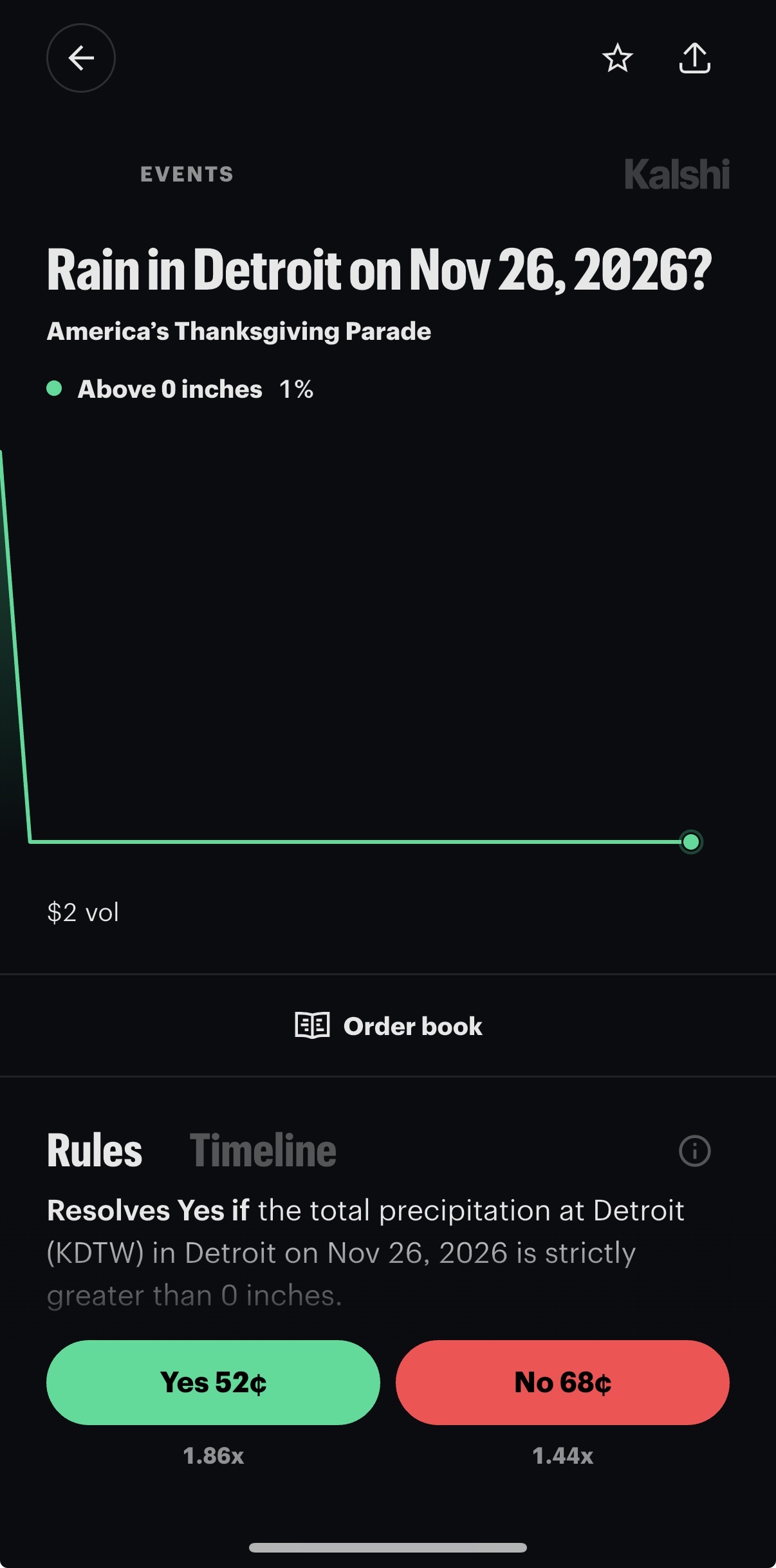
These contracts are interesting because businesses can identify their financial exposure before the event.
Food trucks, outdoor vendors, restaurants, event production companies, and retail stores often make inventory and staffing decisions days or weeks in advance. A sudden weather change can leave them with expenses they can’t recover.
A vendor preparing for Detroit’s Thanksgiving parade might use a rain YES contract to offset some of the losses associated with poor attendance. Alternatively, a company that benefits from bad weather could consider a NO position to hedge against conditions that reduce demand for its services.
The important distinction is that the position should pay when the business is financially vulnerable, rather than simply reflect a directional opinion about the weather.
Not Every Weather Market Is a Good Hedge
There are real limits.
The Christmas snowfall contracts measure new snowfall at designated stations, not snow accumulation, road conditions, or whether a local event is canceled.
Similarly, Detroit’s Thanksgiving precipitation contract resolves according to total precipitation at Detroit Metropolitan Airport. That total can include the liquid equivalent of snow, sleet, and hail, not just rainfall.
A market can settle YES even when the event experiences little disruption. The reverse can also happen. Severe weather may affect an outdoor venue without producing qualifying precipitation at the settlement airport.
Liquidity is another concern. The screenshots of the event-day rain markets show very limited trading volume and substantial differences between YES and NO purchase prices. A business might not be able to purchase hundreds of contracts at the displayed price, particularly if the order book is thin.
A hedge that looks attractive on paper may be expensive or difficult to execute.
These contracts also involve transaction fees, settlement risk, and the potential loss of the entire amount spent on a position.
A New Approach to Managing Weather Risk
Small businesses are already exploring the concept.
Kalshi has highlighted examples of restaurants, landscaping services, construction companies, and tourism businesses using prediction markets to manage financial exposure.
One example described by Kalshi involves a Los Angeles ice cream business called 28 Wishes, which experiences reduced sales during cold or rainy weather. According to Kalshi’s account, the business has used weather contracts to help offset those weaker sales periods.
The broader concept extends to scheduled events.
A holiday vendor could estimate how much revenue would be lost if precipitation affects a major shopping day. A Christmas tree seller could evaluate snow-related disruptions. A hotel near an outdoor festival might examine whether event-day weather contracts could offset unexpected cancellations.
Businesses could also use weather contracts to support promotions. For example, a retailer might advertise a special discount if it snows on Christmas, while purchasing a corresponding contract to offset part of the promotional cost.
But this works only when the contract’s payout is meaningfully linked to the business’s actual exposure.
Conclusion
Kalshi’s expansion into Christmas snowfall and event-specific weather markets introduces an interesting application of prediction markets. They could help businesses manage unpredictable operating conditions.
For restaurants, outdoor vendors, event organizers, and other weather-dependent companies, these contracts could provide a way to partially offset revenue losses associated with rain or snow.
The biggest opportunity may not be predicting the weather more accurately than everyone else. It may be using a weather outcome to reduce the financial impact of conditions a business can’t control.
The central question becomes less about whether it will snow on Christmas or rain during a parade, and more about whether a correctly sized financial position can help a business operate with greater certainty.
As more event-specific markets become available, prediction markets could become an additional risk-management option for local businesses, provided the contracts are liquid enough, their settlement criteria match the business’s exposure, and the cost of protection is justified.
This article includes links to PredictQ partner Kalshi. We may earn a commission if you use them. It doesn’t cost you anything extra, and it helps keep the lights on here. Nothing in this piece is investment advice, and prices, odds, and entry counts can change.
This article discusses prediction markets and weather-related business risk management for educational purposes. It isn’t investment, legal, tax, or business advice. Event contracts involve financial risk, transaction costs, liquidity constraints, and potential losses