
When people hear “trading bot,” they usually picture computers competing over milliseconds. A bot watching daily temperature markets doesn't necessarily need to react in one-thousandth of a second. It needs to react while new weather information is still useful.
Checking everything 100 times a second doesn't create an edge if the underlying information hasn't changed. The useful moments might be a fresh station observation, a model update, an unexpected cloud break, a wind shift, or a temperature running above or below the forecast curve.
The question is whether the bot can turn that information into a sound decision. Speed comes after that.
Why Speed Matters
The advantage of automation isn't just that a computer can move faster. It's that the system can run the same checks consistently when useful information arrives.
A manual trader might notice an observation, open several weather pages, compare the forecast with the market, and decide whether the price makes sense. A bot can automate that workflow, though its actual response time depends on data delivery, processing, and execution.
A weather-price discrepancy can shrink as other traders absorb the same information. That doesn't mean every update calls for a trade. It means the bot needs to distinguish a meaningful change from noise.
Two Clocks, Weather and Market
A weather bot watches two clocks. The weather clock includes model runs, station observations, cloud cover, radar, wind, dew point, and the pace of warming or cooling. The market clock includes bids, asks, trades, liquidity, and order-book changes.
The bot becomes useful when it connects those streams.
If you're new to temperature contracts, PredictQ's Kalshi guide explains contract mechanics and fees before you start comparing estimated probabilities with prices.
Here's a hypothetical example. An 85–86°F Yes contract is available at 30¢. The forecast expected the settlement station to be at 81°F at 11 a.m., but the newest observation is 83°F and skies have cleared earlier than expected.
Suppose the bot now estimates a 45% chance of the final high landing in that exact range. For a contract that pays $1 if it resolves Yes and $0 otherwise, its estimated expected payout is 0.45 × $1 = 45¢. At a 30¢ purchase price, that leaves 45¢ − 30¢ = 15¢ of estimated expected value per contract before fees and execution costs.
That's an estimate, not a guaranteed return. If the contract resolves No, the 30¢ purchase price is lost. And a warmer observation doesn't automatically increase the probability of the 85–86°F range. It might push probability into a higher range instead.
The bot needs to update the whole distribution, not just decide that “warmer” means “buy.” For more on that distinction, see how the shape of a weather distribution changes the trade.
Where Automation Saves Time
Illustrative Reaction Time, Manual vs. Automated
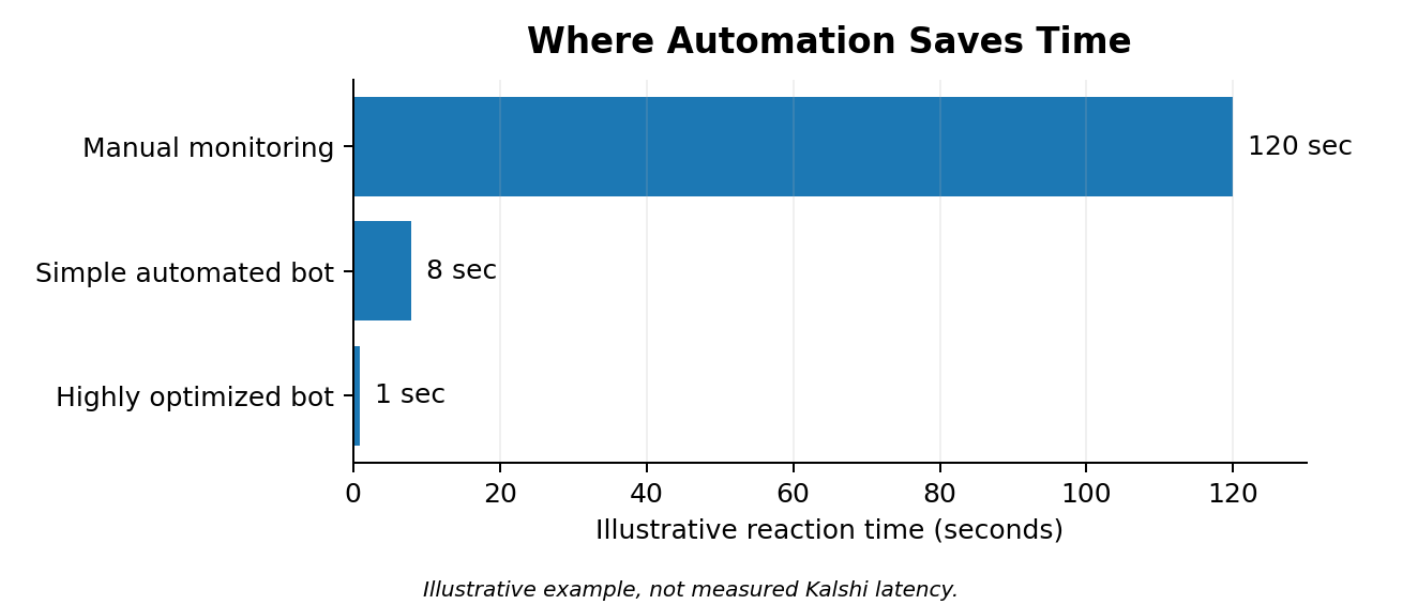
The chart's numbers are illustrative, not measured market data or a performance promise. In this example, a manual workflow takes 120 seconds and a simple bot takes 8 seconds. That's 120 − 8 = 112 seconds less workflow time, or 120 ÷ 8 = 15 times faster. It doesn't establish that the faster system earns more.
The same idea applies to price changes. Suppose a bot estimates a contract's value at 55¢ and sees an executable offer at 42¢. Its estimated gap is 55¢ − 42¢ = 13¢ before costs. If the available price moves to 53¢ while someone checks the weather, the gap falls to 55¢ − 53¢ = 2¢. That's 11¢ less room before fees and slippage.
The bot therefore needs to know when the weather changes and when the executable price changes. A stale quote or a price without enough available contracts isn't the same as a fill.
When Speed Matters Most
Speed can matter more when incoming information is unexpected. A routine model update that moves the forecast by 0.2°F might not change the decision. A station running 3°F above its forecast curve could. So could a marine layer clearing earlier than expected, rain arriving sooner, or a short-range model shifting the expected high.
Those are examples, not universal trading thresholds. Whether they matter depends on the temperature range, the forecast uncertainty, and the price.
As the day's temperature path develops, a bot can compare new observations with the expected curve and revise its distribution. It should check observation timestamps and the market's designated settlement station and source. Data from a nearby station may tell a useful weather story without determining how the contract resolves.
When Speed Matters Less
The night before settlement, there may be more time to compare forecasts, ensembles, historical model bias, climatology, and the overall shape of the market. Better analysis can matter more than reaction time.
A fast bot using a poor probability model can simply make bad decisions faster.
This is also why a bot shouldn't react to every tiny change. A 0.1°F observation change or a single contract trade may not alter its decision. It should respond when new information meaningfully changes the distribution or when the executable price differs enough from its estimate to justify the costs and uncertainty.
Before trusting speed, test what happens when data are stale, a feed disconnects, an order only partly fills, or the model is wrong. A system that pauses safely can be more useful than one that keeps firing orders.
What Actually Matters Most
For many weather strategies, a sensible development order is better data, better probability estimates, cleaner decision rules, and then faster execution. Treat that as a starting framework, not a measured ranking that applies to every strategy.
Receiving an observation quickly can matter. Understanding how it changes the final temperature distribution can matter more. Shaving a fraction of a second off the code won't fix a mismatched station, a stale observation, or an untested model.
Conclusion
A weather trading bot does not need to be the fastest computer in the market. It needs to be fast enough that its information is still useful when it acts. For many weather strategies, the biggest improvement comes from turning a manual reaction measured in minutes into an automated reaction measured in seconds.
Beyond that, better weather data, probability estimates, and decision rules may matter more than shaving milliseconds. The real advantage is not being fast every second of the day. It is recognizing the few moments when the weather actually changes and reacting before that information is fully reflected in the market.
This article links to PredictQ's guide to Kalshi, a PredictQ partner. We may earn a commission if you sign up through the partner links there. It doesn't cost you anything extra, and it helps keep the lights on here. This piece is educational, not a trade recommendation or investment advice. All prices, probabilities, and reaction times in the examples are hypothetical, not live quotes or measured performance. Actual prices, odds, and entry counts can change.