
Risk Management: Understanding Kelly Criterion for Kalshi Climate Markets
By Peter Nickerson, Climate & Weather Analyst — September 11, 2026
Winning trades matter, but there is another question that matters just as much: how much money should you put on each trade? Risk too much and a short losing streak can badly damage your account. Risk too little and you may not take full advantage of a good opportunity. Risk management is the process of finding a balance between those two problems.
One way to work through that balance is the Kelly Criterion. Kelly is a formula that helps decide what percentage of your bankroll to risk based on how large you think your edge is. Your bankroll is simply the total amount of money you have set aside for trading.
The basic idea is intuitive: the stronger your advantage, the more you can risk. If your advantage is small, Kelly tells you to risk less. If you don’t have an advantage at all, Kelly tells you not to make the trade.
For a YES/NO prediction market — the format used on exchanges like Kalshi — a simple version of the formula is:
Kelly % = (Your Estimated Probability − Market Price) ÷ (1 − Market Price)
You don’t need to memorize the formula to understand the idea. The important part is that Kelly compares what you think the true probability is with what the market is charging.
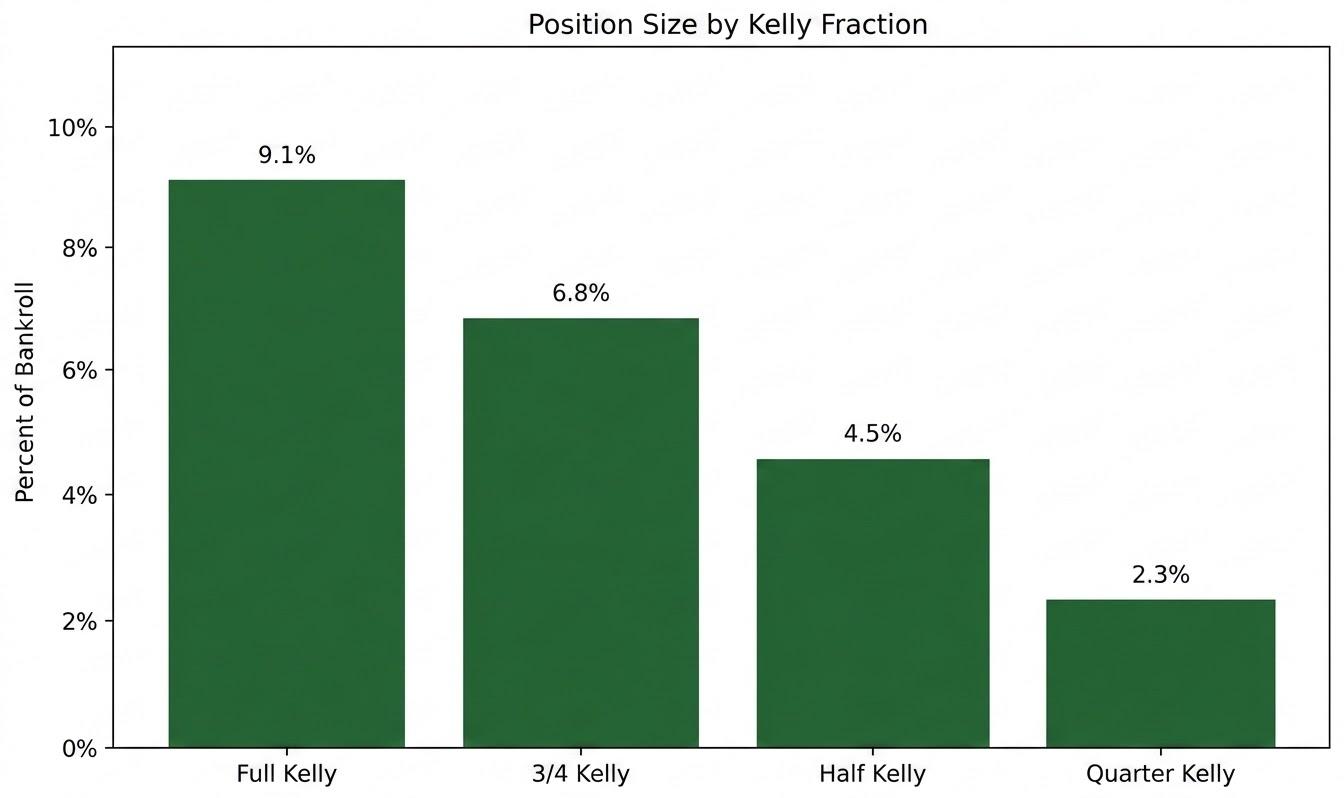
For example, imagine a YES contract costs 45 cents. That means the market is roughly pricing the event at 45%. Your model says the event actually has a 50% chance of happening. Kelly sees that 5-point difference as an edge. In this example, Full Kelly would suggest risking about 9.1% of your bankroll. On a $1,000 bankroll, that comes out to about $91.
Full Kelly vs. Fractional Kelly
You don’t have to use the full amount Kelly recommends. Many traders use a smaller version called fractional Kelly. Half Kelly means taking half of the Full Kelly amount. Quarter Kelly means taking one-fourth. In the example above, Full Kelly risks 9.1% of the bankroll, Half Kelly risks about 4.5%, and Quarter Kelly risks about 2.3%.
Why use less than Full Kelly? Because your estimate can be wrong. Kelly only works perfectly if your probability estimate is accurate. If you think an event has a 60% chance of happening but the real chance is only 52%, Full Kelly may tell you to risk too much. Using Half Kelly or Quarter Kelly gives you more room for error.
What a Simulation Shows
To illustrate the difference, I ran a simple simulation of 3,000 possible trading paths, with 250 trades in each one. Every path started with a $1,000 bankroll. The same trades were used for every strategy — the only thing that changed was how much money each strategy risked.
The strategies compared were Full Kelly, 3/4 Kelly, Half Kelly, Quarter Kelly, a fixed 2% strategy, and a fixed 5% strategy. A fixed strategy is exactly what it sounds like: risk the same percentage of your bankroll on every trade, no matter how large the estimated edge is.
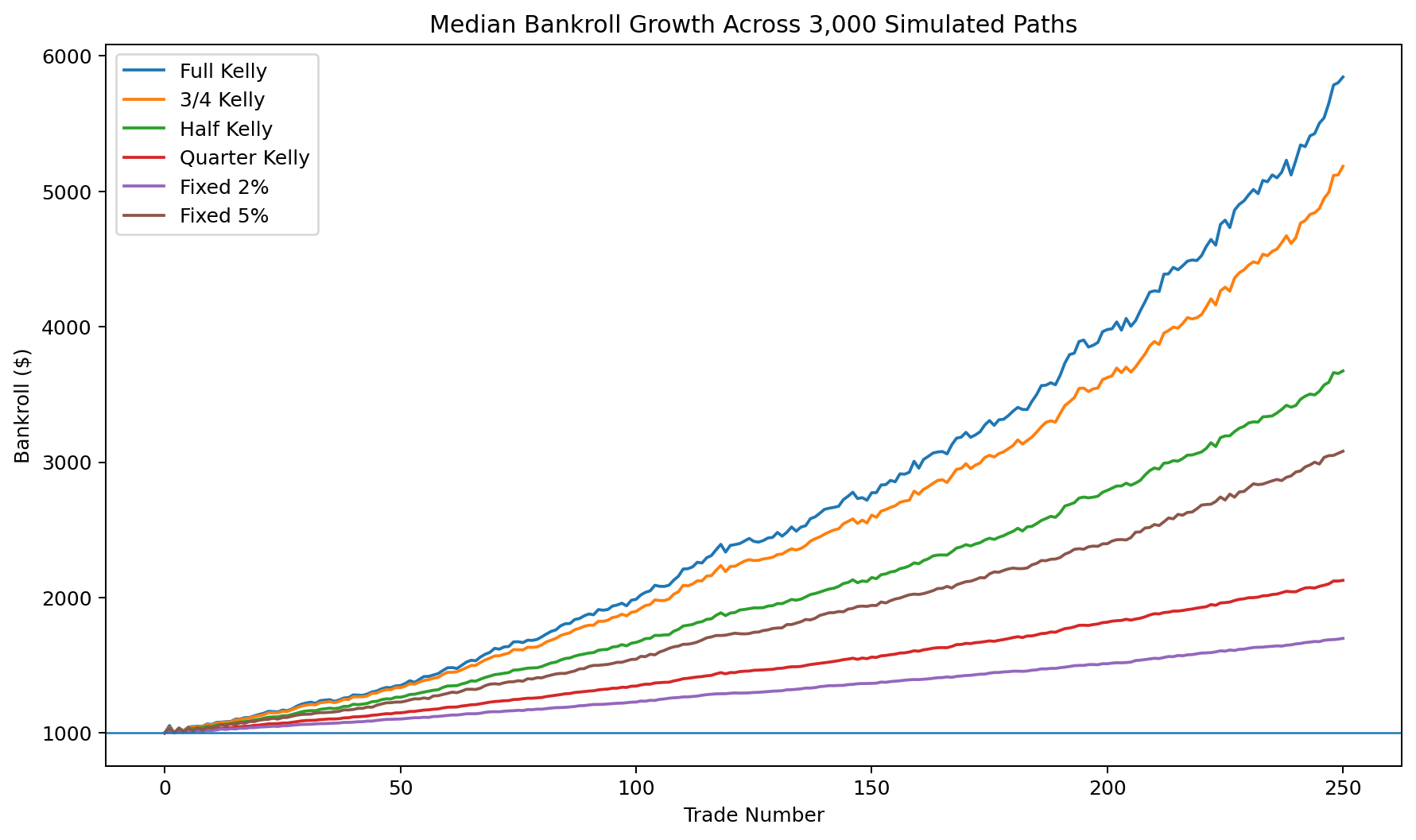
In this simulation, Full Kelly grew the fastest. The typical $1,000 bankroll finished around $5,845. Half Kelly finished around $3,674, Quarter Kelly around $2,127, Fixed 5% around $3,081, and Fixed 2% around $1,698. This does not mean Full Kelly will always produce the highest returns in real trading — the simulation is only meant to show the tradeoff between growth and risk.
The biggest difference shows up when we look at drawdowns. A drawdown is simply how far your bankroll falls from a previous high. For example, if your bankroll grows to $10,000 and later falls to $7,000, that is a 30% drawdown.
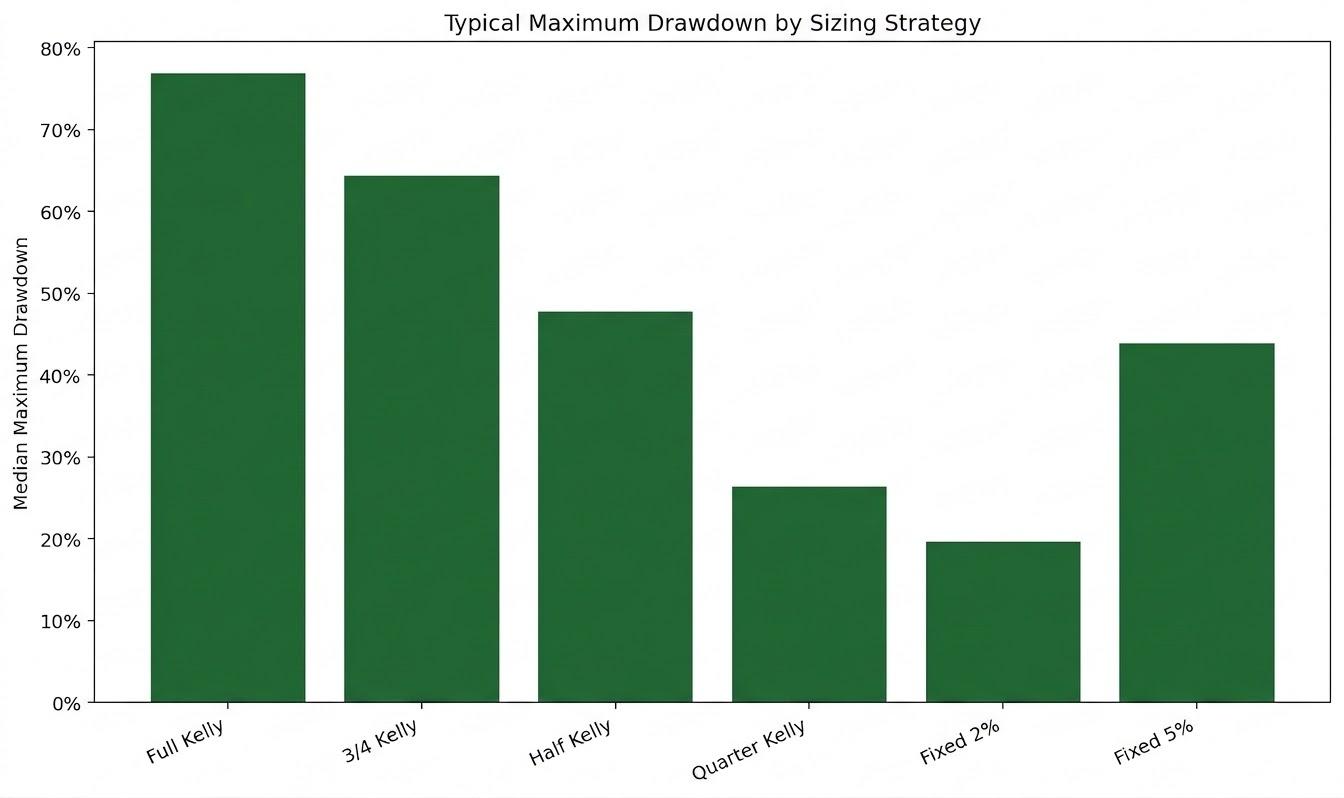
Full Kelly produced the largest drawdowns. In the simulation, its typical worst decline was about 77%. That means a bankroll that had reached $10,000 could temporarily fall to around $2,300. Half Kelly reduced the typical worst drawdown to about 48%, while Quarter Kelly reduced it to about 26%.
This is the main tradeoff. Full Kelly can grow faster when your estimates are right, but the ride can be extremely rough. Smaller Kelly fractions grow more slowly, but they also make it harder for a losing streak or a bad model estimate to seriously damage the bankroll.
Kelly vs. Fixed Sizing
Fixed sizing is easier to understand and follow. You might simply decide to risk 2% of your bankroll on every trade. The downside is that every trade is treated the same — a tiny edge and a very strong edge receive the same position size. Kelly changes the size of the trade based on how large the estimated advantage is.
Think of it this way: fixed sizing asks, “How much do I always bet?” Kelly asks, “How much should I bet on this specific opportunity?” That is the main difference.
A Weather Market Example
Suppose a weather YES contract is trading at 40 cents. Your forecast gives it a 48% chance of resolving YES. Full Kelly would suggest risking about 13.3% of your bankroll. On a $1,000 bankroll, that is about $133. Half Kelly would risk about $67, and Quarter Kelly about $33.
Now imagine you are not fully confident in that 48% estimate. Maybe the weather models disagree, or your forecasting method has only been tested for a short time. Instead of risking the full $133, using Half Kelly or Quarter Kelly gives you a cushion in case your estimate is too optimistic.
Kelly also adjusts automatically as your bankroll changes. If you lose money, the dollar size of future trades becomes smaller. If your bankroll grows, position sizes gradually become larger. This helps keep risk connected to the amount of money you actually have available.
Conclusion
The Kelly Criterion is a risk-management tool that answers a simple question: how much should I risk when I believe I have an edge? Instead of risking the same amount every time, Kelly considers both the market price and your estimated probability.
Full Kelly is the most aggressive version. It can produce faster growth, but it can also create very large drawdowns. Half Kelly and Quarter Kelly reduce the amount being risked and give more protection when your probability estimates are wrong. Fixed sizing is simpler, but it does not adjust position size when the strength of the opportunity changes.
For most traders, the main lesson is not that one Kelly fraction is always best — it is that position size matters. Even a good strategy can fail if too much is risked at the wrong time. The goal of risk management is to keep enough of your bankroll intact so you can keep trading when the next good opportunity appears.
Try it yourself: run your own numbers with PredictQ’s Kelly Calculator — enter your estimated probability, the market price, and your bankroll to get a suggested position size. When you’re ready to put a sizing plan to work on real YES/NO contracts, open an account on Kalshi and try the method on a market you already have a view on. Prices may change.
This article discusses risk management and hypothetical simulations, not directional predictions, trade recommendations, or investment advice. Simulation results are illustrative and do not represent guaranteed returns. PredictQ is a marketing partner of Kalshi and may receive compensation for referrals. #ad