
Most people who enter a survivor pool pack their bags like they’re going for a weekend camping trip in an air-conditioned cabin. They bring some granola, a single, lukewarm Dasani water bottle, and simply take the biggest favorite every week until they, and the rest of the field with the same strategy, get eliminated. That approach may work on short, flat trails and office pools. It won’t survive though in the large, uphill path that is the Splash Sports Survivor World Championship and other large field pools. Survival in those requires a completely different kit. Here are the 6 things you need equipped to survive.

Rule #1: Ration and save your best gear for when you actually need it.
Rookie mistake on the trail: burning your best supplies on day one because the trail looks easy. Don’t use your strongest teams in the beginning of the season unless you absolutely have to. Even then, take a peek at their upcoming schedule and ask whether they will be more valuable later in the season. Every team can only be used once so that turns elite clubs into valuable inventory.
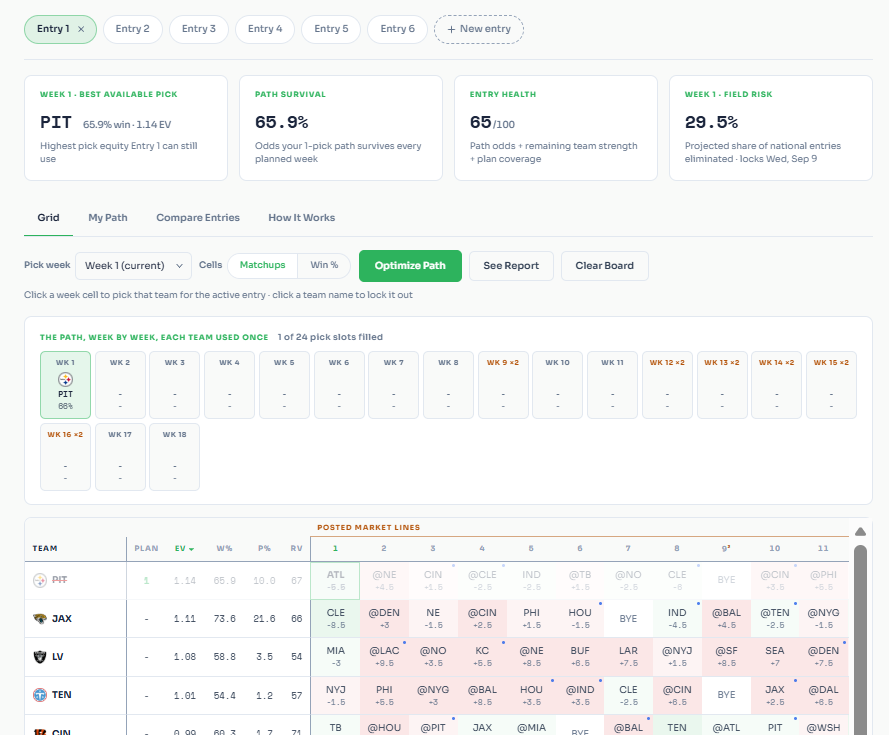
“Future value” is one of the most consistently cited edges in serious survivor strategy: map out the full season, identify the weeks where the “safe” options run thin, and hold onto the best teams for those exact spots. A squad you could’ve used safely in Week 2 might be the only thing standing between you and elimination in Week 11. Take the Chargers for instance who look like a smash hosting the Cardinals on Sunday. Sitting at a robust ~83% implied win probability, many will flock to play the Herbert-led ‘Bolts in Week 1.

As the biggest favorite of the week, they are also likely to carry the most ownership in your Survivor Pools. Is that the best path though? That same team gets the Raiders at home next week, Jets at home Week 11, another bout with Vegas and then the Dolphins in Weeks 14 & 16 respectively. The path will only get harder the longer you last, don’t burn premium resources that can help you later.
Plan the whole route before you take the first step, don’t just go week to week. Jumping in a contest and blindly playing Week 1 without ever looking ahead is the quickest way to hit a roadblock in the near future. Plan accordingly, use tools like the Survivor Optimizer | PredictQ Tools to map out your strategy to survive and advance.
Rule #2: The herd isn’t your friend
On these trails, there is no safety in numbers. Moving with the crowd is not going to keep you safe week to week: your equity doesn’t move much when the crowd survives with you. If 75% of the field takes the same team and wins, you didn’t gain much ground, everyone just advances together. The real equity swings happen when the heavily popular team loses, eliminating the 75% herd from the competition. That’s when your winning pick becomes exponentially more valuable. Contrarian plays that carry slightly more individual risk can produce a meaningfully higher expected payout over a full season, specifically because of how much ground is gained when the popular pick loses. Now, I’m not advocating to find a spot to take a team like the Dolphins or Cardinals just to get different (please don’t), but I do think pivoting off the highest favorited team each week is the sharp play in large fields. That equity concept isn’t just theoretical anymore, either. Splash has added a marketplace that lets you sell a surviving entry for real money mid-season, so protecting your equity is now a literal bottom-line decision.
A strategy built for a 30-person pool will get you eliminated quickly in a 5,000 person field, and vice versa. In smaller, office-style pools, it may make sense to lean into a conservative approach and simply outlast the small party. In larger fields, that same approach all but ensures you blend into a massive surviving pack every week, and that’s not going to win you anything. In bigger fields, with more treacherous terrain, a calculated, more purposeful risk-taking strategy is a must from the jump. Obviously, the goal isn’t to target underdogs each week, but to attack the teams with strong implied win probabilities that the crowd isn’t also on. Avoid the inevitable mass-elimination weeks so you’re not one of the thousands that go home together.
Rule #3: Don’t overlap your trails
For those that are running multiple entries in the same contest, or even across separate contests the instinct may be to hedge by playing it safe across all your bullets. To me, that’s backwards. Having multiple entries allows you to take different paths, increasing your chances of finding the right one. Splitting your entries up and not duplicating your picks protects you from a single bad week destroying your portfolio and offers you different paths to winning the whole contest once it gets more difficult later in the season. As long as you aren’t going full contrarian across every entry in the same week, spreading your risk is a good way to make a deep run in these contests.
Think in paths, not picks.

Rule #4: Know when the path might change shape.
This is going to seem obvious for some of you but, please, read the rules of your pool before making a single pick. Some large-field formats include buybacks, double-pick weeks, double elimination, and even stipulations where if the entire field gets wiped in the same week everyone advances together. Splash’s World Championship, for instance, includes six double-pick weeks (9 & 12-16). Quality inventory matters even more in those weeks.
The specific mechanics of your league have a direct impact on what strategy you should employ and how conservative or aggressive you should be down the stretch. A route that makes sense in a clean, sole-survivor finish looks very different if there are safety nets or additional obstacles in your way.
If you haven’t read the format, you are packing for the wrong mountain.
Rule #5: Read the terrain
Each week should be approached and treated as a live, intelligence-gathering exercise for your trail. Line movement, injury news, coaching changes, player personnel and how a game’s market-implied win probability shifts all function as terrain readings. The Steelers-Falcons game this week is a perfect example, the market opened up with Steelers in the high .50- low .60 as the home favorites. In light of Tua injury news, and all around camp sentiment if we are being honest, the market has pushed the Steelers up to almost .70.
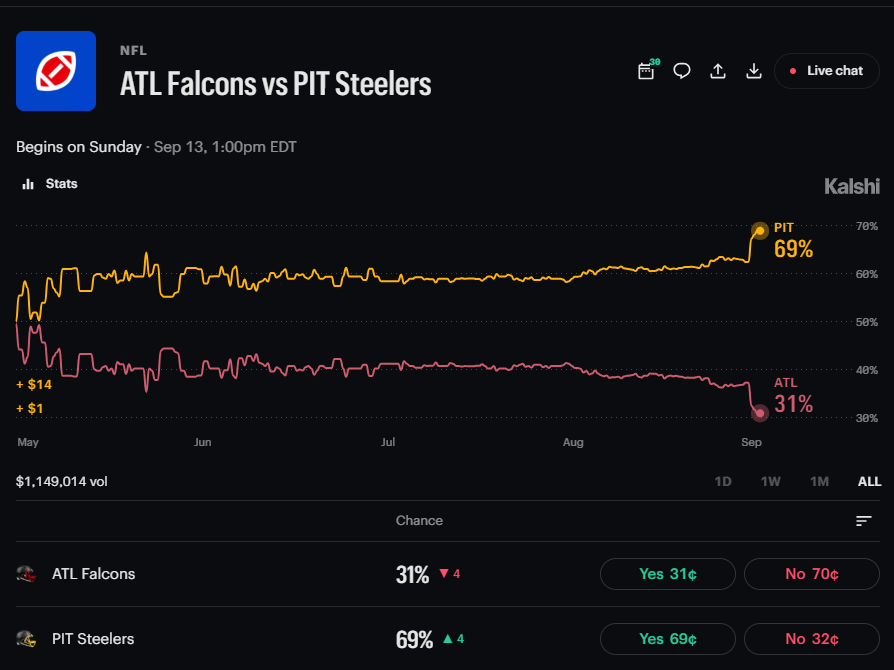
It’s turned the team from a fringe selection in survivor pools to one of the more safe options on the whole week.
A market that starts to drift in the other direction, away from the “obvious” side before kickoff is telling you something a static line from three days ago can’t. Just keep your eyes open for movement in the market before locking in your pick.
On that note, it’s probably wise to make your final decision as close to kickoff as possible.
Rule #6: Study your herd, not just the path
Your actual edge comes from knowing your specific pool. If the platform you play on shows weekly pick percentages, track them. A team that looks like obvious chalk nationally might be far less popular within your specific field, which will change your strategy altogether. Know the tendencies of those in your pool so that you can carve out your edge.
The bottom line
Anyone can survive Week 1 of a large field survivor pool. Most don’t have a plan for Week 12. The players who actually win these contests are the ones treating it less like a weekly guessing game and more like a season-long expedition. Understand that surviving with the crowd is worth a lot less than surviving without. Be smart and plan ahead. Use resources like the Survivor Optimizer | PredictQ Tools to optimize your strategy and track your portfolio seamlessly.
This article is survivor pool strategy commentary. It is not a directional prediction, a trade recommendation, or investment advice. Prices and odds shown are point-in-time and may change. PredictQ is a marketing partner of Kalshi and may receive compensation for referrals.