
We are just four weeks out from the regular season and I am legitimately a Scott Hanson tweet away from getting The Shield tattooed on my chest. Before I go for the ink, this seems like ample time to talk strategy when it comes to buying Futures contracts for the upcoming NFL season.
Every year around this time it feels like I see the same headline “Best NFL Futures for 2026” followed by a fun name, a meh price and usually solid justification. What I don’t normally see is the framework behind selecting the right futures contract, especially if you are new to Kalshi or Polymarket.
For those that are still placing futures on a sportsbook, I would highly suggest you read Justin Herzig’s article on why he’s never placing a future on one again. His experience in getting locked into a future with a sportsbook is one I’m sure we all shared: getting offered a brutal cashout price that doesn’t match the live outcome probability. A prediction market treats the same position as a live one where you can trim, build or exit the second new information changes the math. That distinction is basically the theme for everything below.
Here are four ways to help you actually read the NFL Futures markets, before you put a dollar into one.
1. The QB Tax
I am, of course, referencing one of my favorite markets every year: The MVP race. I can’t think of another market in all of sports that carries such a clear bias year over year. 28 of the last 34 MVP winners were quarterbacks on a team with 10 or more wins (per Pro Foorball Reference). So unless we somehow get a 2012-esque Adrian Peterson season (I am looking at you, Bijan) the framework writes itself.
Let's look at where the field is right now:
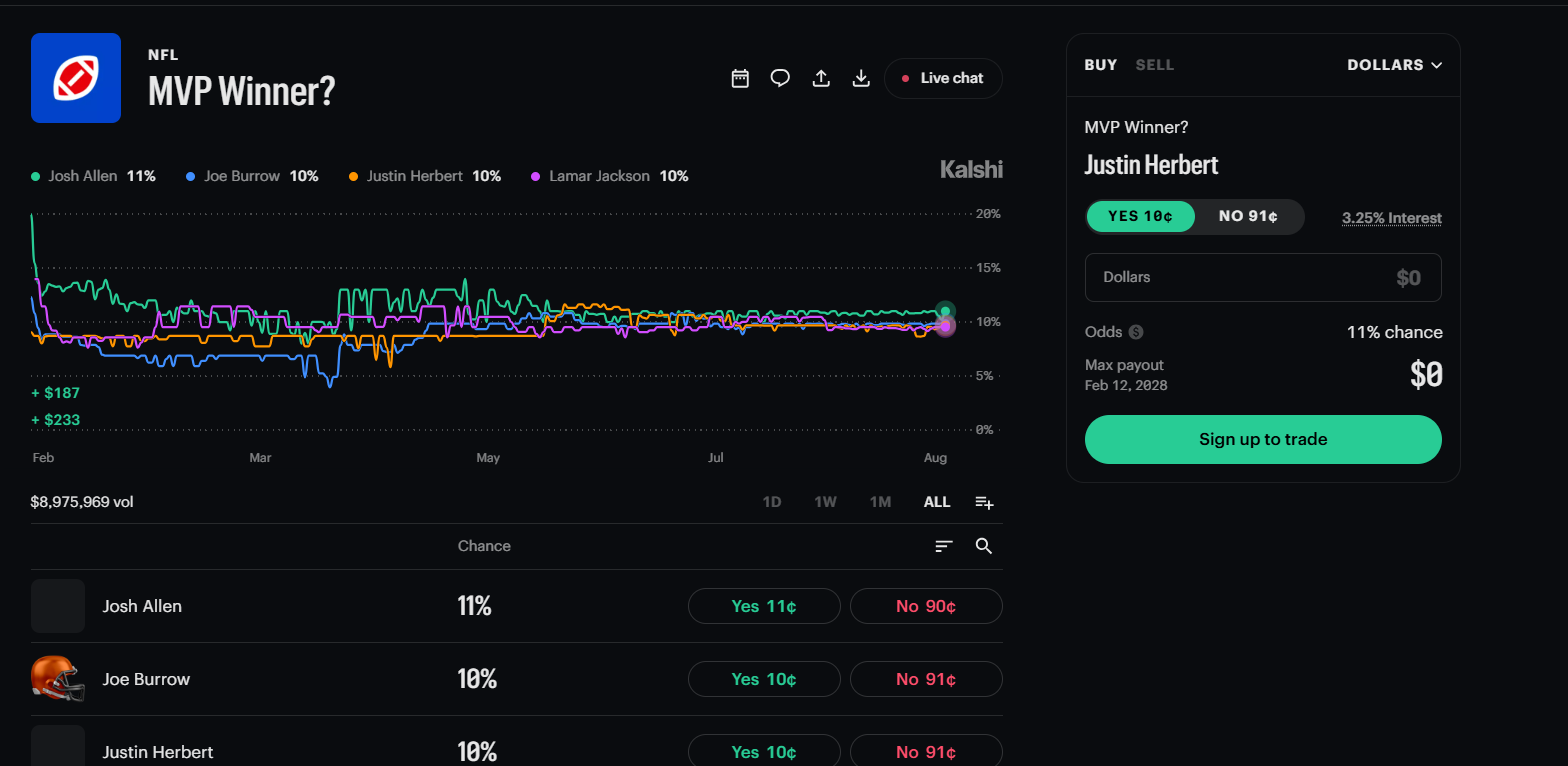
Pretty flat across the board here, all those lines stacked up like that remind me of Silly Bandz that we used to wear in middle school. Everyone in the top 4 carries a team that boasts a win total of 9.5 or more. History tells us that should be a baseline requirement before you consider anyone for the award.
When trading this market it’s always position first (QB) then consider team quality. And team quality isn’t a vibes-based metric either: it’s its own tradable market. Win-total futures will often tell you more about an MVP candidate’s actual odds than the MVP market itself does.
Looking at Burrow for example, his MVP price (10%) makes a lot more sense once you check the correlated market: Cincinnati Total Wins?
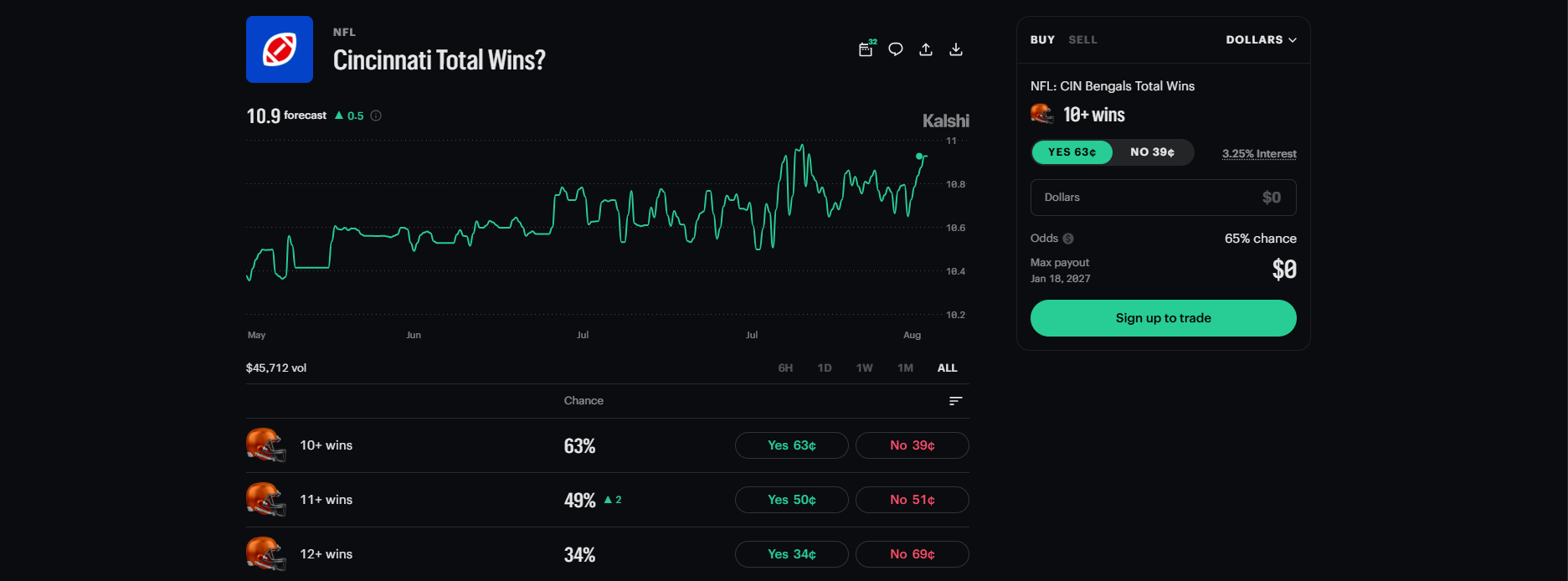
At the time of writing, the Bengals have a 63% implied probability to hit double-digit wins on Kalshi, largely because they have the second easiest schedule in the league (per Sharp Football Analysis).
So to me, him being the second favorite to win MVP isn’t just a “Burrow is good” number. I think it's far more reflective of the Bengals as a team being priced to win enough games to actually support his MVP case.
Two separate markets, one underlying thesis and reading them together is a pretty easy way to stress-test a name before you ever hit the buy button.
2. Volume Doesn’t Lie (Even If The Price isn’t Moving)
On Kalshi and Polymarket, every price has a volume number next to it, and volume tells you something the price alone cannot: how much disagreement exists on the price.
Patrick Mahomes is one of the most polarizing names in the sport. Perhaps unsurprisingly, he also leads all MVP candidates in trading volume. Even though he’s being priced all the way down at 7%. We can use that combination of big volume and flat price as a signal: a lot of money is fighting over whether 7% is correct.
Let’s compare Patty Ice with the Momma’s Boy, Jayden Daniels, who is sitting lower in the odds than Mahomes but has the thinnest trading among the upper tier. The low volume there suggests nobody is really arguing that number (which usually suggests the market has quietly converged on “no”).
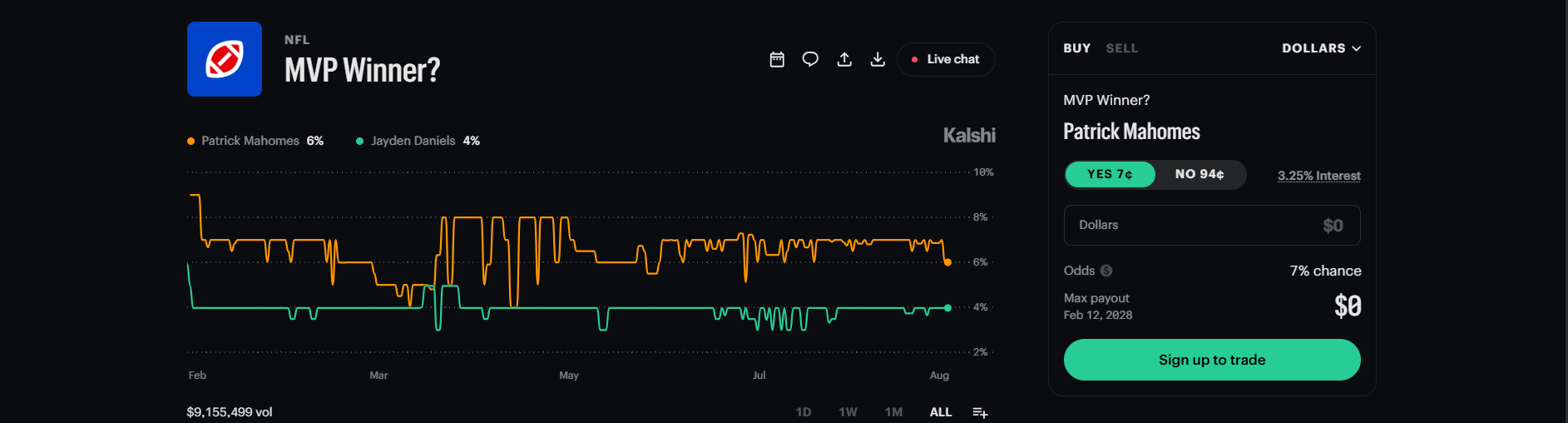
High volume and a stubborn price just means we have a live battle going on. Low volume and a stagnant price is just Kumbaya (a consensus, or maybe more accurately, apathy).
Basically, before you decide a number looks wrong or good, just check the volume to see if anyone is “fighting” about it. If the volume’s thin, it may just be a market that nobody has bothered to correct (usually for good reason).
3. Beat the Buzzer
You don’t have to wait until the Super Bowl to cash out a futures position. If you buy a team’s contract and they start hot, you can sell the contracts for a nice profit mid-season instead of sitting on it for five months hoping the outcome holds. A prediction market future is a position, not just taking a stand, you can add, trim or exit early depending on the new information you receive.
Practically, that means the right time to buy a futures contract isn’t just when you think you know how the entire season will go, it’s whenever you think the price itself is more likely to move in your favor before resolution. A team that may be fringe to make the playoffs doesn’t even need to get there to be a good trade in that market, if they get priced like they are a true contender by Week 5, you can close the position at that price without needing the outcome to hold for the next 3 months.
4. Bargain Shopping
Always check the gap. Since these are separate, competing markets rather than a central bookmaker, the exact same outcome can be priced differently in two places at once.
It’s happening right now with the aforementioned MVP market across Kalshi and Polymarket. In the above Kalshi market we saw Josh Allen as the favorite sitting at 11% implied probability. On Polymarket, at the time of writing, he's sitting at 14%:
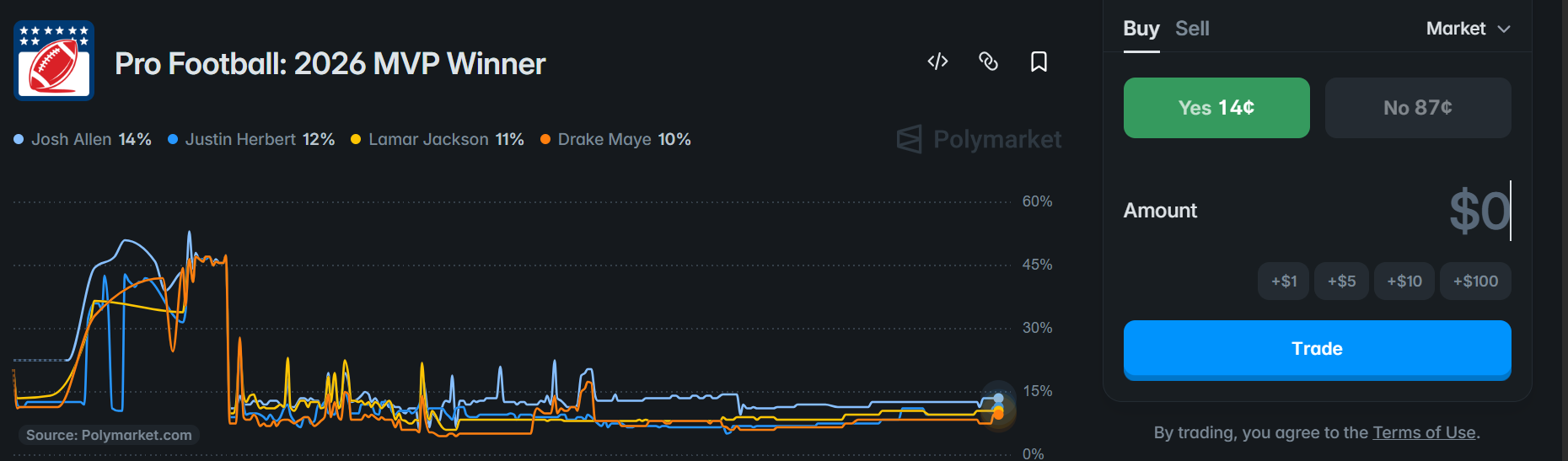
This is two different consensuses existing on the same player at the same time.
Honestly, this is less about finding a clean arbitrage (anything massive rarely lasts long and liquidity matters) and more about building a disciplined habit. Every price you see should be treated as one market’s opinion, not the final answer. At PredictQ, we provide price comparison on tens of thousands of markets. Find the market you want to trade and make sure you are getting the best price before actually trading it. If Kalshi has a name at 10% and Polymarket has the same name meaningfully higher or lower, that gap signals a disagreement. It’s always worth taking a second to understand why that disagreement exists before deciding what side of it you’re on.
Keep in mind this is still a high variance game, just because you find a discrepancy between markets doesn’t mean you should jump in before testing the water. Check the prices, check your sizing, and check your priors.
In less than a month, we all get to return to our happy places of just watching football again. If you plan on taking a position before kickoff, take the position with an understanding of the market you’re trading on. I’ll see you on the other side of the tattoo appointment (with a stinging chest).
As always, the full board, live odds and price comparison at Market Dashboard | PredictQ. Sign up for Kalshi and Polymarket by clicking their names.
This article reflects market activity and pricing across Kalshi and Polymarket, not directional predictions, trade recommendations, or investment advice. Prices shown are point-in-time and may change. PredictQ is a marketing partner of Kalshi and Polymarket and may receive compensation for referrals.