
Will 2026 become the hottest year ever recorded? Prediction markets put a price on that question. The Kalshi YES quote used in this article is 88.8¢, roughly an 89% implied probability before fees. It's a snapshot for the examples below, not a live quote.
But does the climate data support that price?
With ten months of 2026 temperatures recorded, only November and December remain. Comparing NASA's data with historical records shows what still needs to happen for the contract to settle YES.
What Kalshi Actually Measures
Kalshi’s market settles using NASA’s Goddard Institute for Space Studies (GISS) unsmoothed Land-Ocean Temperature Index. The contract requires the annual 2026 anomaly to exceed both the 2025 value and 1.28°C, the published record set in 2024.
The baseline matters. This dataset uses a 1951–1980 reference period, not the preindustrial baseline commonly used in climate reports.
Different organizations can report different rankings for the same year. A new record in one dataset doesn't necessarily mean this Kalshi contract settles YES.
How Close Is 2026 to Breaking the Record?
NASA's published GISTEMP monthly values, checked November 17, put the January–October 2026 temperature anomaly at an average of approximately 1.268°C above the 1951–1980 baseline. (NASA GISTEMP monthly table.)
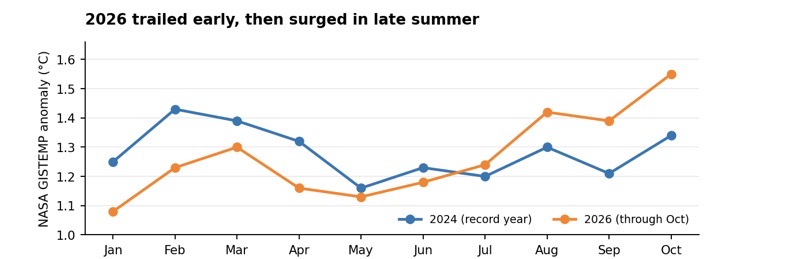
The 2024 record was approximately 1.282°C when calculated from the published monthly values, meaning 2026 is extremely close despite starting the year relatively cooler. (NASA GISTEMP monthly table.)
October was particularly significant. NASA recorded a global temperature anomaly of 1.55°C for October 2026, compared with 1.34°C in October 2024. (NASA GISTEMP monthly table.)
This acceleration has been supported by exceptionally warm ocean temperatures and a rapidly strengthening El Niño.
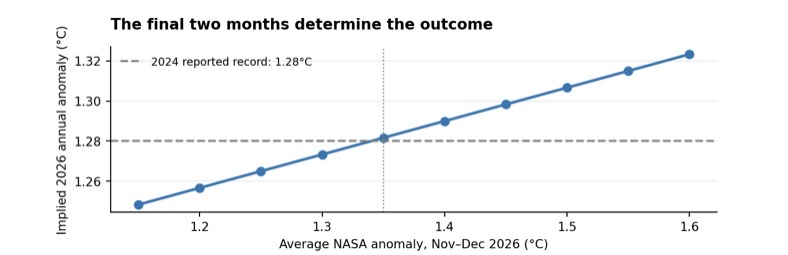
For 2026 to surpass the average calculated from 2024's published monthly values, November and December must average just above 1.35°C. To register 1.29°C in a two-decimal annual table, the required average is roughly 1.37°C, subject to rounding and revisions. The contract settles on NASA's published annual value, not this reconstruction from rounded monthly figures.
That leaves a narrow but important margin between a new record and a second-place finish.
What Independent Forecasts Predict
Climate forecasting organizations currently disagree on the likelihood of 2026 becoming the hottest year.
Carbon Brief's November 3 analysis estimated an 82% probability of a new record specifically in NASA's GISTEMP dataset, using observations available through September. (Carbon Brief, November 3.)
In the same analysis, Carbon Brief's model put the probability of a record in the Berkeley Earth dataset at 97%. Separately, Copernicus's October assessment put the chance of tying or exceeding 2024 in ERA5 at about 20%, as reported by Yale Climate Connections in November. These aren't forecasts of an identical settlement outcome. (Carbon Brief; Yale Climate Connections.)
That's a wide spread. It doesn't necessarily mean one forecast is wrong.
Each organization uses different measurements, historical reconstruction methods, and statistical forecasts. The baseline and geographical coverage can also affect the resulting rankings.
For Kalshi traders, the most relevant estimate is the one based specifically on NASA GISTEMP.
Market Example: YES at 88.8¢
At 88.8¢, a YES contract costs $0.88 and pays $1 if 2026 breaks the temperature record.
Using Carbon Brief’s older NASA-specific probability estimate of 82%, the theoretical expected value would be:
YES: 82¢ fair value − 88.8¢ purchase price = −6.8¢ expected value per contract.
At an illustrative NO price of 11.8¢, the expected value would be +6.2¢ per contract using the same probability estimate, before fees.
That isn't necessarily a current trading edge. Carbon Brief's 82% estimate was published before NASA released October's unusually warm result. The YES and NO prices here are illustrative snapshots, not live executable quotes.
If updated forecasts suggest a 90% probability, YES at 88.8¢ would instead have a small positive expected value of 1.2¢, before fees.
The market is particularly sensitive to these small probability changes because traders are paying nearly 90¢ for a contract with limited remaining upside.
Why El Niño Matters
One of the biggest drivers of the recent temperature acceleration is an exceptionally strong El Niño. (Carbon Brief.)
El Niño events raise sea surface temperatures across the tropical Pacific and can temporarily increase global average temperatures.
The current event is unusually intense, with climate models predicting additional warming effects through the end of 2026 and into 2027. (Carbon Brief.)
Global temperatures often respond several months after Pacific Ocean temperatures peak. That lag leaves uncertainty about whether the strongest effects arrive before December 31 or carry into next year. (Carbon Brief.)
For the 2026 contract, that timing is particularly important.
Conclusion
NASA's year-to-date data leaves a path to a new record in 2026. It doesn't settle the outcome.
With January–October temperatures averaging approximately 1.268°C above NASA’s baseline, the final two months will determine whether the year can surpass 2024.
At the illustrative price of nearly 90¢, YES requires a high degree of confidence. The older NASA-specific forecast of 82% suggests possible overpricing against that snapshot, but October's exceptional warmth could materially change the assessment.
The most valuable information for traders will come from updated NASA-specific projections for November and December rather than broad global temperature headlines.
The lesson is similar to daily temperature markets: the objective is not simply predicting the most likely outcome, but determining whether the actual probability differs enough from the market price to justify a trade.
This article includes a link to PredictQ partner Kalshi. We may earn a commission if you use it. It doesn't cost you anything extra, and it helps keep the lights on here. Nothing in this piece is investment advice. Prices and forecasts can change, and historical results don't guarantee future outcomes.